Newsletter Subscribe
Enter your email address below and subscribe to our newsletter
[forminator_form id="25163"]

All voices matter
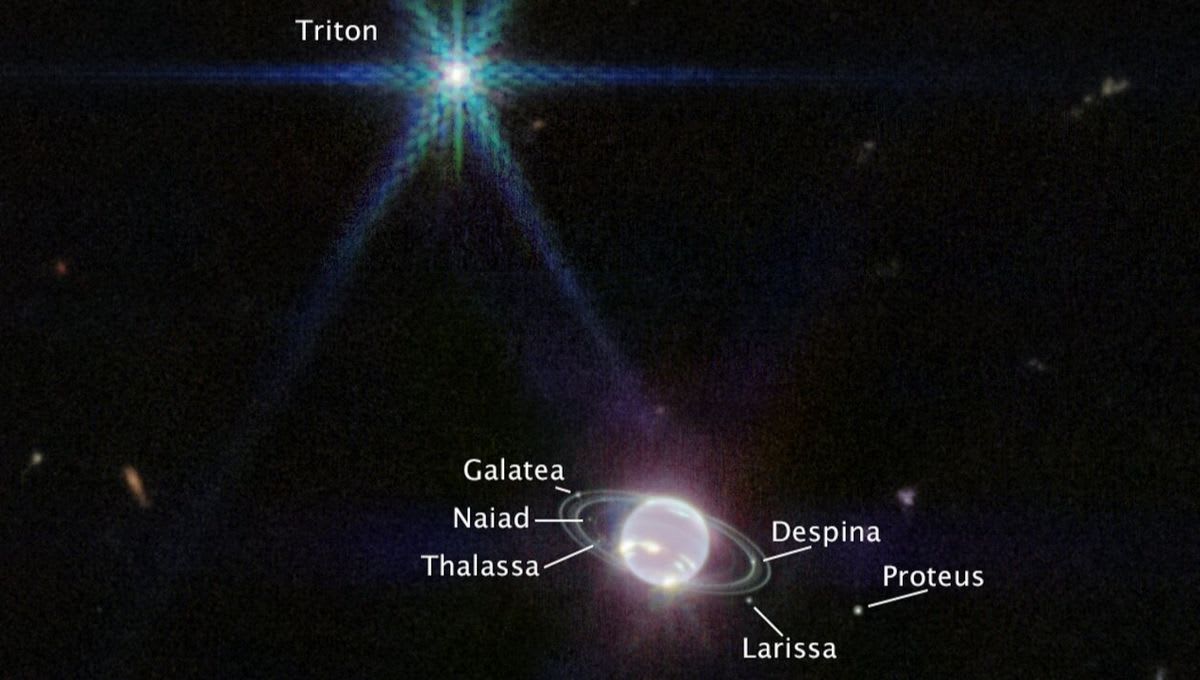
caltech+1caltech+1caltechNASA's James Webb Space Telescope has revealed that Neptune's inner moons are unlike anything else in the outer solar system — and may be the exposed guts of ancient icy worlds torn apart billions of years ago.
A team of Caltech researchers published findings Wednesday in Science Advances showing that three of Neptune's small inner moons — Larissa, Galatea, and Proteus — contain magnesium-rich phyllosilicates, clay minerals that can only form in the presence of liquid water. It marks the first time such minerals have been detected beyond Jupiter in the outer solar system.iflscience+1
The discovery points to a violent chapter in Neptune's history. The researchers believe the planet once hosted a conventional system of large, ordered moons — similar to what Uranus has today — that was obliterated when Triton, Neptune's largest moon, was captured from elsewhere in the solar system.caltech+1
"This is exciting new evidence that something catastrophic happened at Neptune that completely destroyed its original satellites, and we're getting to see the fingerprints left behind by that process," said Ryleigh Davis, former Caltech graduate student and lead author of the study, who is now a postdoctoral researcher at UC San Diego.caltech
The clay minerals found on the moons had to originate deep inside bodies far larger than Neptune's current small inner moons — objects large enough to generate sufficient internal heat to melt water ice. The team believes the most likely source was the original moon system itself.science+1
One puzzle stands out: while phyllosilicates require liquid water to form, no water ice appears in the spectra of the three moons or their rings. "Everything out in this part of the solar system is really icy," Davis said. "So, we're fairly confident that they had to come from deep inside something that was big enough to generate enough heat that it melted its water ice".caltech
The findings also revealed that Proteus, the largest of the three moons studied, lacks the phyllosilicates found on Larissa and Galatea, suggesting it may have formed from a different region of the debris disk. Additionally, the team detected an unidentified hydrated mineral present on all three moons that does not match anything in existing spectral libraries.caltech
The research builds on a related study from the same JWST program, published in May, which found that Neptune's moon Nereid may be the sole surviving intact member of the original satellite system.nypost+1
"Either way, what we're seeing on these moons had to come from deep inside something much larger," Davis said, noting that Neptune's inner moons offer a rare direct window into the deep interior composition of a large icy world — material normally buried permanently out of reach.caltech