Newsletter Subscribe
Enter your email address below and subscribe to our newsletter
[forminator_form id="25163"]

All voices matter
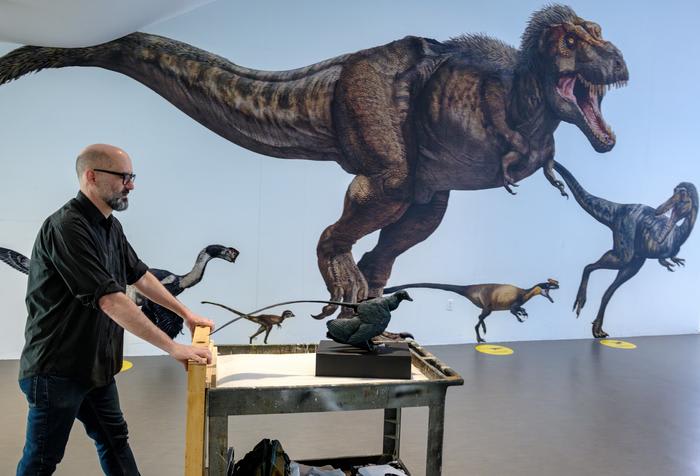
sciencedaily+1sciencedaily+1sciencedaily+1Dinosaurs ruled the Earth as some of the largest land animals in history, but a new study suggests one of the most puzzling aspects of their evolution lies at the opposite end of the size spectrum: why they never became truly tiny. Research published in the journal Evolution points to early mammals as a likely reason, proposing that small, shrew-sized creatures effectively blocked dinosaurs from shrinking into the smallest ecological niches.
The study, led by researchers from the American Museum of Natural History and Princeton University, used mathematical models to examine how body size evolved across vertebrate groups. While the models successfully predicted the size ranges of mammals, birds, and turtles based on physiology and energetics, they could not explain why the smallest non-avian dinosaurs — weighing roughly 450 grams, about the size of a large rabbit — never approached the tiny proportions seen in modern animals.sciencedaily+1
By comparison, the bee hummingbird weighs about 1.75 grams, the Etruscan shrew about 1.8 grams, and the dwarf gecko just 0.15 grams. About 75 percent of living mammal species and 90 percent of living bird species are smaller than the smallest known non-avian dinosaurs.yourweather+1
"The absence of tiny dinosaurs may be just as interesting as the existence of giant ones," said study co-author Roger Benson, the Macaulay Curator of Dinosaur Paleobiology at the American Museum of Natural History. "We already knew that dinosaurs prevented mammals from evolving to large sizes before the end-Cretaceous mass extinction. Here we suggest that mammals in turn prevented dinosaurs from evolving to small sizes."sciencedaily+1
The researchers argue that the fossil record undermines the idea that tiny dinosaurs simply haven't been found yet. Sites preserving dinosaur remains also frequently contain much smaller animals, including mammals, lizards, and amphibians. If mouse-sized dinosaurs had been common, some evidence should have surfaced.yourweather+1
Instead, the team concludes that ecological competition — particularly from early mammals that had already occupied small-bodied niches — imposed a lower size limit on dinosaurs. Lead author Stephanie Lechki, a postdoctoral fellow at Princeton University, noted that "small animals dominate modern ecosystems" and that understanding why tiny dinosaurs were absent is essential to explaining how today's biodiversity took shape.scmp+1
The findings also shed light on a turning point in evolutionary history: the emergence of birds. Though birds evolved from dinosaurs, they rapidly achieved body sizes far below those of any other dinosaur group. The researchers propose that powered flight opened access to habitats and ecological roles unavailable to ground-dwelling dinosaurs, freeing early birds from the competitive constraints that kept other dinosaurs large.sciencedaily+1
"We have this unusual situation where the ancestors of dinosaurs could be tiny. The living descendants of dinosaurs — birds — they can be tiny. But dinosaurs themselves seemed to be forbidden from being tiny," Benson said. "And we don't really understand that yet, but it's a question we should continue to explore."sciencedaily