Newsletter Subscribe
Enter your email address below and subscribe to our newsletter
[forminator_form id="25163"]

All voices matter

livescience+1esa+1yahooThe European Space Agency's Euclid space telescope has produced the largest and most detailed visible-light photograph ever taken of the Milky Way's galactic center, revealing more than 60 million stars in a six-gigapixel mosaic released on Wednesday, June 24.livescience+2
The image, captured during a dedicated 26-hour observation session on March 23, 2025, represents a departure from Euclid's primary mission of mapping dark matter and dark energy across the cosmos. The telescope pointed its visible-light camera at nine neighboring fields of view, each covering a patch of sky larger than the full moon, to assemble the panorama of the galaxy's dense central bulge.yahoo+2
Though Euclid was designed to observe billions of distant galaxies, the galactic bulge survey opens a new chapter in exoplanet research. The image captures 51 known planetary systems and will serve as a reference point for future discoveries using a technique called microlensing, in which the gravity of a foreground star bends and magnifies the light of a more distant one, potentially revealing orbiting planets.livescience+1
"Anyone who detects a microlensing event in the same region, for example with Roman, will be able from now on to use Euclid data as a time reference in the past and see how the stars looked before they overlapped," said Natalia Rektsini, a postdoctoral fellow at the Paris Institute of Astrophysics who led the data release, in an ESA statement.livescience
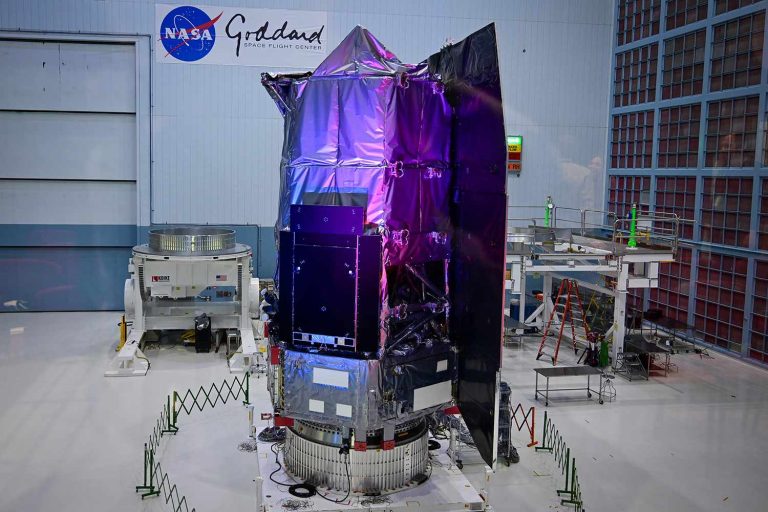
The data will complement NASA's Nancy Grace Roman Space Telescope, which is scheduled to launch no earlier than August 30 from Kennedy Space Center in Florida on its own microlensing planet-hunting mission.miragenews+1
Pointing Euclid at such a densely crowded stellar region required years of preparation. Dr. Eamonn Kerins, an astrophysicist at the University of Manchester who co-led the Euclid Exoplanet Science Working Group, helped secure approval for the survey and coordinated extensive simulations to ensure the spacecraft could handle the dense star fields without compromising its core dark-energy mission.miragenews
"Opening Euclid's eyes towards the centre of our Galaxy was a very exciting moment for the team," Kerins said. "The view Euclid gives us of the Galactic Centre region is absolutely stunning."miragenews
ESA praised the telescope's performance under demanding conditions, noting that its camera proved "sensitive enough to tell apart individual stars in our super-crowded galactic bulge, without being blinded."livescience