Newsletter Subscribe
Enter your email address below and subscribe to our newsletter
[forminator_form id="25163"]

All voices matter
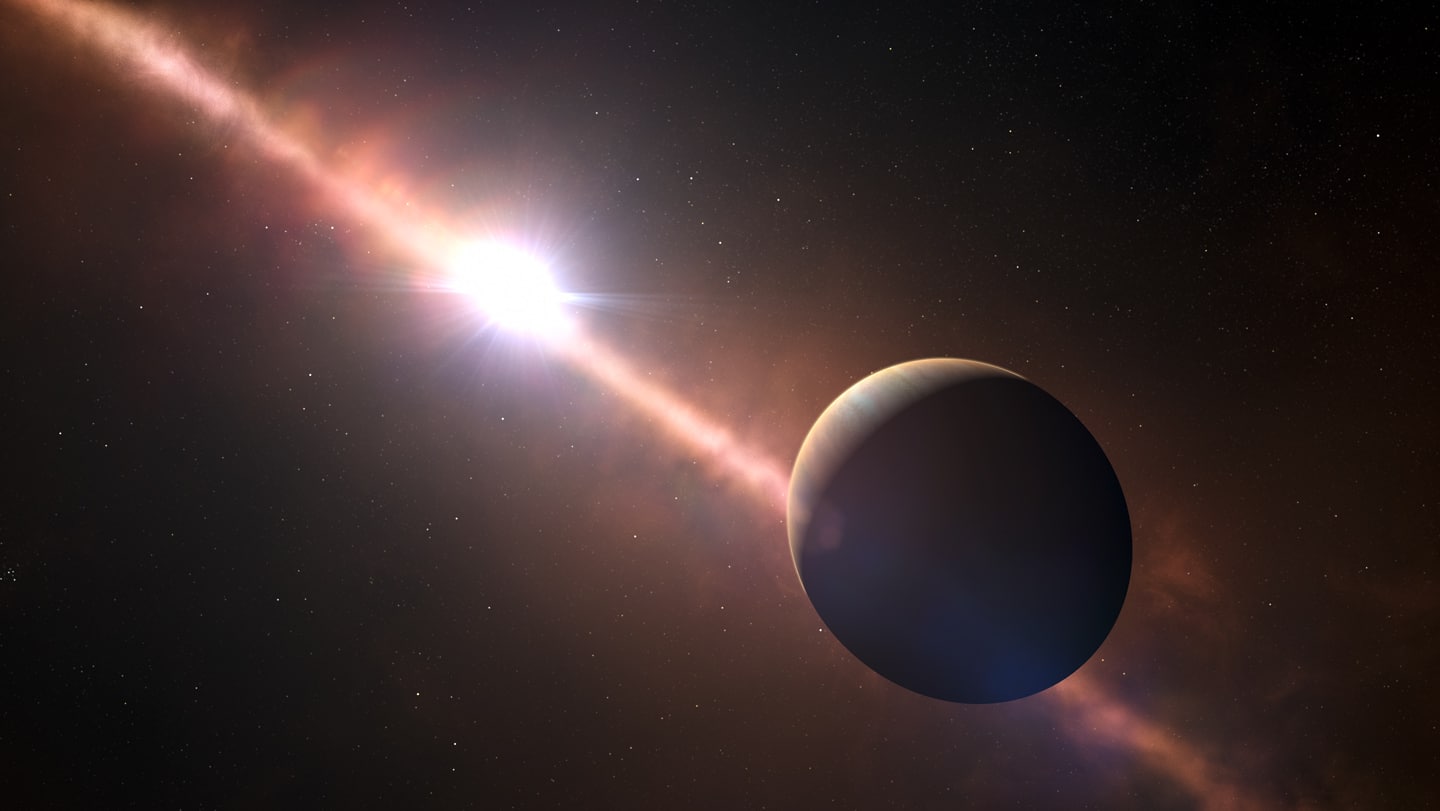
arxiv+1sciencenews+1skyatnightmagazineFor the first time, astronomers have detected radio waves originating directly from a planet outside our Solar System — a discovery that opens a new window into the magnetic environments of distant worlds and the search for habitable exoplanets.
An international team led by researchers from the Harvard-Smithsonian Center for Astrophysics and the University of Oregon used South Africa's MeerKAT radio telescope array to capture rapid, repeating, and highly circularly polarized radio bursts from Beta Pictoris b, a gas giant roughly 10 times the mass of Jupiter located about 63 light-years from Earth. The paper, submitted September 15 to arXiv, reports detections at frequencies between 0.85 and 3.5 GHz across four observation sessions in 2025 and 2026.arxiv+2
The signals are not evidence of extraterrestrial intelligence. Instead, the researchers identified the emissions as electron cyclotron maser radiation, the same mechanism that drives auroral radio emissions on Jupiter and other Solar System planets. "When people see 'radio signal from an exoplanet,' they think aliens," said astronomer Yvette Cendes of the University of Oregon, a coauthor of the study. "But, sorry — it's not aliens."sciencenews+1
The critical breakthrough was tracing the signal to the planet itself rather than its host star. Previous efforts to detect exoplanetary radio emissions could not clearly separate a planet's signal from stellar noise. Because Beta Pictoris is magnetically quiet, the team was able to isolate Beta Pictoris b as the source. "We can rule out the star, and … we can say that it's from this one particular planet," Cendes said.skyatnightmagazine+1
Because auroral radio emissions are tied to magnetic field strength, the detection allowed the team to make the first direct measurement of an exoplanet's magnetic field. They estimate Beta Pictoris b has a field of at least 1,250 gauss — thousands of times stronger than Earth's roughly 0.5-gauss field.moneycontrol+2
Magnetic fields are central to planetary habitability. Earth's field shields the atmosphere from solar wind; understanding which exoplanets possess similar protection could help narrow the search for worlds capable of supporting life.sciencenews+1
The study has not yet undergone peer review. But with next-generation radio observatories on the horizon, the techniques demonstrated here could be applied to other giant exoplanets, giving astronomers a new tool to probe distant planetary environments. Beta Pictoris has already been a prolific target — in July 2026, a third planet in the system, Beta Pictoris d, became the faintest exoplanet ever directly imaged from Earth.watchers+2
"It's an incredibly, incredibly strong magnetic field, much stronger than anything in our solar system," Cendes said.sciencenews