Newsletter Subscribe
Enter your email address below and subscribe to our newsletter
[forminator_form id="25163"]

All voices matter
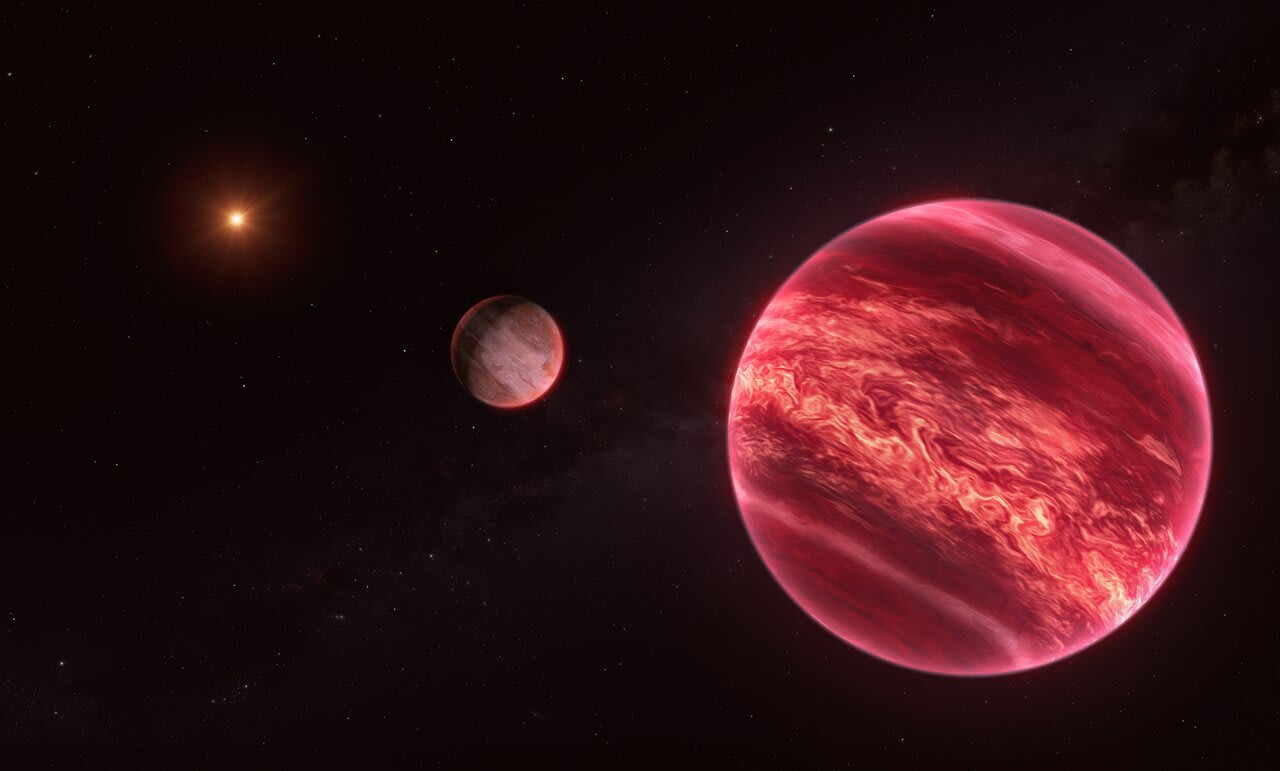
www.eso.org+1arXiv.org+1arXiv.orgAstronomers have found the first strong evidence for a moon-like object beyond our solar system — but it does not orbit a planet. Instead, the Jupiter-mass body circles a brown dwarf in the CD-35 2722 system, roughly 71 light-years from Earth, in a discovery published on July 22 in Nature that challenges existing definitions of planets and moons.www.eso.org+1
The discovery was made using the European Southern Observatory's Very Large Telescope in Chile, employing the same radial velocity technique used to find the first exoplanet around a Sun-like star in 1995. Researchers at Chile's Universidad Diego Portales, ESO, and Italy's National Institute for Astrophysics (INAF) detected periodic wobbles in the spectrum of CD-35 2722 B, a brown dwarf companion roughly 30 times Jupiter's mass that orbits a red dwarf star.arXiv.org+2
The candidate satellite has a minimum mass of about 0.74 Jupiter masses and an orbital period of 169 days. A second, less certain companion — with a minimum mass of 0.28 Jupiter masses and a period of 87 days — may also be present. The two would sit near a 2:1 mean motion resonance, echoing the orbital relationship seen among Jupiter's Galilean moons.arXiv.org
Because brown dwarfs are neither stars nor planets, the object does not fit neatly into the category of "exomoon." The research team coined the term "exosatellite" to describe it. "As exotic as it is, this system is truly unique and represents a breakthrough: the first plausible detection of an exosatellite," said Alice Zurlo, one of the researchers, in an ESO statement.www.eso.org
As Science News reported, the hierarchy of orbits — a satellite orbiting a brown dwarf that itself orbits a star — has no analogue in our own solar system, leaving astronomers without adequate vocabulary.physicsworld.com+1
The detection opens new avenues for studying how planetary-mass objects form around substellar bodies and whether such systems could harbor conditions relevant to habitability. Prior work has suggested CD-35 2722 B likely formed through gravitational instability rather than core accretion, a detail that may inform how its satellites came to exist.arxiv.org
Confirmation and further characterization will likely require next-generation instruments, including ESO's Extremely Large Telescope currently under construction in Chile. For now, the discovery redraws the map of where moons — or their equivalents — can exist in the cosmos.arXiv.org+1