Newsletter Subscribe
Enter your email address below and subscribe to our newsletter
[forminator_form id="25163"]

All voices matter
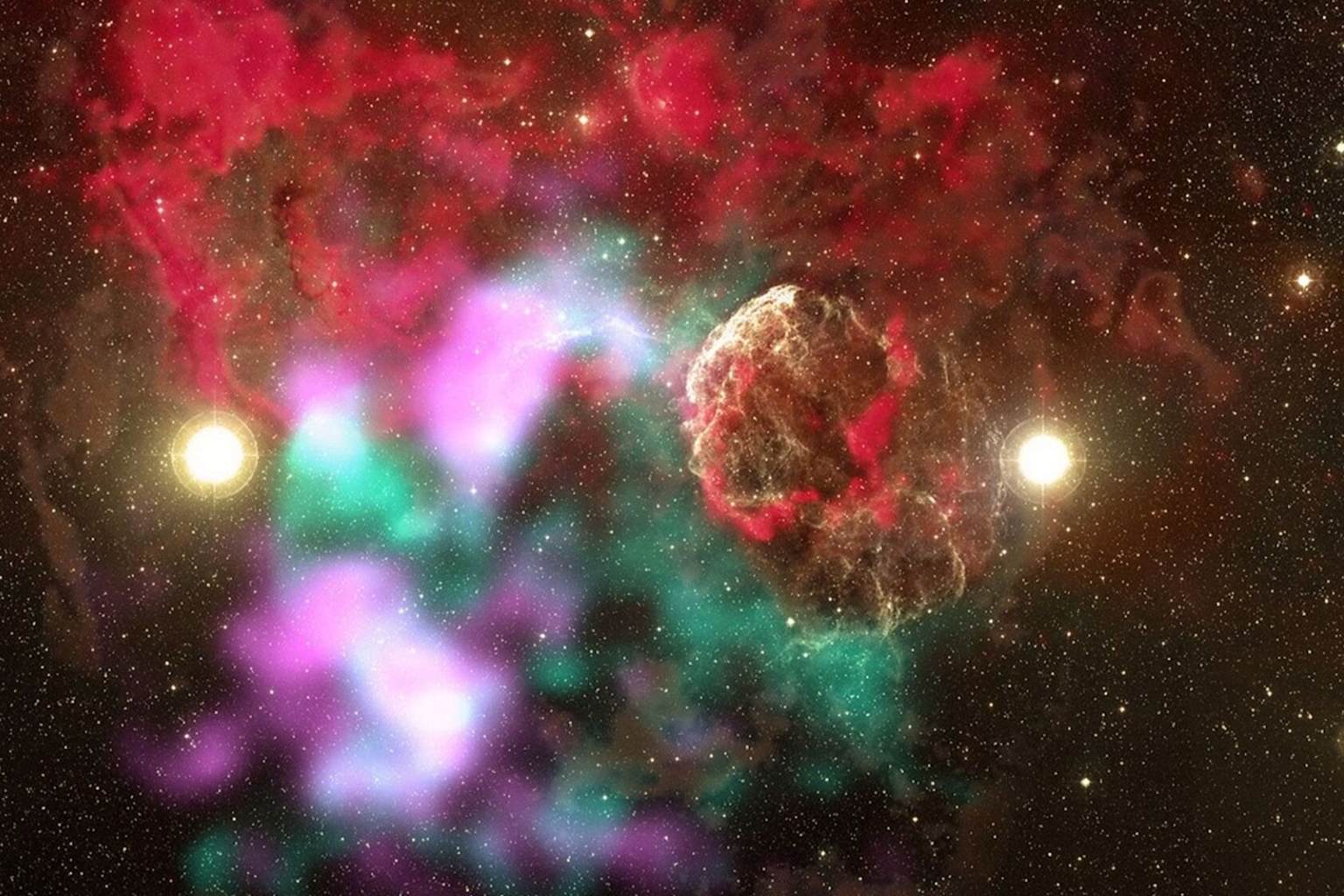
Phys.org+1The Touch | Today's R & B and Old School | 96.5 FM · 95.5 FM · 1560 AM+1Phys.org+1Astronomers have identified what they believe is the first known binary star system in which both stars ended their lives in supernova explosions, each leaving behind a distinct cloud of glowing debris still visible thousands of years later. The discovery, published Tuesday in Nature Communications, links one of the Milky Way's most recognizable stellar remnants — the Jellyfish Nebula — to a companion explosion that preceded it by tens of thousands of years.Phys.org+1
Led by Miltiadis Michailidis, a postdoctoral fellow in Stanford University's physics department, the research team combined 16 years of observations from NASA's Fermi Gamma-ray Space Telescope with X-ray data from eROSITA and other instruments to establish that the Jellyfish Nebula, formally known as IC 443, shares the same physical environment as a recently identified supernova remnant called G189.6+3.3.The Touch | Today's R & B and Old School | 96.5 FM · 95.5 FM · 1560 AM+1
Both remnants sit about 6,000 light-years from Earth in the constellation Gemini. The researchers estimate that the star associated with G189.6+3.3 exploded first, between 20,000 and 110,000 years before the blast that created the Jellyfish Nebula. That first explosion disrupted the binary system, sending the surviving companion hurtling through space until it, too, ran out of fuel and detonated.Phys.org+1
"This system provides a rare opportunity to reconstruct the complete evolutionary history of a massive binary — from the birth and interaction of two massive stars, through both supernova explosions, to the remnants they left behind," Michailidis told Reuters.The Touch | Today's R & B and Old School | 96.5 FM · 95.5 FM · 1560 AM
The researchers believe the star that produced the Jellyfish Nebula was roughly 15 to 25 times the mass of the sun, while its companion was at least 20 times the sun's mass. During their lifetimes, both would have been tens of thousands of times more luminous than the sun. After their explosions, both may have collapsed into neutron stars.The Touch | Today's R & B and Old School | 96.5 FM · 95.5 FM · 1560 AM
While the two stars once orbited each other at close range — perhaps just a few multiples of the Earth-sun distance — the centers of their respective supernova remnants are now separated by 30 to 50 light-years.The Touch | Today's R & B and Old School | 96.5 FM · 95.5 FM · 1560 AM
Although most massive stars are born in binary systems, no pair in which both partners exploded and left behind observable remnants had previously been identified. The finding offers direct observational evidence for a process that until now existed only in theoretical models.Phys.org+1
"Systems like this one can provide direct observational constraints on how the evolution of massive stars is modified by the presence of a binary companion — one of the major outstanding questions in stellar astrophysics," Michailidis said.The Touch | Today's R & B and Old School | 96.5 FM · 95.5 FM · 1560 AM