Newsletter Subscribe
Enter your email address below and subscribe to our newsletter
[forminator_form id="25163"]

All voices matter

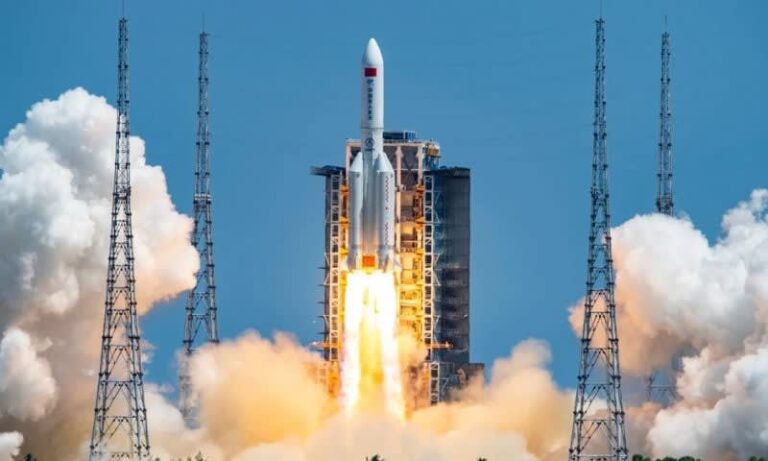
nbcnews+1wralnbcnewsNASA's Nancy Grace Roman Space Telescope, the agency's next flagship observatory, is set to launch Sunday, Aug. 30, 2026, at 7:26 a.m. ET aboard a SpaceX Falcon Heavy rocket from Launch Complex 39A at Kennedy Space Center in Florida. The $4.3 billion infrared telescope will head to a point roughly 1 million miles from Earth, where it will begin a five-year mission to survey billions of galaxies, probe the mysteries of dark energy and dark matter, and discover tens of thousands of new planets.mashable+2
NASA will stream live coverage beginning at 6:20 a.m. ET on NASA TV and its YouTube channel. If weather or technical issues force a delay, a backup launch window is available at 7:22 a.m. ET on Monday, Aug. 31.jpl.nasa+1
Roman carries a 300-megapixel infrared camera with a field of view at least 100 times larger than the Hubble Space Telescope's, allowing it to survey the sky roughly 1,000 times faster. Its 2.4-meter mirror — about the same diameter as Hubble's — was originally built by the National Reconnaissance Office for a spy satellite before being transferred to NASA in 2012 and repurposed for astronomy.wral+2
"If what you want to do is survey the universe, either to understand why the expansion of the cosmos is speeding up, or to discover planetary systems like our own, or to map the Milky Way galaxy, then Roman Space Telescope is like having several 100 Hubble Space Telescopes all working for you at the same time," said David Weinberg, a distinguished professor of astronomy at Ohio State University.thelantern
Over its mission, Roman is expected to image more than 2 billion galaxies, detect tens of thousands of supernovae, and uncover more than 100,000 exoplanets using transit observations and gravitational microlensing. The telescope also carries a coronagraph instrument designed to block starlight and directly image Jupiter-sized planets around nearby stars — a technology demonstration for future missions seeking Earth-like worlds.scientificamerican+3
One of Roman's central tasks is investigating why the expansion of the universe is accelerating. Recent measurements have produced tensions with the standard cosmological model, and Roman's observations of galaxies and supernovae could confirm or challenge those predictions. "We're likely to go beyond standard models and explore entirely new phenomenon for the first time," said Julie McEnery, Roman's senior project scientist.wral
The mission is arriving nine months ahead of schedule — a rare feat for a NASA flagship, especially given disruptions from the Covid pandemic and government shutdowns. After launch, Roman will spend more than three months traveling to its orbit at the second sun-Earth Lagrange point, L2, where it will join the James Webb Space Telescope. Science operations are targeted to begin around January 2027.nbcnews+3
The telescope honors Nancy Grace Roman, who became NASA's first chief of astronomy in 1959 and championed the Hubble Space Telescope, earning her the nickname "mother of Hubble." She died in 2018, and NASA named the observatory after her in 2020. Roman did her early research at Yerkes Observatory in Williams Bay, Wisconsin, where glass plates she once used to study stars in the Milky Way are still preserved.tmj4+1
"I very much hope, and in fact expect, that the most exciting science from Roman will be a surprise," McEnery said.wral