Newsletter Subscribe
Enter your email address below and subscribe to our newsletter
[forminator_form id="25163"]

All voices matter
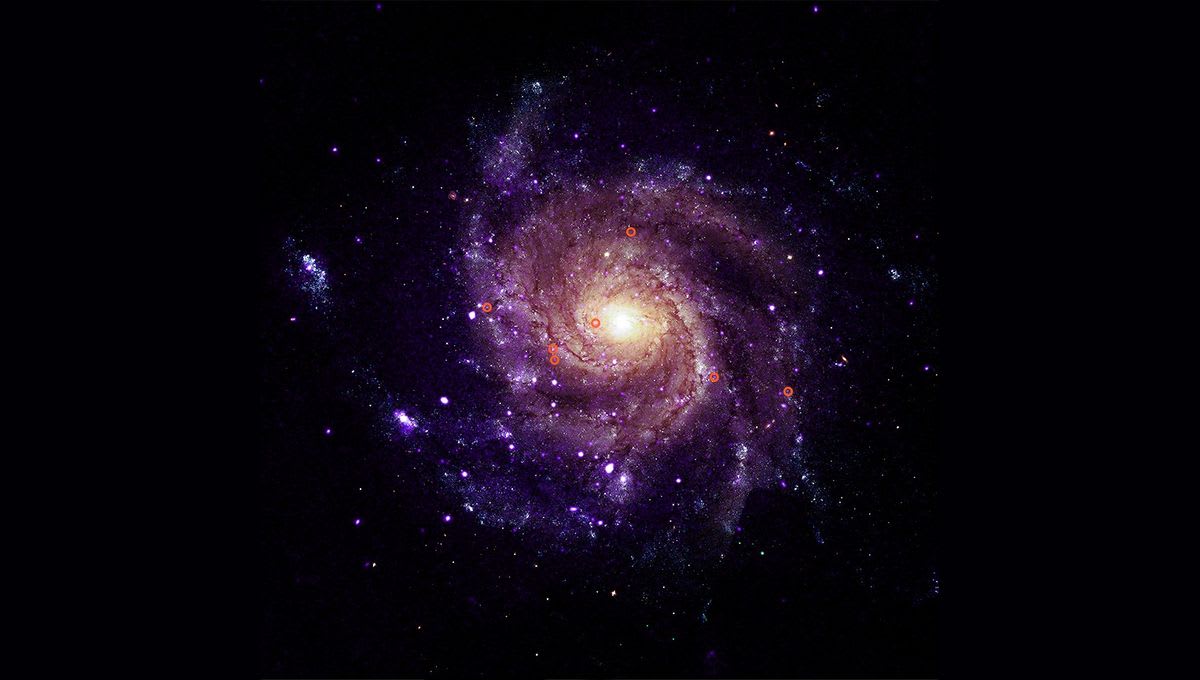
science.nasa+1science.nasa+1science.nasa+1Scientists using NASA's Chandra X-ray Observatory have identified a previously unknown class of cosmic objects — dubbed "hypersoft X-ray sources" — that emit unusually low-energy X-rays and intense ultraviolet radiation, a finding published Wednesday in Nature Astronomy.science.nasa+1
The research team, led by Mustafa Muhibullah of the University of Alabama, found 84 of these objects across six galaxies by mining publicly available data in the Chandra archive. The galaxies searched include two spirals — M31 (the Andromeda galaxy) and M101 (the Pinwheel galaxy) — along with four elliptical galaxies.newswise+1
The team identified the sources by locating objects visible in Chandra's lowest-energy X-ray images that disappeared entirely in higher-energy images. Because low-energy X-rays border ultraviolet radiation on the electromagnetic spectrum, the researchers determined these sources are also producing large amounts of energetic ultraviolet light.science.nasa
"We've never encountered a group of objects that act like this," Muhibullah said. "Of course, the next step was to try to figure out what these things are."newswise+1
The objects had eluded detection until now because their ultraviolet radiation is readily absorbed by hydrogen and helium gas between the stars, while their low-energy X-ray output sits at the edge of what telescopes like Chandra can detect.iflscience
The researchers believe the sources most likely involve a compact object — a black hole, neutron star, or white dwarf — pulling material from a companion star. Co-author Jimmy Irwin told IFLScience that in his view, "they are probably white dwarfs just because they can more easily obtain this kind of temperature," with the accreted material reaching between 200,000 and 250,000 degrees Celsius.iflscience
If many of these objects turn out to be white dwarfs accreting material, they could be progenitors of Type Ia supernovae — the explosions used as "standard candles" to measure cosmic distances and which led to the discovery that the universe's expansion is accelerating. Astronomers have long searched for these pre-explosion systems without success.science.nasa+1
"If we could find a way to spot these Type Ia supernova explosions before they go off, that would be really important," Irwin said.science.nasa
The hypersoft sources may also help explain what strips electrons from interstellar gas in galaxies, a process that influences star formation rates and galactic life cycles.newswise+1
Co-author Rosanne Di Stefano of the Center for Astrophysics | Harvard & Smithsonian noted that the class likely contains multiple types of objects. "It could very well be the case that some hypersoft sources are accreting neutron stars, some are accreting black holes, and some are nuclear burning white dwarfs," she told IFLScienceiflscience. The team plans to observe the 84 objects with the Hubble Space Telescope to confirm the energy estimates derived from the Chandra dataiflscience.