Newsletter Subscribe
Enter your email address below and subscribe to our newsletter
[forminator_form id="25163"]

All voices matter
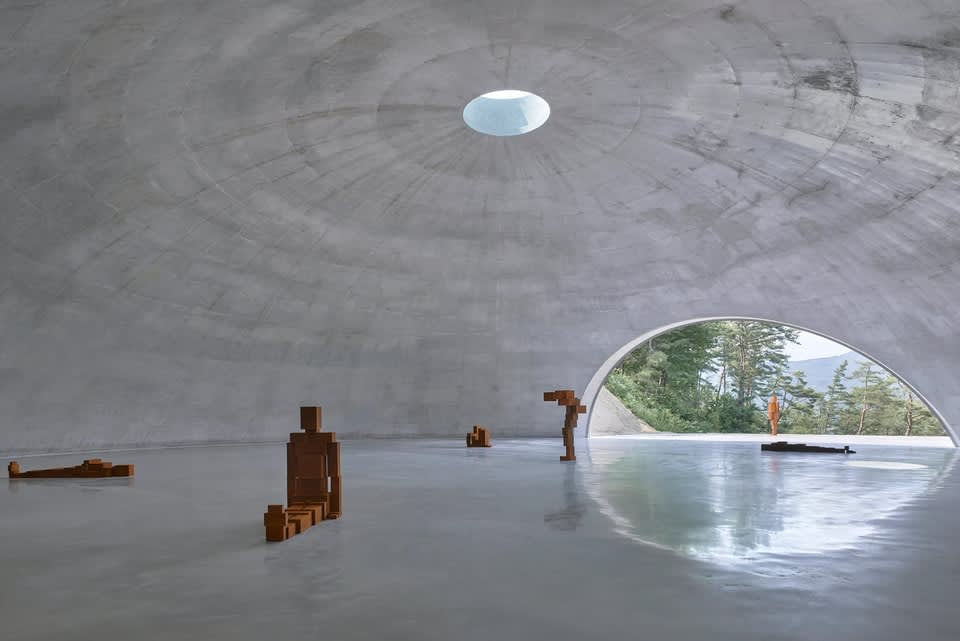
koreajoongangdaily.joins+2.ropac+2.ropac+2.koreajoongangdaily.joins+2.ropac+2.In June 2025, Museum SAN in Wonju, South Korea will unveil "Ground," a groundbreaking permanent installation that marks the first collaboration between celebrated British sculptor Antony Gormley and renowned Japanese architect Tadao Ando, featuring a 25-meter subterranean concrete dome housing seven of Gormley's "Blockworks" sculptures designed to explore the relationship between nature and the human condition.
Underground architecture represents some of humanity's most innovative structural achievements, with concrete serving as the primary material for these subterranean marvels. Japanese architect Junya Ishigami pioneered a remarkable technique where concrete is poured into carefully excavated holes, allowed to set, and then revealed by removing the surrounding earth—creating cavernous spaces with arched openings and stalagmite-like columns covered in mud. These underground structures often require specialized engineering solutions, including pile foundations to counterbalance earth pressure and waterproofing membranes to prevent moisture intrusion, particularly in locations beneath the water table.youtube+1
Notable examples of underground concrete architecture span the globe, from functional to artistic. The NORAD Cheyenne Mountain Complex in Colorado stands as one of the most formidable underground military installations, featuring 15 buildings mounted on 1,300-pound steel springs buried beneath 2,000 feet of solid rock—designed to withstand direct nuclear blasts. In Tokyo, engineers created the G-Cans Project, a hydraulic superstructure with five massive vertical silos connected by a 6.3 km underground tunnel, featuring a colossal water tank often called the "underground Parthenon" due to its 59 concrete pillars each standing 18 meters tall. More artistically, projects like The Lowline in New York demonstrate how underground spaces can be reimagined as public amenities, using cutting-edge solar technology to bring natural light below ground.parametric-architecture+1
Gormley's Blockworks series, initiated in the early 2000s, represents his exploration of the relationship between the human body and architecture. In these sculptures, Gormley replaces anatomical features with architectural blocks that are stacked, propped, and cantilevered to evoke the human form while reflecting our "urban-bound condition." What began as an experiment with "physical pixels" evolved into larger blocks where, as Gormley explains, "what the blocks do to each other is the critical thing" in conveying the feeling of inhabiting a body.ropac+2
These works appear in various scales and materials, from the massive 46-tonne red granite Block II (2017) composed of 22 stacked stones to the smaller cast iron pieces like Small Stress IV that render the body at half-height using the fewest blocks possible. The series draws inspiration from architectural principles, particularly Le Corbusier's Modulor Man, reconfiguring the organic human outline into geometric interplays of verticality and horizontality. In installations like STAND at the Philadelphia Museum of Art, these iron figures create powerful presences that invite viewers into what Gormley describes as the rare experience of "looking another human being in the face, eyeball to eyeball, and sharing a personal truth."whitecube+2
The oculus, a circular opening in the center of a dome or wall originating in classical architecture, has evolved into a powerful design element in contemporary spaces. Modern interpretations range from traditional skylights to sophisticated LED installations that mimic natural daylight. Light Cognitive's circular LED skylight "Oculus," for example, uses machine learning algorithms to match the actual color and intensity of Barcelona's sky throughout the day, creating gradual shifts from dawn's vivid reds to midday blue and dusk's warm hues. This technology not only provides aesthetic value but supports human circadian rhythms by emitting stimulating blue light during the day before gradually reducing it in the evening.dezeen+1
Architects often incorporate oculi to transform otherwise mundane spaces with dramatic natural lighting. In projects like the High School in Morieres Les Avignon, rhythmically placed oculi turn cramped hallways into airy environments, while the James Turrell Skyspace uses an oculus to create a poetic relationship between light and space. Beyond circular forms, some designers opt for irregular shapes to create more complex light patterns, ensuring visitors experience different illumination each time they enter the space. Whether functioning as sustainable illumination solutions for windowless rooms or as central aesthetic features, oculi continue to serve as the "eyes" of buildings, connecting interior spaces with the natural world above.etcconnect+1