Newsletter Subscribe
Enter your email address below and subscribe to our newsletter
[forminator_form id="25163"]

All voices matter
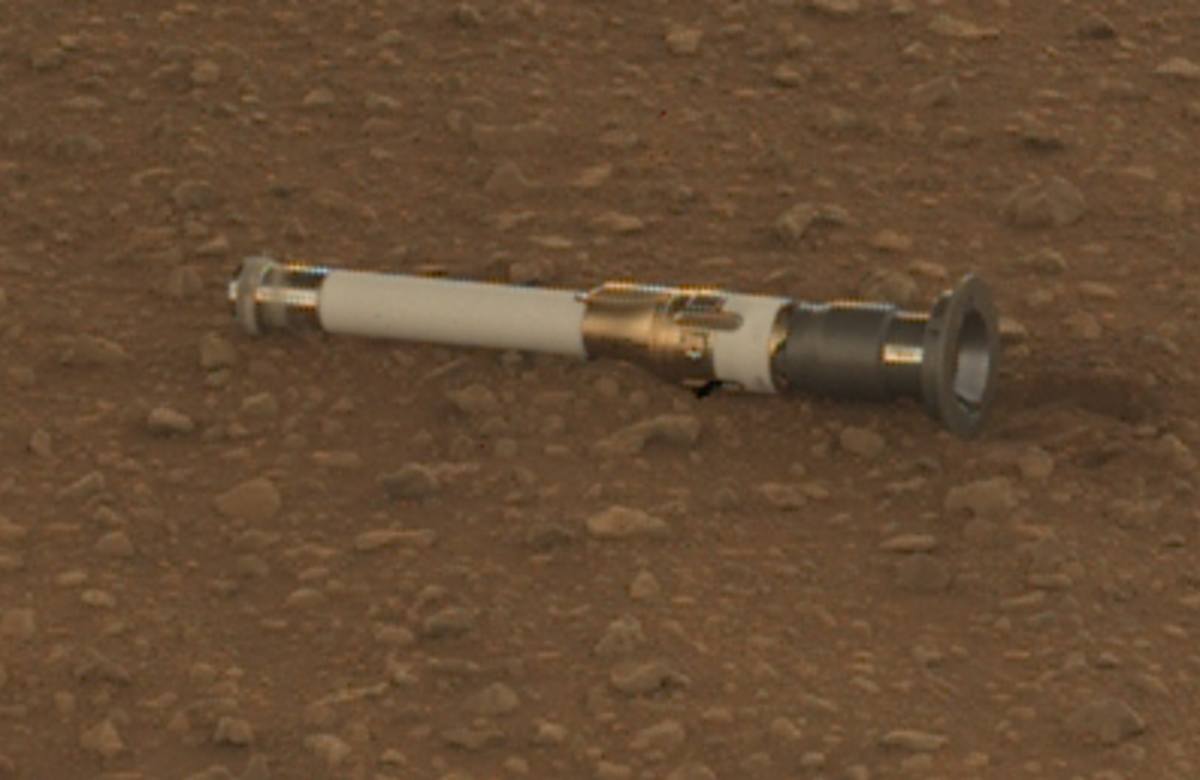
newsweek+1newsweeknewsweekNASA's Perseverance rover has collected what scientists describe as the most compelling evidence to date that ancient microbial life may have once existed on Mars — but the rock samples sit millions of miles from any laboratory capable of confirming the discovery, with no funded plan to bring them home.
The agency's findings center on a reddish, arrowhead-shaped rock nicknamed Cheyava Falls, discovered in July 2024 in an ancient dry riverbed within Mars' Jezero Crater. A peer-reviewed paper published in Nature last September detailed how the sample, called Sapphire Canyon, contains potential biosignatures including distinctive "leopard spots," organic carbon, sulfur, oxidized iron, and phosphorus — chemical and mineral signatures consistent with ancient microbial activity.spacepolicyonline+1
"This finding by Perseverance, launched under President Trump in his first term, is the closest we have ever come to discovering life on Mars," then-acting NASA Administrator Sean Duffy said at the time of the announcement.nasa
The Mars Sample Return mission, a joint NASA and European Space Agency campaign designed to retrieve Perseverance's cache, was effectively canceled in January after Congress confirmed the Trump administration's plan to defund the program. NASA had already spent $2.5 billion on MSR before shelving it. Independent reviews had projected total costs exceeding $11 billion, with samples not returning to Earth until 2040.newsweek+2
Dr. Lindsay Hays, NASA's senior scientist for Mars Exploration, told Newsweek News Corp that the agency remains "somewhat agnostic in exactly how those Perseverance samples will be returned" but acknowledges their importance. Evidence indicates "something was there and ate there," she said, referring to the sedimentary rocks that preserve signatures of microbial activity.newsweek
Katie Stack Morgan, Perseverance's project scientist, has cautioned that abiotic explanations cannot yet be ruled out. "Astrobiological claims, particularly those related to the potential discovery of past extraterrestrial life, require extraordinary evidence," she said. Only analysis in terrestrial laboratories could provide a definitive answer.spacepolicyonline+1
As NASA's retrieval plans stall, China announced it remains on track to launch its Tianwen-3 Mars sample return mission in 2028, aiming to collect roughly 500 grams of Martian material and return it to Earth by 2031. Chief mission scientist Zengqian Hou told reporters that searching for past Martian life is the mission's "primary objective".space+2
Derrick Pitts, chief astronomer at Philadelphia's Franklin Institute, estimated that even with an immediate reversal in priorities, NASA could not return its own samples before 2036. "NASA is not hobbled by lack of funds, it's cut off at the knees by politics," he told Newsweek.newsweek
Meanwhile, Perseverance continues to build the case. In June, new data revealed hundreds of detections of complex organic carbon in Jezero Crater mudstones — described as "the most robust organic detection" at the site. Each finding adds weight to what scientists cannot yet prove without the samples in hand.space