


Newsletter Subscribe
Enter your email address below and subscribe to our newsletter
[forminator_form id="25163"]

All voices matter
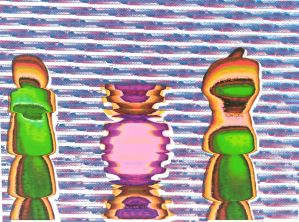
news.artnet+2.tell.toledo+1.news.artnet.news.artnet+1.tell.toledo+1.Opening July 12 at the Toledo Museum of Art, "Infinite Images: The Art of Algorithms" traces the evolution of generative art across six decades, featuring 24 artists whose work explores how rules, systems, and code can structure visual expression—from early pioneers like Josef Albers and Vera Molnár to contemporary digital creators using blockchain and AI technologies.
The early 1960s witnessed the birth of algorithmic art through the groundbreaking work of several visionary artists. Georg Nees, Frieder Nake, A. Michael Noll, Manfred Mohr, and Vera Molnár became the first to explore computer-generated algorithmic art, using plotters controlled by computer programs to execute their creative visions. Rather than drawing by hand, these pioneers wrote programs that specified sequences of actions for machines to perform, transforming mathematical concepts into visual expressions.trippymojo+1
Harold Cohen represents another significant figure in this artistic movement, developing AARON in the late 1960s—the first artificial intelligence software in fine art. Initially creating abstract black and white forms that Cohen manually colored, AARON evolved to autonomously generate and color figurative images by 1995. These pioneering artists, sometimes collectively known as "The Algorists," challenged traditional notions of artistic creation by leveraging early computers to program algorithms that generated art, often requiring access to scientific laboratories and universities for the necessary technology. Their experimental approach forever changed the relationship between artist, tool, and creative output.library.fiveable+2
Early algorithmic artists primarily used mechanical plotters—essentially drawing robots that hold pens and move across paper based on computer instructions. These machines excelled at creating optical art with precise, repetitive line patterns that would be tedious to draw by hand, producing mesmerizing moiré effects by layering fine-lined patterns with slight offsets. Unlike human artists, plotters never tired of endless repetition and could draw with extreme precision, making them perfect for executing complex geometric designs.illumin.usc+1
The evolution of algorithmic art has followed technological advancement, moving from physical plotter drawings to purely digital creations stored in computer memory. This shift occurred notably with fractal art in the 1980s, which existed primarily as digital files rather than physical drawings. Today's algorithmic art spans from digital generative pieces to NFTs (non-fungible tokens), with museums like the Toledo Museum of Art now showcasing this artistic progression "from plotters to NFTs." Contemporary algorithmic artists continue exploring the same fundamental concepts as their predecessors—using code to blend mathematical precision with creative expression, just through increasingly sophisticated technological means.piratefsh.github+1
Josef Albers, though not primarily known as a computational artist, laid crucial groundwork for algorithmic art through his systematic approach to color theory and geometric form. His famous "Homage to the Square" series, begun in 1949, comprised over a thousand variations of nested squares exploring color relationships and optical effects—essentially a manual algorithm executed across decades. Albers articulated this systematic methodology himself: "I think one form demands, if you really deal with it, 1000 performances." His influential 1963 book "Interaction of Color" provided comprehensive analysis of color perception that profoundly influenced minimalist and color field artists.eko33+2
While Albers explored algorithmic thinking through traditional media, Vera Molnár directly bridged classical and computational approaches. After beginning her career creating hand-drawn geometric abstractions, Molnár became one of the first artists to use computer programming in the 1960s. Both artists share a Bauhaus-influenced systematic approach that emphasized process over product—a philosophy central to algorithmic art. Their work demonstrates how algorithmic thinking preceded computer-generated art, with Albers' geometric explorations and color studies representing an analog precursor to the computational methods that Molnár would later pioneer with emerging technologies.toledomuseum


