Newsletter Subscribe
Enter your email address below and subscribe to our newsletter
[forminator_form id="25163"]

All voices matter
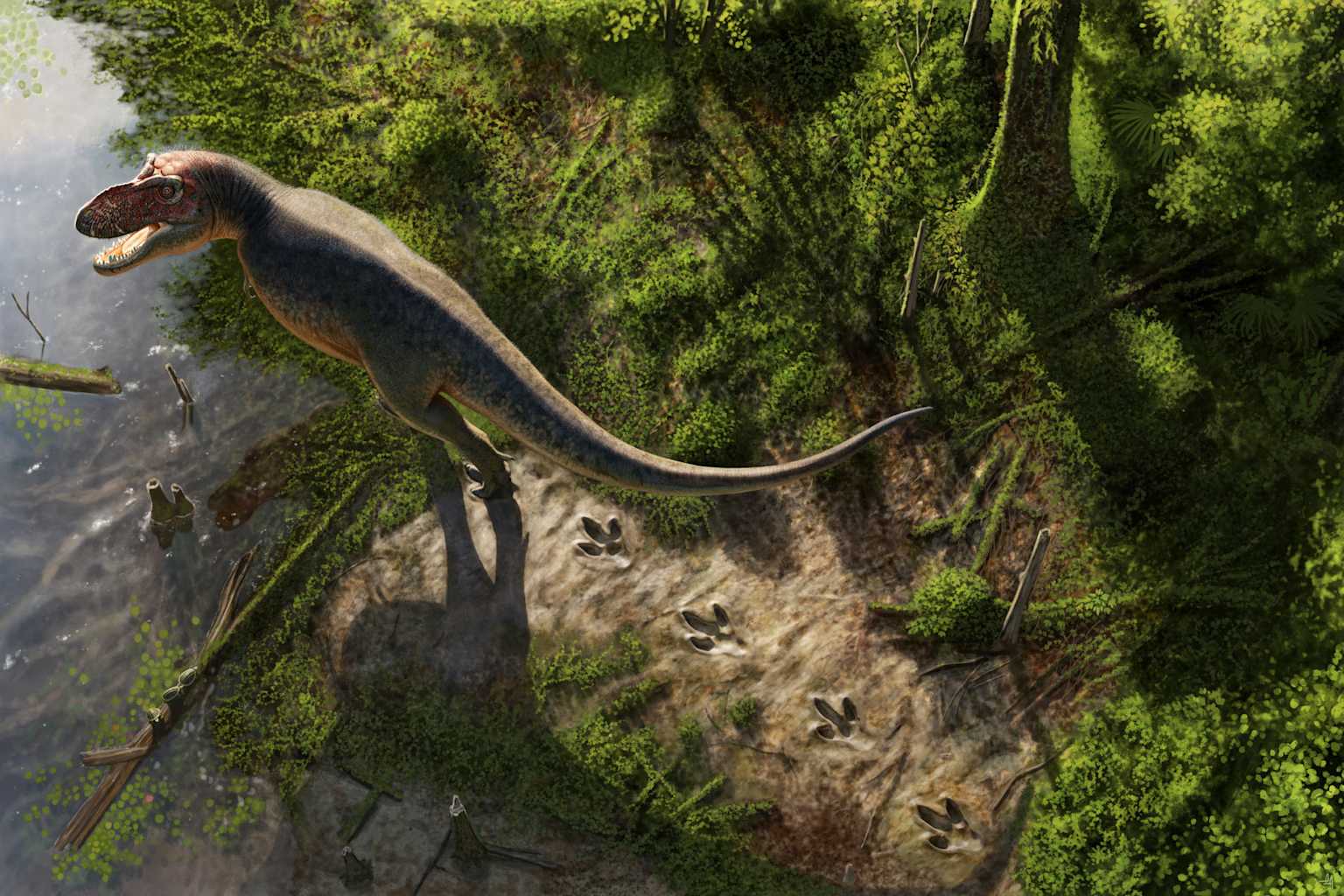
sciencealert+1gizmodo+1sciencealert+1Paleontologists have uncovered the first known trackway left by a fully grown Tyrannosaurus rex — four massive, three-toed footprints stamped into what is now the Hell Creek Formation of southwestern North Dakota roughly 66.5 million years ago, on the geological eve of the asteroid impact that wiped out the non-avian dinosaurs.
The discovery, published Monday in the Journal of Vertebrate Paleontology, was made by a team from the Denver Museum of Nature & Science and Liverpool John Moores University in England. While isolated T. rex footprints have previously been identified in New Mexico and Montana, no sequence of tracks from an adult of the species had ever been documented.sciencealert+2
The trackway stretches about 23 feet and preserves two left and two right footprints, each roughly three feet long and cemented in place by calcium carbonate. The stride length averages about 13 feet, and researchers estimate the animal was walking at approximately 3.5 to 4.5 miles per hour — comparable to a brisk human pace.gizmodo+1
"Bones tell us an enormous amount about these animals, but footprints capture a moment of behavior," said Tyler Lyson, senior curator of vertebrate paleontology at the Denver Museum of Nature & Science. "With a trackway, we can actually follow an animal as it moved across the landscape. That is incredibly rare for T. rex."ynetnews+1
The team used high-resolution 3D surface scanning to document the prints in the field. Peter Falkingham, a paleobiologist at Liverpool John Moores University and lead author of the study, said the digital models allowed him to examine the tracks remotely "on my computer and in VR, enabling me to take as close a look as they did in person."discovermagazine+1
The trackway was first spotted in 2025 on federal land managed by the U.S. Forest Service near Marmarth, North Dakota, by Kent M. Hups, a science teacher at Northglenn High School in Colorado and amateur fossil hunter who became a co-author of the paper.gizmodo+1
"As a teacher, I'm always telling my students that science starts with curiosity, passion and careful observation," Hups said. "I never imagined that could lead me to a discovery like this."discovermagazine
Three of the four footprints are set to be excavated and airlifted by helicopter to the Denver Museum of Nature & Science, where the team hopes to put them on display. Further excavation of the site, however, may prove difficult: the steep, clay-rich terrain surrounding the trackway makes expanding the dig unlikely, according to the researchers.sciencealert+1