Newsletter Subscribe
Enter your email address below and subscribe to our newsletter
[forminator_form id="25163"]

All voices matter
sci+1nhk+1dw+1In a striking coincidence of timing, space agencies from China and Japan have each released new closeup images from flybys of two different asteroids, offering fresh views of these rocky worlds within days of each other.
China's Tianwen-2 probe beamed back the first-ever closeup photograph of Kamo'oalewa, a small near-Earth asteroid sometimes called Earth's "mini-moon," after approaching within about 12 miles of the object on July 2. The image reveals Kamo'oalewa to be a small, asymmetrical rock measuring roughly 50 to 65 feet in diameter, according to Space.com. The asteroid, formally known as 2016 HO3, belongs to a rare class of objects called quasi-satellites — small bodies that orbit the sun on paths keeping them near Earth without truly orbiting it.sci+2
The China National Space Administration said Tianwen-2 traveled roughly one billion kilometers over 400 days to reach its target after launching atop a Long March 3B rocket on May 28, 2025. The probe will now spend months studying the asteroid's shape, surface composition, and internal structure before attempting to collect a sample, which is scheduled to be returned to Earth in 2027. Some scientists believe Kamo'oalewa may be a fragment of Earth's own moon, knocked loose by an ancient impact.space+3
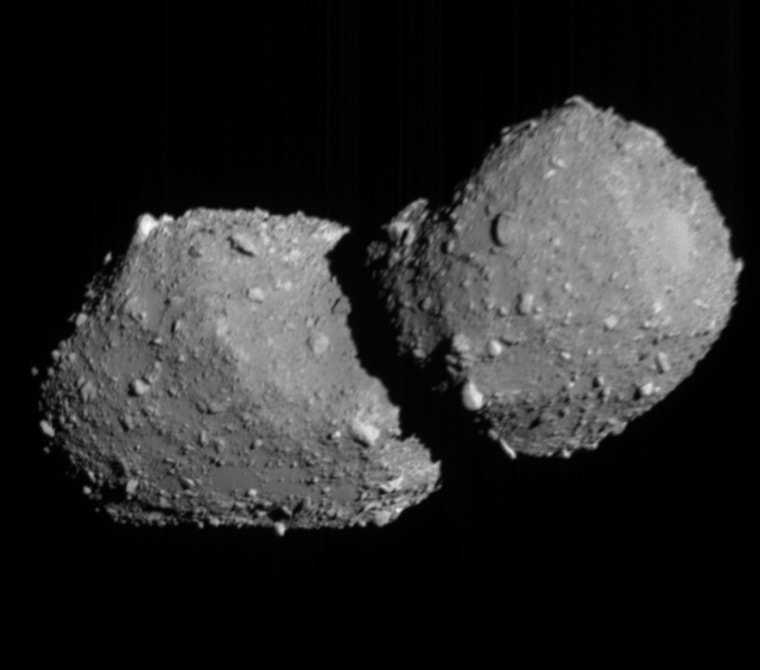
Days later, Japan's Hayabusa2 probe flew past the asteroid Torifune on July 5 at a speed of five kilometers per second, passing within roughly 800 meters of the asteroid's center at a distance of about 100 million kilometers from Earth. The Japan Aerospace Exploration Agency released images the following day showing Torifune's distinctive snowman-like shape, with many rocks visible on its surface. The asteroid measures about 450 meters long.petapixel+3
JAXA said the flyby also served as a test of orbital maneuvering techniques relevant to planetary defense, specifically the kind of navigation that would be needed for a kinetic impactor mission to deflect a dangerous asteroid. The Planetary Society reported that Torifune's small size and low reflectivity required last-minute navigational adjustments in the days before the encounter.planetary
Hayabusa2 previously made history by collecting samples from asteroid Ryugu and returning them to Earth in 2020. Its next and final target is the tiny asteroid 1998 KY26, which it is expected to reach in 2031. For China, Tianwen-2 marks its first asteroid mission and only its second interplanetary endeavor after the Tianwen-1 Mars mission. After completing work at Kamo'oalewa, the probe is planned to travel onward to the main-belt comet 311P/PanSTARRS, arriving in 2035.dw+3