Newsletter Subscribe
Enter your email address below and subscribe to our newsletter

All voices matter
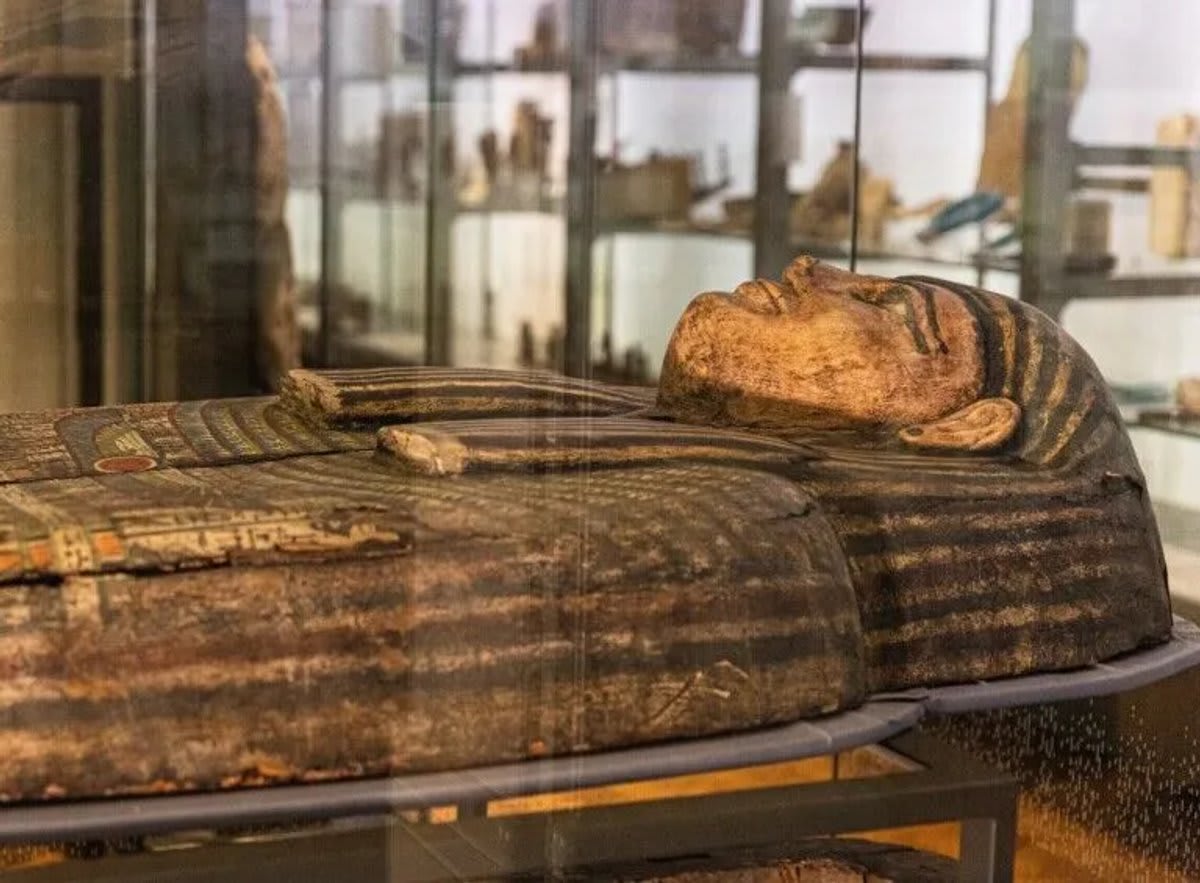
cairoscene+1.thenationalnews+1.thenationalnews+1.thenationalnews.egyptmanchester.wordpress.As reported by The Art Newspaper and The National News, Manchester Museum is conducting a public consultation on whether to continue displaying the 2,700-year-old mummified remains of Asru, an ancient Egyptian woman whose body has been exhibited for nearly 200 years since being unwrapped in 1825, raising broader questions about the ethical display of human remains in UK museums.
Asru's mummified body and coffins were acquired in Egypt by cotton merchants Robert and William Garnett in the early 1800s and donated to the Manchester Natural History Society in 1825. Her remains were unwrapped that April, likely as both investigation and entertainment, which was common practice in 19th century learned societies. A contemporary report described her skull as having "excellent proportions," reflecting the pseudoscientific practice of craniometry popular among Western scientists at that time. When first displayed in the museum on Peter Street, writer George Head observed in 1834 that the "Egyptian damsel lay entirely divested of her cerements" with the "colours of her portrait within the centre wooden case perfectly vivid."egyptmanchester.wordpress+1
Over two centuries, Asru's remains have been continuously exhibited while also being subjected to scientific examination. In the 1970s, she became a key subject in the Manchester Egyptian Mummy Project, revealing numerous health conditions including arthritis and parasitic infestations such as Strongyloides and Schistosomiasis. Her body was scanned again in 2012 in preparation for gallery renovations, under the direction of Professors Rosalie David and Judith Adams. Now, 200 years after her unwrapping, the museum has placed a small plaque beside her remains, inviting visitors to share their thoughts on her future display as part of the institution's broader reconsideration of how it cares for human remains in its collection.thenationalnews+3
The movement to decolonize museum collections represents a fundamental shift in how institutions approach objects acquired during colonial periods. Rather than simply removing artifacts, decolonization involves acknowledging colonial histories, providing fuller context about acquisition methods, and crucially, giving agency to source communities in determining how their cultural heritage is interpreted and displayed. This process requires museums to recognize their roots in imperial power structures—as the Great North Museum: Hancock acknowledges, many institutions were "founded during the height of the British Empire" and their collections directly reflect colonial expansion.engagingplaces+2
Museums across the UK are implementing decolonization through various approaches: inclusive storytelling that moves beyond Eurocentric perspectives, as seen at the British Museum and Hampton Court Palace; collaborative research with source communities to uncover previously hidden narratives, as practiced by Tyne & Wear Archives & Museums; and open discussions about repatriation possibilities. These efforts aim not to erase history but to democratize museums by ensuring all communities feel represented and welcome, while building stronger relationships with people around the world whose cultural heritage resides in British institutions.museumsassociation+3
The Kingdom of Kush emerged as a powerful civilization in northern Africa around 1069 BCE, centered in what is now modern-day Sudan. Piye (also known as Pi), who ascended to the Kushite throne in 742 BCE, was the son of Kashta, a chieftain who had established strong leadership in northern Nubia. Under Piye's rule, Kush expanded dramatically through military conquests into Egypt, which was experiencing political fragmentation at the time. His successful campaigns against local Egyptian rulers, particularly Tefnakht, laid the groundwork for what would become Egypt's 25th Dynasty – a period of Kushite pharaonic rule.ebsco+2
Piye's conquest represented more than mere territorial expansion; it demonstrated a fascinating cultural synthesis. While the Kushites had adopted many Egyptian customs and religious practices, they maintained their distinct cultural identity. Piye himself was deeply religious, often invoking Egyptian gods like Amun during his campaigns to legitimize his rule among Egyptians. His legacy is preserved in a remarkable stela erected at Napata in the twenty-first year of his reign, now housed in the Cairo Museum, which vividly recounts his Egyptian expedition and reveals details about his temperament, piety, and generosity. This cultural exchange between Kush and Egypt created a unique blend of traditions that would influence the region for nearly a century of Kushite control.worldhistory+2