Newsletter Subscribe
Enter your email address below and subscribe to our newsletter
[forminator_form id="25163"]

All voices matter
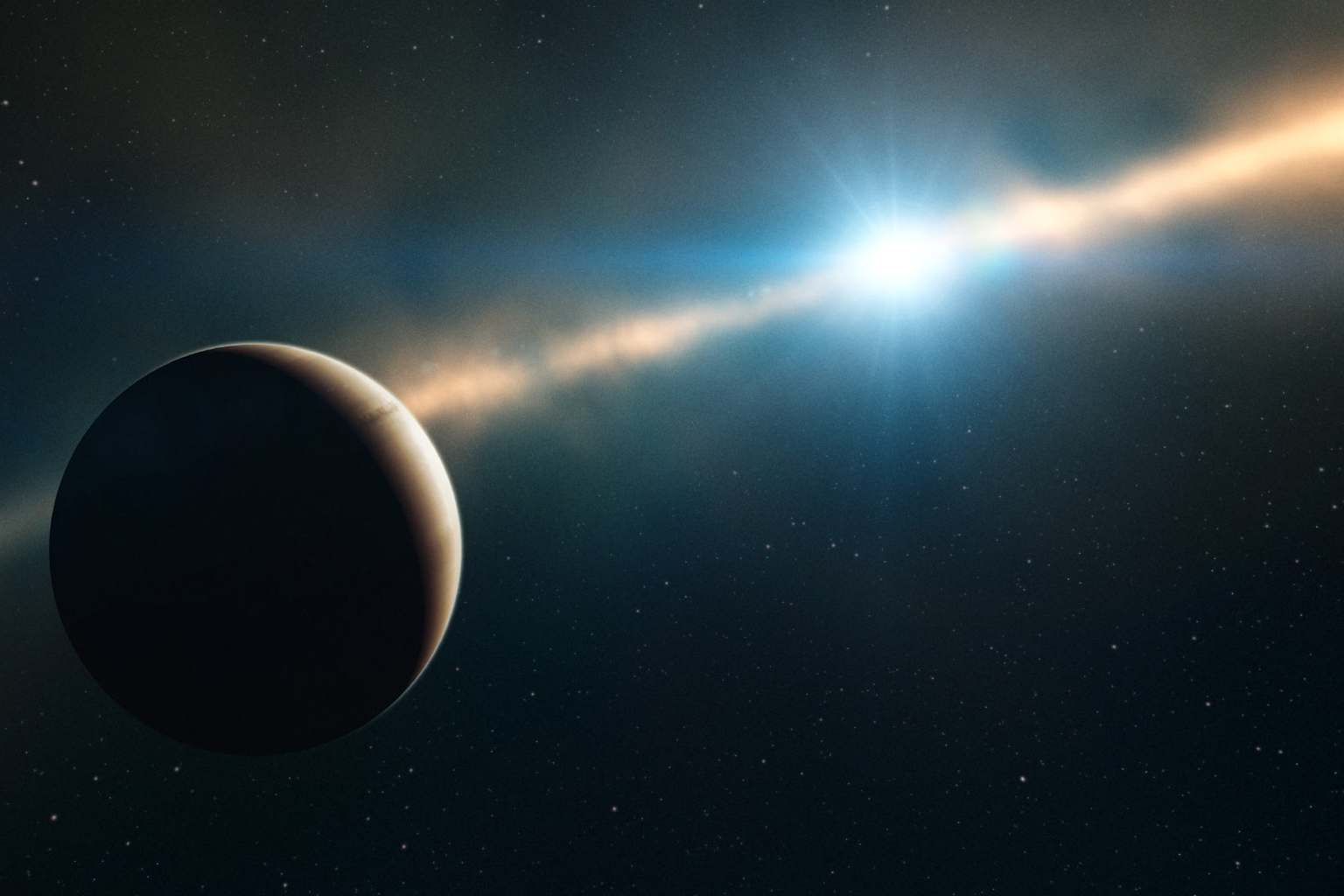
cnn.cnn+1.cnn.Astronomers say they have detected radio emission coming directly from a planet outside the solar system for the first time. The source is Beta Pictoris b, a gas giant about 63 light-years from Earth. The signal points to a very strong magnetic field driving auroras, not to intelligent life.cnn+1
"I know radio signals are associated with searches for extraterrestrial intelligence," said Edo Berger, a Harvard University astronomy professor and coauthor of the study. "But this is something very different." The findings appear in a preprint posted to arXiv on September 15. They have not yet been peer reviewed, and Berger said that review will take the next few months.cnn
The team used MeerKAT, an array of 64 radio dishes in South Africa. They picked up rapid, repeating bursts that were strongly circularly polarized, along with steadier emission, at frequencies between about 0.85 and 3.5 gigahertz. The researchers put this down to auroral radio emission, which is produced when charged particles spiral inside a planet's magnetic field. Jupiter and Saturn give off the same kind of signal.thedailystar+1
Berger said the planet's magnetic field is "at least 200 times stronger than the magnetic field of Jupiter." According to The Daily Star, the team calculated a field strength of at least about 1,250 gauss in the region producing the emission. The researchers call this the first direct measurement of an exoplanet's magnetic field.cnn+1
The planet is about 12 times as massive as Jupiter. It orbits a young star, roughly 23 million years old, that is 1.75 times the mass of the suncnn. Lead author Kevin Ortiz Ceballos, a doctoral researcher at the Center for Astrophysics | Harvard & Smithsonian, found the signal while going through survey data. Berger called the survey "a bit of a fishing expedition."cnn
Earlier hints of exoplanet radio emission, including from the YZ Ceti system, were never confirmed because astronomers could not rule out the host star as the source. BBC Sky at Night Magazine reported that this time the star's low magnetic activity helped the team isolate the planet's signal.skyatnightmagazine+2
"What is unique for this study is that they localise the emission to the planet itself, separate from the star," said Joseph Callingham of the University of Amsterdam, who was not involved in the work. Imke de Pater, a planetary scientist at Berkeley, told The New York Times: "Nobody has seen radio emission from a planet in this way."cnn+1
Outside researchers are urging caution until the work passes peer review. Jonathan Nichols of the University of Leicester said that if the result holds up, auroral emissions could let scientists "test theories and ideas developed for our own solar system in more extreme conditions."cnn
The team has asked for more telescope time to work out why the planet's field is so strong. "I think that's going to be a question that occupies people for a while," Berger said.cnn