Newsletter Subscribe
Enter your email address below and subscribe to our newsletter
[forminator_form id="25163"]

All voices matter
reuters+1reuters+1reutersChina's GDP deflator turned positive in the second quarter of 2026 for the first time in more than three years, data released Wednesday showed, marking the end of a prolonged period of falling prices that had weighed on corporate profits and consumer confidence. But the shift owed more to global supply shocks than to any domestic recovery.
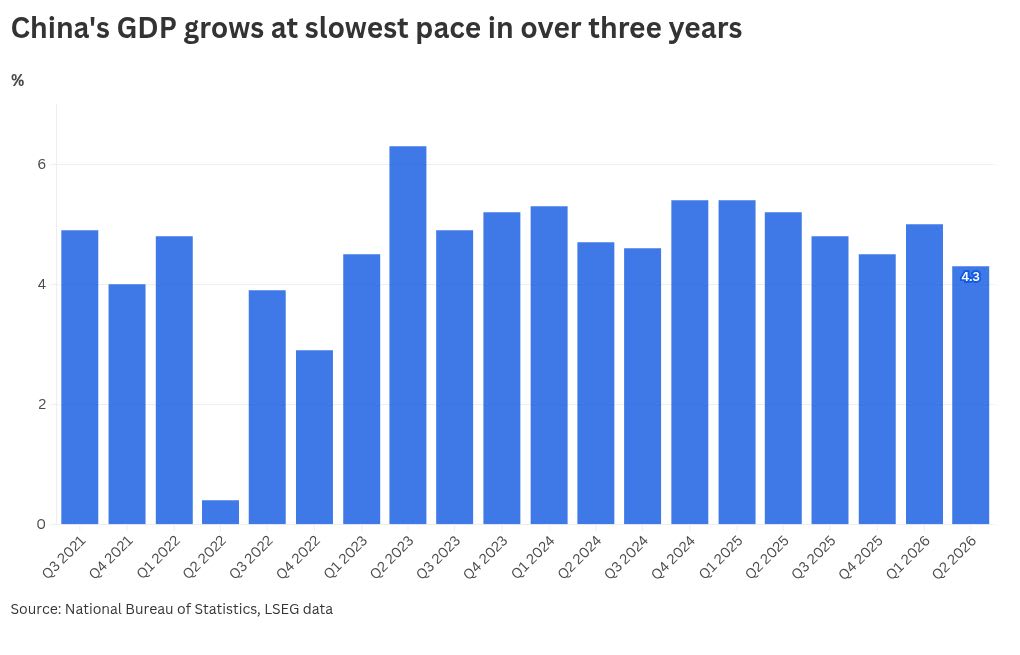
The National Bureau of Statistics reported that China's economy grew 4.3% year-on-year in the second quarter, missing market expectations of 4.5% and slowing from 5.0% in the first quarter. The GDP deflator — a broad measure of economy-wide price changes — crossed into positive territory after 12 consecutive quarters of negative readings, according to Bloomberg calculations.reuters+3
The reversal was driven primarily by surging global oil prices linked to the U.S.-Iran conflict and rising costs across the AI supply chain. The war between Iran and the U.S.-Israel coalition disrupted traffic through the Strait of Hormuz, through which over 20% of global oil trade passes, triggering what the International Energy Agency called the "largest supply disruption in the history of the global oil market". Brent crude rose sharply early in the conflict and has remained volatile, spiking again in early July after the United States launched fresh strikes on Iran and revoked a temporary sanctions waiver on Iranian oil.wikipedia+3
China's producer price index rose 4.1% year-on-year in June, a four-year high, according to Reuters , while the consumer price index climbed a more modest 1.0%. Bloomberg reported in May that export prices jumped 5% in April from a year earlier — the biggest gain since 2023 — as energy costs and AI-related demand broke a long streak of falling prices.bloomberg+1
Su Jian, director of Peking University's National Center for Economic Research, estimated the second-quarter GDP deflator at around 1.9%, aided by a low comparison base, higher global commodity prices, and firmer prices for some consumer durables. The KPMG China Economic Monitor noted the deflator had improved to -0.06% in the first quarter, suggesting it was on the cusp of turning positive even before the latest oil price surge.chinadaily+2
Yet many economists cautioned against reading too much into the shift. Bloomberg reported in June that consumer inflation "unexpectedly stalled" even as factory prices accelerated, highlighting a widening gap between input costs and domestic demand. Weak retail spending and falling investment — expected at -4.9% year-on-year in June — underscored that the underlying demand deficit persists. China's oil imports fell to their lowest level in nearly a decade, suggesting the price shock is squeezing rather than stimulating the economy.investinglive+2
Beijing pledged in March to "steer general price levels back into positive territory," the most emphatic language on deflation from China's leaders in years. But the manner of that exit — driven by imported costs rather than domestic demand — leaves the economy vulnerable. With GDP growth missing forecasts and the U.S.-Iran situation fluid, analysts expect policymakers will face renewed pressure to deliver additional stimulus in the second half of the year.bloomberg+2