Newsletter Subscribe
Enter your email address below and subscribe to our newsletter
[forminator_form id="25163"]

All voices matter
asianewsasianewsasianewsThe contest between the United States and China over artificial intelligence has entered a new phase, moving beyond chips and tariffs into a struggle over whose AI models — and whose rules — the rest of the world will adopt. At the center of this shift is China's aggressive push to distribute open-weight AI models globally, positioning itself as the champion of accessible technology against what Beijing calls an American "AI Iron Curtain."
Chinese President Xi Jinping personally attended the World Artificial Intelligence Conference in Shanghai in July — his first appearance at the annual event since it began in 2018 — to launch the World Artificial Intelligence Cooperation Organization (WAICO), a new Shanghai-based intergovernmental body. Twenty-nine countries, including Kazakhstan, Russia, Indonesia and Pakistan, signed the founding agreement on July 16, with UN Secretary-General Antonio Guterres attending the ceremony.asianews+2
Xi pledged to provide developing countries with 5,000 AI training opportunities over five years and promised access to China's AI-powered meteorological warning system, framing AI as an "international public good". The message dovetailed with the commercial appeal of Chinese open-weight models: since DeepSeek's breakout in January 2025, Chinese models' share of tokens used by US firms on the OpenRouter platform grew to 58 percent in July from 1.2 percent in December 2024, driven largely by prices 60 to 90 percent cheaper than closed American alternatives.asianews
The launch of Moonshot AI's Kimi K3 open-weight model at the conference, which rivals leading systems from Anthropic and OpenAI on several benchmarks, triggered a sell-off in US and South Korean chip shares.asianews
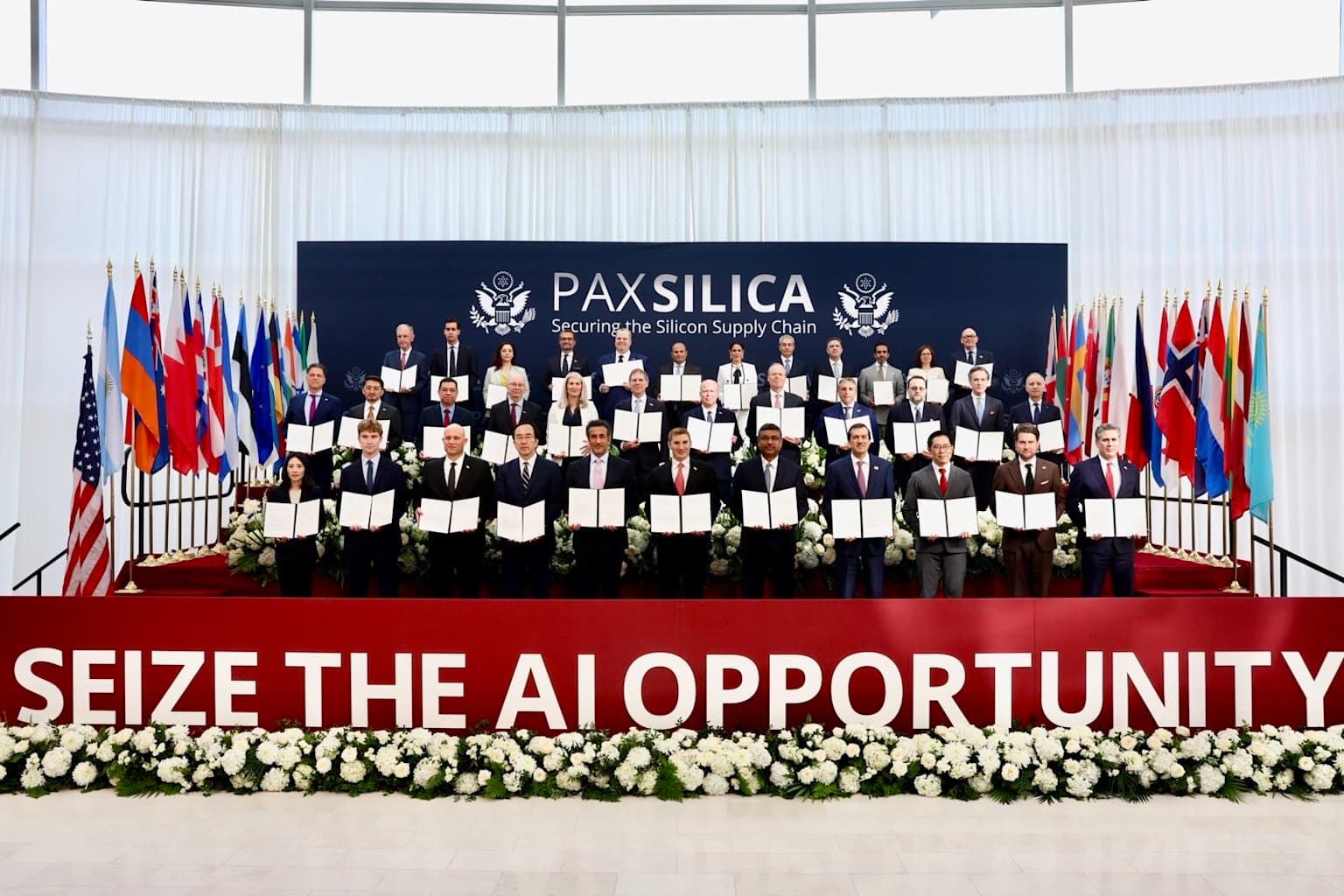
On the American side, Undersecretary of State Jacob Helberg is leading efforts to build an alternative coalition. His Pax Silica initiative, launched in December 2025, now counts the European Union, Germany, Greece and more than 30 partners committed to building AI supply chains free from Chinese control. Reuters Thomson Reuters Corporation reported in August that the State Department had drafted a letter warning signatories they could be excluded from the US-led coalition if they also joined WAICO.bhfs+2
In a Politico profile published Friday, Helberg framed the rivalry in stark terms: "For years, Washington's default was that anyone who actually understood technology was disqualified from governing it… while Beijing fused its tech sector and its state into one weapon". Meanwhile, President Trump dismissed AI safety concerns as a "hoax" and said on Sept. 13: "We're leading China in AI. And frankly I want to keep it that way because whoever wins AI, wins".asianews+1
The rivalry is forcing countries into uncomfortable choices — or strategic hedging. Kazakhstan is the only known country to be a founding member of both WAICO and Pax Silica. Malaysia has launched a joint AI cooperation center with China while relying on Google Alphabet Inc. , Microsoft and Amazon Web Services Amazon.com, Inc. for its core AI infrastructure.asianews
Commercial pressures are also blurring the lines. Reuters reported in August that Microsoft, Amazon and Google are in talks with Moonshot AI about hosting the K3 model on US cloud platforms, in what could be the first major revenue-sharing deal between a Chinese AI firm and a US cloud company. With Xi expected to make a state visit to the US later this month for the first formal US-China AI dialogue under the Trump administration, the question of whether the two powers can find any common ground — or will further entrench competing blocs — is about to be tested directly.enterprisedna+1