Newsletter Subscribe
Enter your email address below and subscribe to our newsletter
[forminator_form id="25163"]

All voices matter
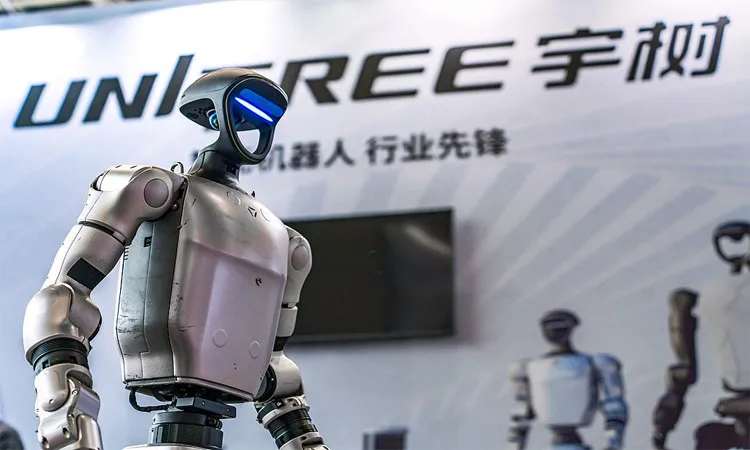
wtvbam+1wtvbamwtvbamChina's Unitree Robotics is set to begin trading on Shanghai's STAR Market on August 19, becoming the first general-purpose humanoid robot maker to go public on the Chinese mainland — a milestone that arrives under the shadow of escalating US restrictions on the company and its products.
The Hangzhou-based firm raised 6.1 billion yuan (approximately $905 million) after pricing shares at 150.8 yuan each, with retail investors oversubscribing the offer by more than 8,000 times, a record for the STAR Market, according to CNN and Reuters. The listing values the company at roughly $9 billion, well above the $7 billion floated during the run-up. Grey-market pricing has pointed to first-day gains of triple to quadruple the offer price.wtvbam+2
The IPO coincides with a Reuters investigation published on Monday detailing how Unitree's most successful robot dog designs drew on breakthroughs in quadruped locomotion funded by the US Army Research Laboratory. Gavin Kenneally, a former University of Pennsylvania researcher involved in the Army-funded program, told Reuters the project "turned into, basically, the first Unitree robot that had any kind of scale". Ben Katz, who worked at MIT's Biomimetic Robotics Lab, said dimensions of Unitree's popular Go series were "to the millimeter" almost identical to the Mini Cheetah robot he helped develop.wtvbam
Unitree did nothing underhanded — the research was published openly. But the episode illustrates what analysts call a broader failure to commercialize US-funded innovation. Reyk Knuhtsen, a robotics analyst at SemiAnalysis, called it a "dropped ball," citing US venture capital's preference for high-return software startups.wtvbam
In June, the Pentagon added Unitree to its list of Chinese military-linked companies. In July, the Federal Communications Commission banned imports of future models of foreign-made humanoid and quadruped robots over national security concerns. Unitree has warned in its prospectus that it "may be unable to sustain rapid growth in overseas sales" if restrictions continue, with over 40 percent of revenue generated abroad.cnn+1
Despite the curbs, founder Wang Xingxing — still only in his mid-thirties and holding about a third of the company — is now China's first humanoid-robot billionaire. Backers include Tencent, Alibaba , and AI startup DeepSeek.bloomberg+1
On Monday, two days before the float, Unitree unveiled a humanoid dubbed "Superman" that it says can jump two metres and run faster than Usain Bolt at his peak. The company delivered more than 5,500 humanoids and 18,000 quadrupeds last year — volumes no US firm, including Tesla with its Optimus prototype, has matched.thenextweb+2
Kenneally, who founded Ghost Robotics to commercialize the same US Army research, summed up the competitive dynamic: "This isn't just a competition between U.S. and Chinese robotics companies. It's between private U.S. companies and China's coordinated national strategy".wtvbam