Newsletter Subscribe
Enter your email address below and subscribe to our newsletter
[forminator_form id="25163"]

All voices matter
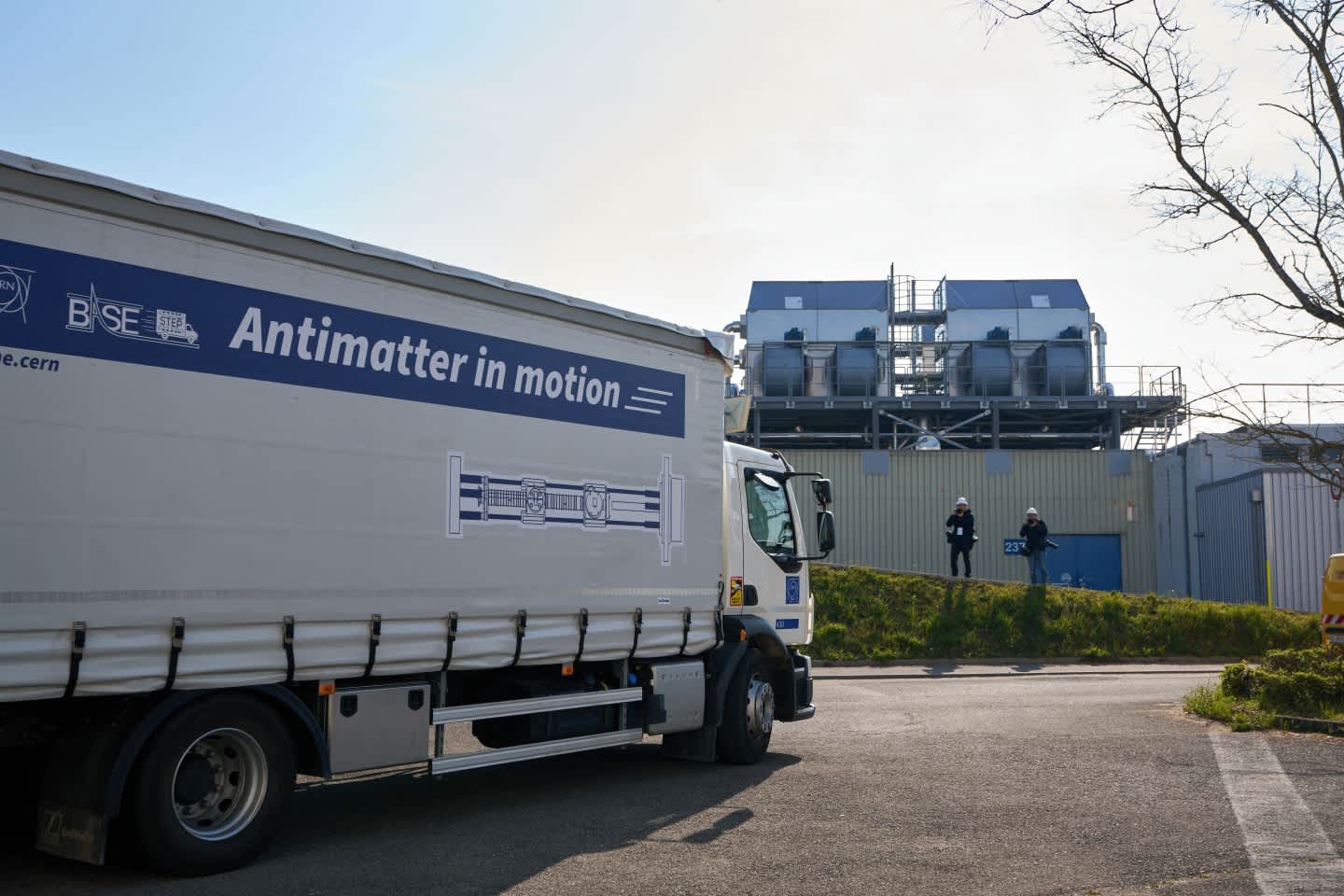
eurekalert+1eurekalert+1eurekalertScientists from the BASE collaboration at CERN have published results in Nature detailing the first-ever road transport of antiprotons and their storage for more than a month in a mobile trap — milestones that open the door to a new era of precision antimatter research.eurekalert+1
The findings, published on Wednesday, describe how in March 2026 the team extracted 92 antiprotons from CERN's Antimatter Factory and loaded them into BASE-STEP, a transportable cryogenic Penning trap weighing nearly 1,000 kilograms. The apparatus was then driven on a truck around CERN's Meyrin campus for approximately half an hour, covering about eight kilometers — all without losing a single particle.home+1
After the transport on March 24, the team continued to observe and manipulate the antiprotons in a controlled manner for more than a month, setting a new record for antimatter storage in an open trap system. Marcel Leonhardt, a doctoral researcher at Heinrich Heine University Düsseldorf (HHU) and lead author of the study, highlighted the vacuum performance as a special achievement: the trap maintained a pressure better than 2.2×10⁻¹⁸ millibar throughout the storage period, far surpassing the design target of 1×10⁻¹⁶ millibar.hhu+1
According to Nature, this record performance "establishes the BASE-STEP trap–vacuum interface as a blueprint for future offline apparatus, enabling operation over months or even years after antiproton delivery".nature
Comparing protons with antiprotons is one of the most promising ways to test CPT invariance — the fundamental symmetry linking charge, parity, and time reversal. Any measurable difference in their mass or magnetic moment could help explain why the observable universe is dominated by matter rather than antimatter.eurekalert
The BASE team, led by Professor Stefan Ulmer and Dr. Christian Smorra at HHU, has already achieved measurements of the magnetic moment of protons and antiprotons to accuracies of 0.3 and 1.6 parts per billion, respectively. But magnetic-field noise at CERN limits further improvement. Transporting antiprotons to quieter laboratories could yield at least a 100-fold gain in precision, according to Smorra.eurekalert
The March transport served as a dress rehearsal. The collaboration's next goal is to make the trap autonomous enough for a ten-hour journey from Geneva to a high-precision laboratory now being established at HHU in Düsseldorf. "We were able to demonstrate that our idea works," Smorra said.cerncourier+1