Newsletter Subscribe
Enter your email address below and subscribe to our newsletter

All voices matter
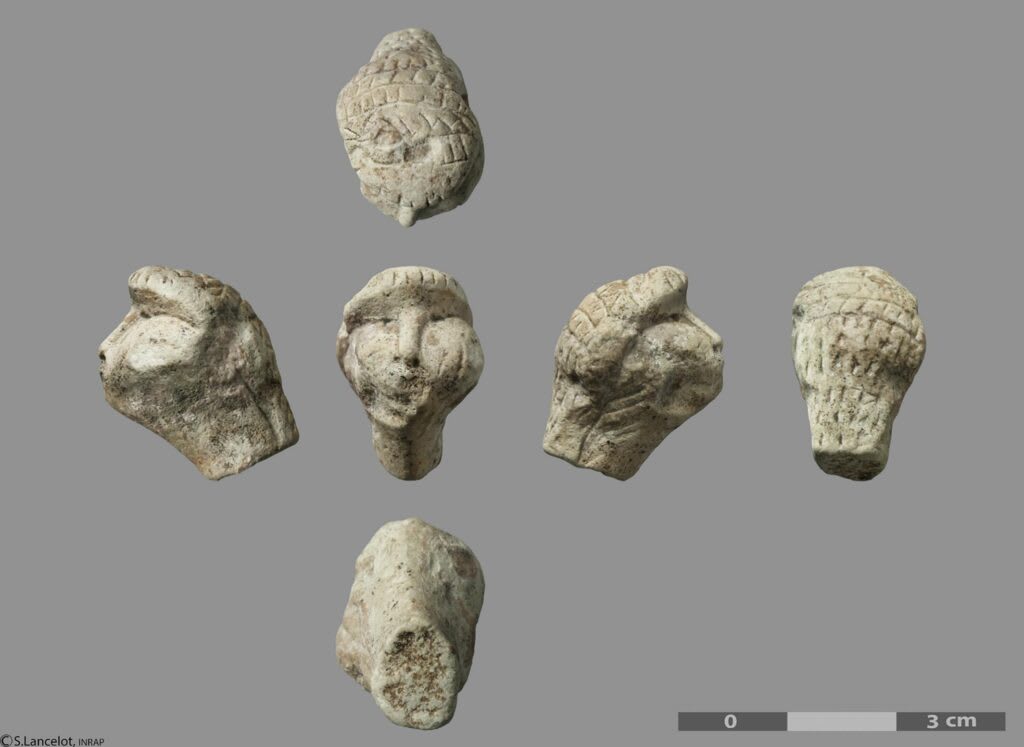
arkeonews+1.labrujulaverde+1.labrujulaverde.labrujulaverde+1.wikipedia+1.Archaeologists have unearthed an extraordinary 27,000-year-old Gravettian female figurine head at the prehistoric site of Amiens-Renancourt in northern France, adding to the collection of Upper Paleolithic "Venus" figurines found across Europe from the Pyrenees to Siberia.
The Gravettian culture flourished during a particularly cold period of European prehistory, spanning approximately 33,000 to 21,000 years BP (Before Present). Dating methods have been crucial in establishing this timeline, with radiocarbon dating being the primary technique. Recent advances in Accelerator Mass Spectrometry (AMS) have allowed for more precise dating of smaller samples, including shells associated with human remains, such as those found at the Cro-Magnon rock shelter.wikipedia+2
Regional variations in Gravettian chronology have been identified through careful dating. The culture was well-established across Europe by 29,000 BP, with the eastern Gravettian regions showing dates between 25,500 and 21,200 BP based on charcoal and bone samples. More sophisticated approaches now employ hierarchical Bayesian models to analyze radiometric data, allowing researchers to separate Gravettian contexts by region and establish more nuanced chronological frameworks. This precise dating has helped archaeologists understand the temporal relationship between the Aurignacian and Gravettian technocomplexes, revealing both cultural continuity and innovation as human populations adapted to the harsh Ice Age environment.youtube+4
Venus figurines have been discovered across a vast geographic expanse, from the Pyrenees Mountains in Western Europe to the plains of Siberia, spanning over 3,300 kilometers. The earliest known examples date back approximately 35,000-40,000 years ago, with the Venus of Hohle Fels from Germany's Swabian Alb representing the earliest known figurative art of this type. Most figurines have been dated between 23,000 and 25,000 years ago during the Upper Paleolithic period, coinciding with Europe's severe ice age conditions.factsanddetails+4
Henri Delporte's geographical classification system organizes these artifacts into five distinct regional groups: the Pyrenees-Aquitaine group (including the Venus of Lespugue and Brassempouy), the Mediterranean group, the Rhine-Danube group (featuring the famous Venus of Willendorf and Venus of Dolní Věstonice), the Russian group, and the Siberian group. This widespread distribution across Europe suggests a shared cultural practice among Gravettian peoples, who emerged about 30,000 years ago. The figurines have been discovered in various contexts, including caves, open-air sites, and settlements, often alongside stone and bone weaponry, ivory jewelry, and remains of Ice Age animals.onlinelibrary.wiley+2
Most Venus figurines are characterized by their lack of facial features, with many having no discernible face at all or highly abstracted representations. This deliberate omission has led scholars to suggest that these artifacts were meant to represent generic female forms rather than specific individuals, emphasizing reproductive capabilities over personal identity. The facelessness of many Venus figurines has prompted some researchers to theorize that prehistoric cultures primarily valued women for their reproductive functions rather than their individual characteristics.thecollector+2
The recent discovery at Amiens-Renancourt presents a striking exception to this pattern, featuring unusually detailed facial anatomy including defined nose, eyes, and cheeks. Unlike the downward-facing heads typical of Gravettian figurines, this specimen has an upward gaze indicated by sunken eye sockets. The back of the head displays intricate incisions forming grid-like patterns, vertical lines, and notches, potentially representing braided hair, a net, or a ritual headdress. These individualized features suggest the possibility that this particular figurine portrayed a specific person or social role, challenging long-held assumptions about Venus figurines as purely symbolic fertility objects.wikipedia+1