Newsletter Subscribe
Enter your email address below and subscribe to our newsletter
[forminator_form id="25163"]

All voices matter
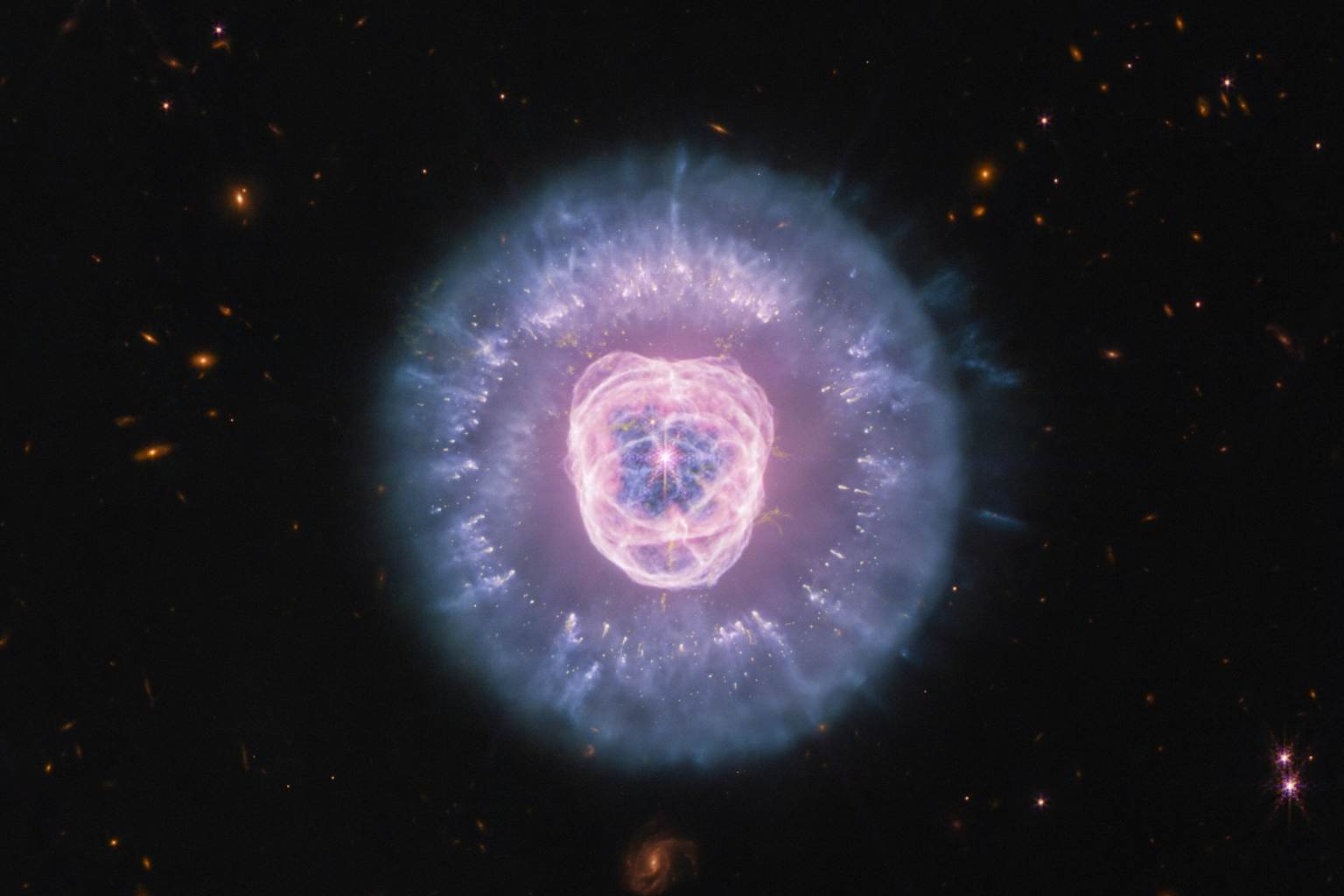
universetoday+1foxweather+1universetoday+1NASA's James Webb Space Telescope has delivered the sharpest images ever taken of NGC 2392, a planetary nebula known as the Lion Nebula, revealing the intricate aftermath of a dying star in unprecedented infrared detail.
The new observations, shared by NASA and reported on August 17, 2026, combine data from Webb's Near-Infrared Camera (NIRCam) and Mid-Infrared Instrument (MIRI) to expose structures invisible in earlier visible-light imaging. The result is a vivid portrait of dust clumps, ionized gas, and expanding shells being sculpted by the radiation of a central white dwarf.foxweather+2
NGC 2392 formed roughly 10,000 years ago when a lower-mass, oxygen-rich star exhausted its nuclear fuel, became unstable, and shed its outer layers into space. What remains is a white dwarf so hot that it ionizes the surrounding hydrogen gas, creating an expanding bubble that gives the nebula its lion-face appearance. The stellar remnant resembles "a small button nose," while the surrounding gaseous envelope and tendrils of dust form what astronomers describe as the lion's mane.universetoday+1
"When a lower-mass star can no longer sustain itself with nuclear reactions in its core, the star becomes unstable and pulsates, losing its mass by shedding its outer layers, which then turn into shells of gas and dust called a planetary nebula," NASA said.foxweather
The Hubble Space Telescope first observed NGC 2392 in visible light in 2000, highlighting its comet-shaped structures. Webb's infrared instruments now bring out features that are harder to detect optically, including compact dust clumps that appear red, orange, and yellow, as well as haze caused by ionized gas. These dense clumps have survived the expanding gas cloud and shield material lying beyond them from the white dwarf's radiation.scitechdaily+1
The forces reshaping the nebula remain active. Gas and dust continue migrating away from the stellar core, gradually altering its appearance. Astronomers estimate the Lion Nebula's distinctive shape will disperse entirely in about 10,000 years — a brief interval on cosmic timescales.universetoday+1
Webb is the largest and most powerful telescope ever launched into space, built through a partnership among NASA, the European Space Agency, and the Canadian Space Agency. ESA contributed the NIRSpec spectrograph and co-developed MIRI with a consortium of European institutes, JPL, and the University of Arizona.scitechdaily