Newsletter Subscribe
Enter your email address below and subscribe to our newsletter
[forminator_form id="25163"]

All voices matter
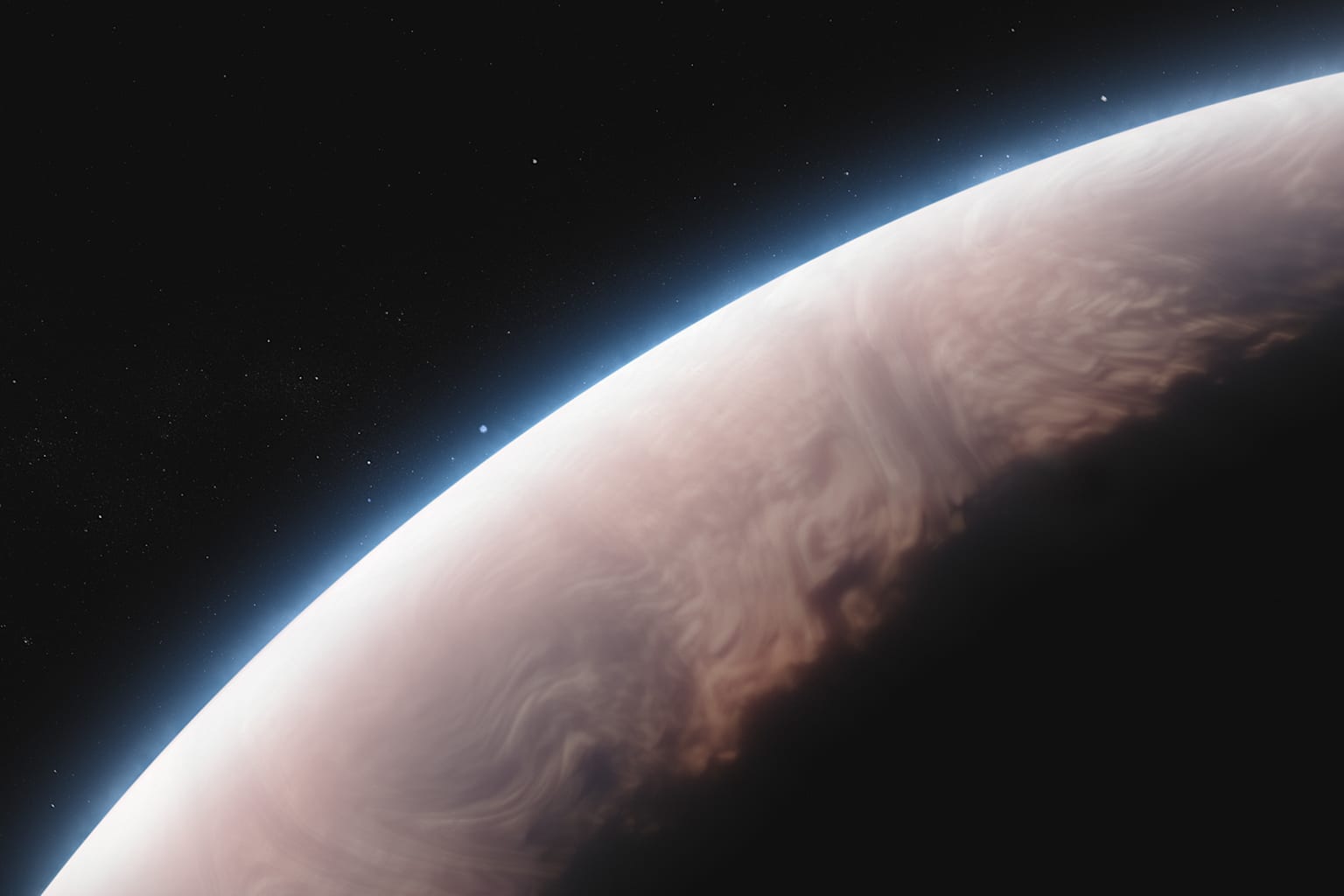
eurekalert+1.arxiv+1.eurekalert+1.Astronomers usually model distant planets as perfect circles. A team led by Cornell University and the University of Bristol has now used data from NASA's James Webb Space Telescope to measure the uneven outline of a planet's atmosphere for the first time. The planet is the hot Jupiter WASP-17b, which orbits a star about 1,300 light-years from Earth. Its atmosphere turns out to be roughly circular but asymmetric, with one side stretched farther out than the other.bristol+1
The study, "A Spatial Map of the Atmospheric Limb of a Hot Jupiter," was published Oct. 14 in Nature Astronomy. Its first author is Lili Alderson, a Klarman Postdoctoral Fellow at Cornell. Cornell described the shape as "slightly egg-shaped," and the team says the planet can now serve as a reference point for comparing the more than 6,000 exoplanets confirmed so far.eurekalert+1
The method, called transmission strings, was developed at Bristol by astrophysicists David Grant and Hannah Wakeford. It is also known as transit mapping. It follows the planet as it crosses in front of its star and records starlight filtering through the planet's outer edge, or limb, from different angles. Older methods average one spectrum over the whole limb.eurekalert+1
"We're able to go around the edge. So, we've gone from a ring to understanding where on the ring the gemstones are, so to speak," Alderson said.miragenews
According to the paper, the team combined transit observations from three of Webb's instruments, covering wavelengths from 0.6 to 12 microns. It is the first time an exoplanet's atmosphere has been mapped from its equator to its poles.arxiv
The swelling sits on the "evening" side of the planet's equator, where theory said it should be. On this side, jet streams carry heat from the side that always faces the star toward the side in permanent darkness, and the warm gas expands. The cooler "morning" side stays more compact. The paper estimates the evening side at about 1,522 kelvin and the morning side at about 858 kelvin, a gap of roughly 650 kelvin. Alderson said the result was "pretty much bang-on what we thought it would be." She added that water and carbon dioxide were present at fairly consistent levels all the way around the limb.bristol+2
The researchers write that this is the first time one exoplanet's atmosphere has been mapped both during transit and with emission (eclipse) mapping. The data came from Webb's TST DREAMS Guaranteed Time Observations program, which Cornell astronomer Nikole Lewis leads as principal investigator.arxiv+1
The team says the technique is starting to pick up differences between latitudes, a first step toward mapping weather on other planets. "Planets are temperamental, their atmospheres complex and chaotic," Wakeford said. "The fact that all of these numbers came together and showed us this very structured, dynamical picture of this giant world over 1,000 light years away was just really exciting".miragenews+1