Newsletter Subscribe
Enter your email address below and subscribe to our newsletter
[forminator_form id="25163"]

All voices matter
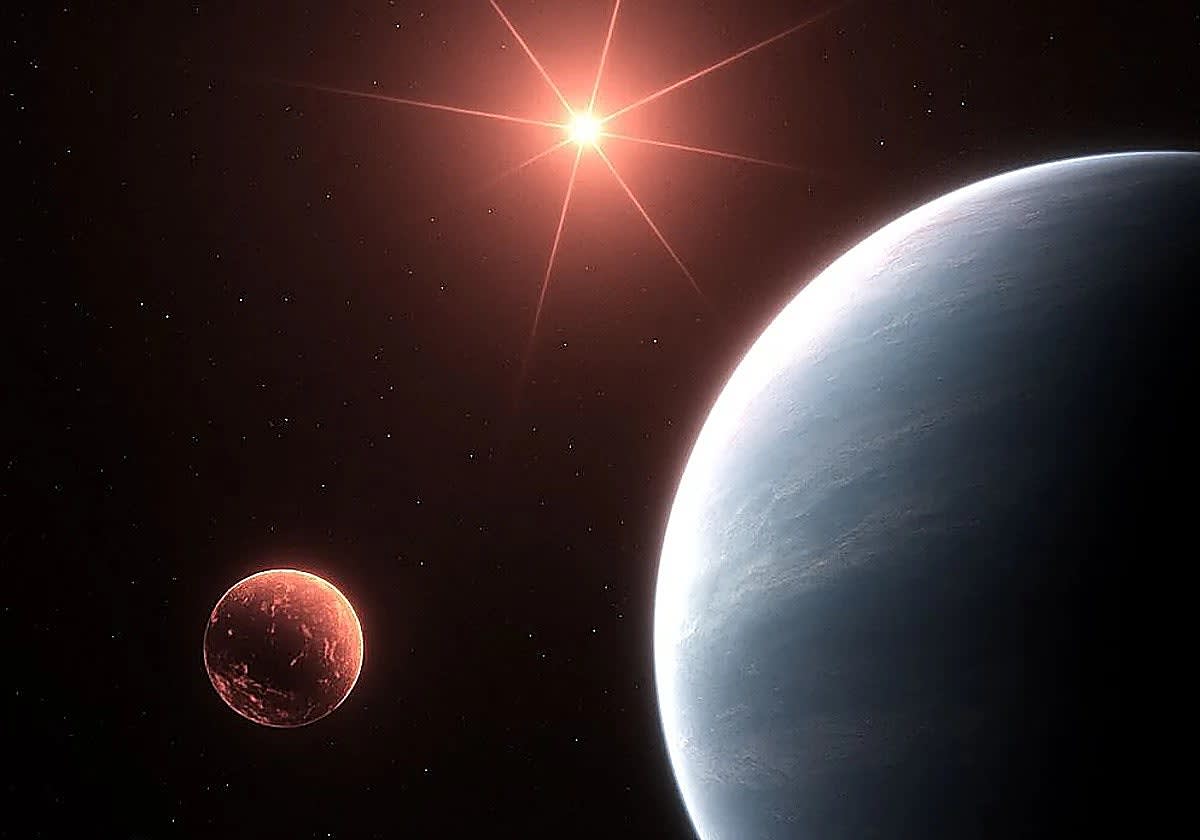
surinenglish+1lavozdelanzarote+1surinenglish+1An international team led by Spain's Institute of Astrophysics of Andalusia (IAA-CSIC) has confirmed the existence of a two-planet system 337 light-years from Earth, one of whose worlds sits in a zone where liquid water could persist on its surface. The study, published in the journal Monthly Notices of the Royal Astronomical Society, validates the TOI-1752 system as a new entry in the catalog of worlds that may warrant closer scrutiny in the search for extraterrestrial life.surinenglish+1
The system's host star is a red dwarf — smaller and cooler than the Sun — first flagged by NASA's TESS satellite, which detects planets by measuring tiny, periodic dips in stellar brightness. Ground-based follow-up observations from the Teide Observatory in the Canary Islands, using the MuSCAT2 instrument, helped rule out false-positive explanations such as eclipsing binary stars.lavozdelanzarote
The inner planet, TOI-1752 b, is a super-Earth with a radius about 1.7 times that of our planet. It whips around its star in less than a day, receiving radiation intense enough to keep rock molten on its star-facing hemisphere — a scenario scientists describe as a "lava world". According to NASA's Exoplanet Archive, the planet's discovery was announced in 2026 and is listed as confirmed.arxiv+2
Farther out orbits TOI-1752 c, roughly 2.3 times the radius of Earth, with an orbital period of about 32.7 days. It lies within the "optimistic habitable zone," the range of distances from its star where liquid water could be maintained under certain atmospheric conditions. Its estimated equilibrium temperature is around 18 to 20 degrees Celsius, and it receives stellar irradiation similar to Earth's.academic.oup+4
Researchers note that TOI-1752 c closely resembles K2-18 b, a sub-Neptune discovered a decade ago that is considered among the most promising candidates for Earth-like habitability due to the presence of carbon molecules in its atmosphere. Both planets share comparable sizes, similar orbital periods of just over 30 days, and red dwarf host stars.surinenglish
The team suggests that future observations with the James Webb Space Telescope could probe the atmosphere of TOI-1752 c for biosignatures. Samuel Geraldía, a researcher at the Institute of Astrophysics of the Canary Islands who contributed to the study, said the planet "is a relic that will help us understand planetary formation and evolution processes a little more, along with its internal composition".lavozdelanzarote