Newsletter Subscribe
Enter your email address below and subscribe to our newsletter
[forminator_form id="25163"]

All voices matter
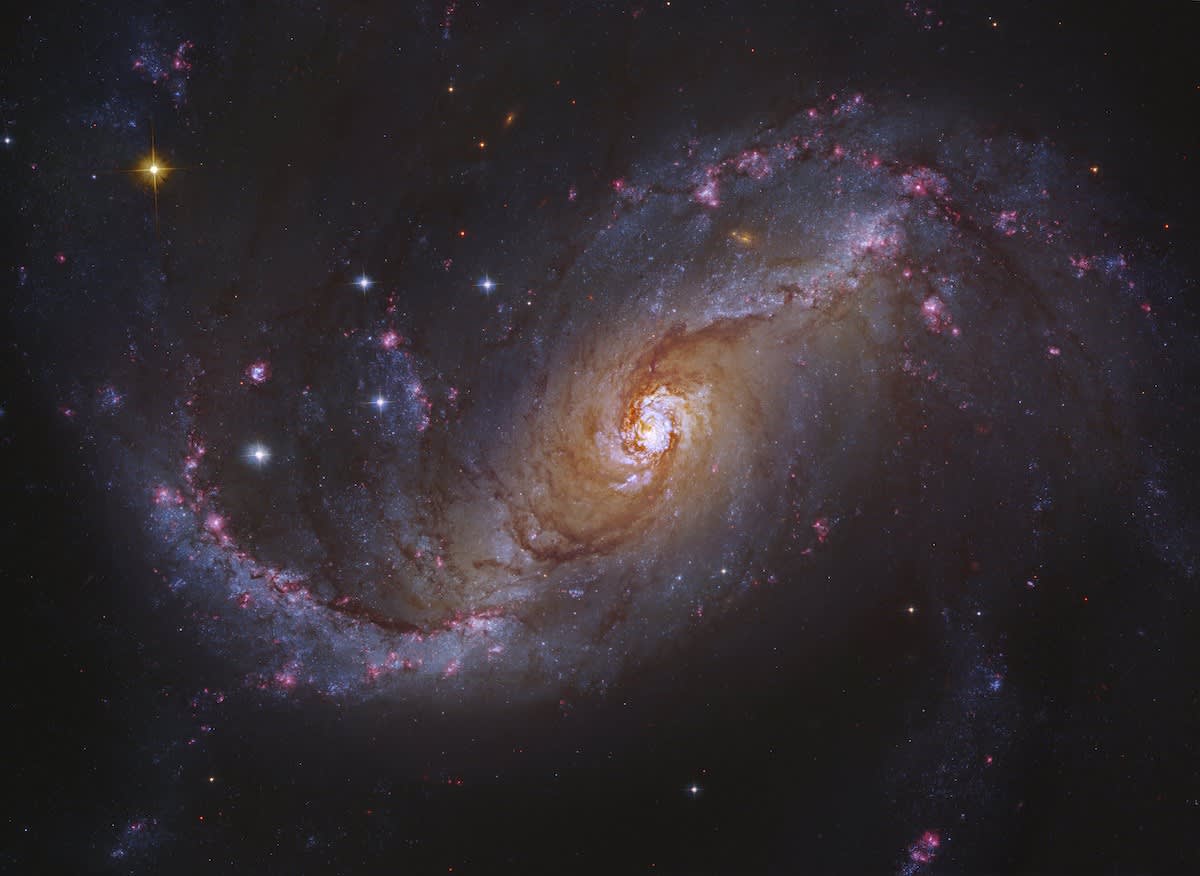
physphys+1linkedinAn international team of astronomers has identified a massive barred spiral galaxy at a redshift of 5.1, making it the most distant such structure ever observed and pushing back the timeline for when organized galaxies could form after the Big Bang.
The galaxy, designated M1149-BSG-z5, was discovered using the James Webb Space Telescope in the parallel field of the galaxy cluster MACS J1149+2223. The findings, led by Xiaohan Wang of Tsinghua University in Beijing, were published on the preprint server arXiv on June 23.themoonlight+1
At a redshift of 5.102, M1149-BSG-z5 existed when the universe was roughly one billion years old — a period known as the Epoch of Reionization, when bar structure formation is expected to be suppressed by the turbulent cosmic environment. The galaxy hosts a stellar bar approximately 14,700 light-years long, spiral arms extending to about 17,900 light-years, and a stellar mass of roughly 28 billion solar masses.phys+2
The discovery is notable because M1149-BSG-z5 exhibits features typically associated with far more evolved systems. Its star-formation rate was measured at about 144 solar masses per year, and spectroscopic analysis confirmed the presence of an active galactic nucleus with a broad-line component. The galaxy's metallicity — about 50 percent of the Sun's — indicates it is chemically mature, a trait not expected so early in cosmic history.themoonlight+1
Previous JWST observations had found barred galaxies emerging as early as a redshift of about 4.0, with observed fractions of just 3 to 7 percent at redshift 3.5. M1149-BSG-z5 extends this boundary further, and is larger than typical galaxies at comparable redshifts.phys+1
The researchers noted that a companion galaxy lies approximately 69,000 light-years from M1149-BSG-z5, suggesting tidal interactions may have played a role in triggering bar formation. Alternatively, the galaxy's baryon-dominated, gas-rich state may have facilitated rapid bar development through gravitational instability, consistent with recent cosmological simulations.linkedin+2
The discovery adds to a growing body of JWST findings that suggest the early universe was more structured than previously thought. Before JWST, the earliest known barred galaxy was ceers-2112, dating back about 11.7 billion years. M1149-BSG-z5 pushes that record back by several hundred million years.nature