Newsletter Subscribe
Enter your email address below and subscribe to our newsletter
[forminator_form id="25163"]

All voices matter
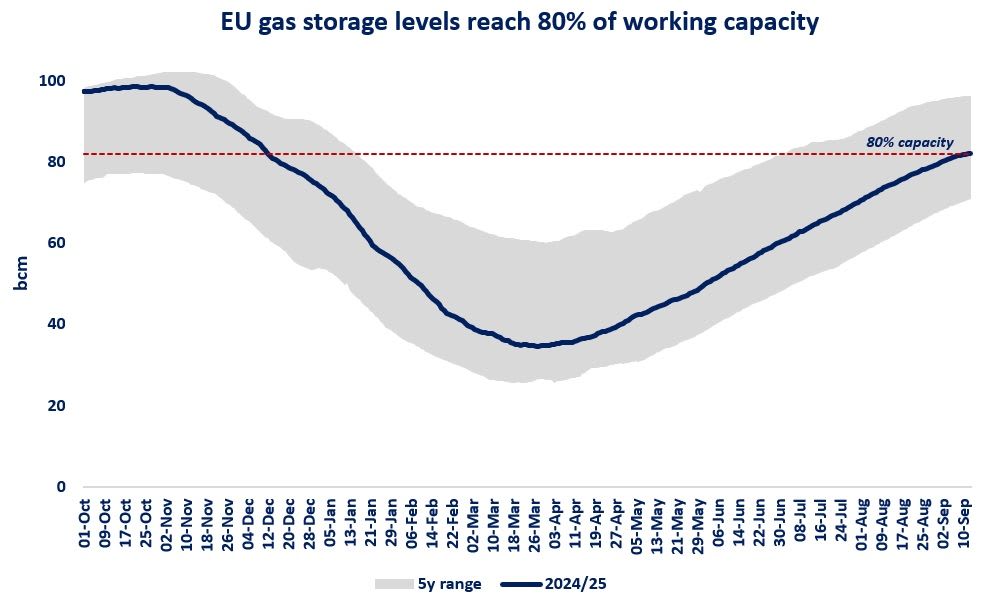
intellinewsintellinewsintellinewsEurope's gas storage tanks are refilling at one of their slowest paces in 15 years, with levels sitting around 58% of capacity in early August — roughly 15 percentage points below where they would normally be at this point in the summer, according to Gas Infrastructure Europe data. The shortfall has left the bloc with virtually no chance of reaching its mandated 90% storage target by November on current trends, analysts warn, even as the EU's imports of Russian LNG continue to climb.intellinews
An analysis by IntelliNews, using a seasonal baseline model built from 15 years of storage history, shows a two-speed Europe emerging. Poland and Hungary are tracking at or above normal levels, while Italy remains within typical variation. But Germany and the Netherlands are deep in deficit territory. Germany's storage stood at just 47.6% full on August 5 against a seasonal norm of 75.1% — a 27.5-point gap that accounts for the single largest hole in European storage. The Netherlands fared even worse in percentage terms, at 38.5% against a 77% baseline.intellinews
The Oxford Institute for Energy Studies projected in late July that if injections continue at recent rates, EU stocks on November 1 could reach only about 67% of capacity — the lowest for the start of winter since 2013. Reuters Thomson Reuters Corporation reported on August 6 that record-low gas stocks are exposing Europe to the risk of further price spikes. The New York Times noted storage was at its second-lowest summer level since 2011, with the Strait of Hormuz conflict complicating efforts to replenish supplies.oxfordenergy+2
The supply crunch comes against a backdrop of deepening contradiction. EU imports of Russian LNG rose 14% in June compared with the same month a year earlier, according to the Centre for Research on Energy and Clean Air, which reported Russian revenues from these sales amounted to roughly €60 million per day. France was the largest buyer, with its Montoir port receiving quantities more than four times higher than in May. Russia's Yamal LNG plant shipped nearly 10 million tons to the EU in the first half of 2026, an increase of about 18% year-on-year.urdupoint+2
This increase persists even as Brussels has formally enacted a phaseout of Russian gas. Under the regulation finalized in January 2026, spot imports of Russian LNG were banned, short-term LNG contracts were prohibited from April 25, and remaining long-term LNG contracts are set to be outlawed from January 1, 2027. Pipeline gas imports under short-term contracts were banned from June 17, 2026.spglobal
The EU has acknowledged the difficulty. The European Council has proposed relaxing the binding 90% filling target, allowing member states to reach it anytime between October 1 and December 1 rather than the current November 1 deadline, and permitting levels as low as 80% under unfavourable market conditions. Even so, the IntelliNews model found that none of 13 historical refill scenarios applied to this year's starting point would bring EU-wide storage to 90% by November, with projected outcomes ranging from 66.5% to 82.1%.europarl.europa+1
The biggest variable remains weather. A mild autumn could let the EU land in the mid-70s; an early cold snap or another supply disruption through the Strait of Hormuz could push Germany and the Netherlands from what analysts call "problem" territory toward outright crisis before winter begins.intellinews+1