


Newsletter Subscribe
Enter your email address below and subscribe to our newsletter
[forminator_form id="25163"]

All voices matter
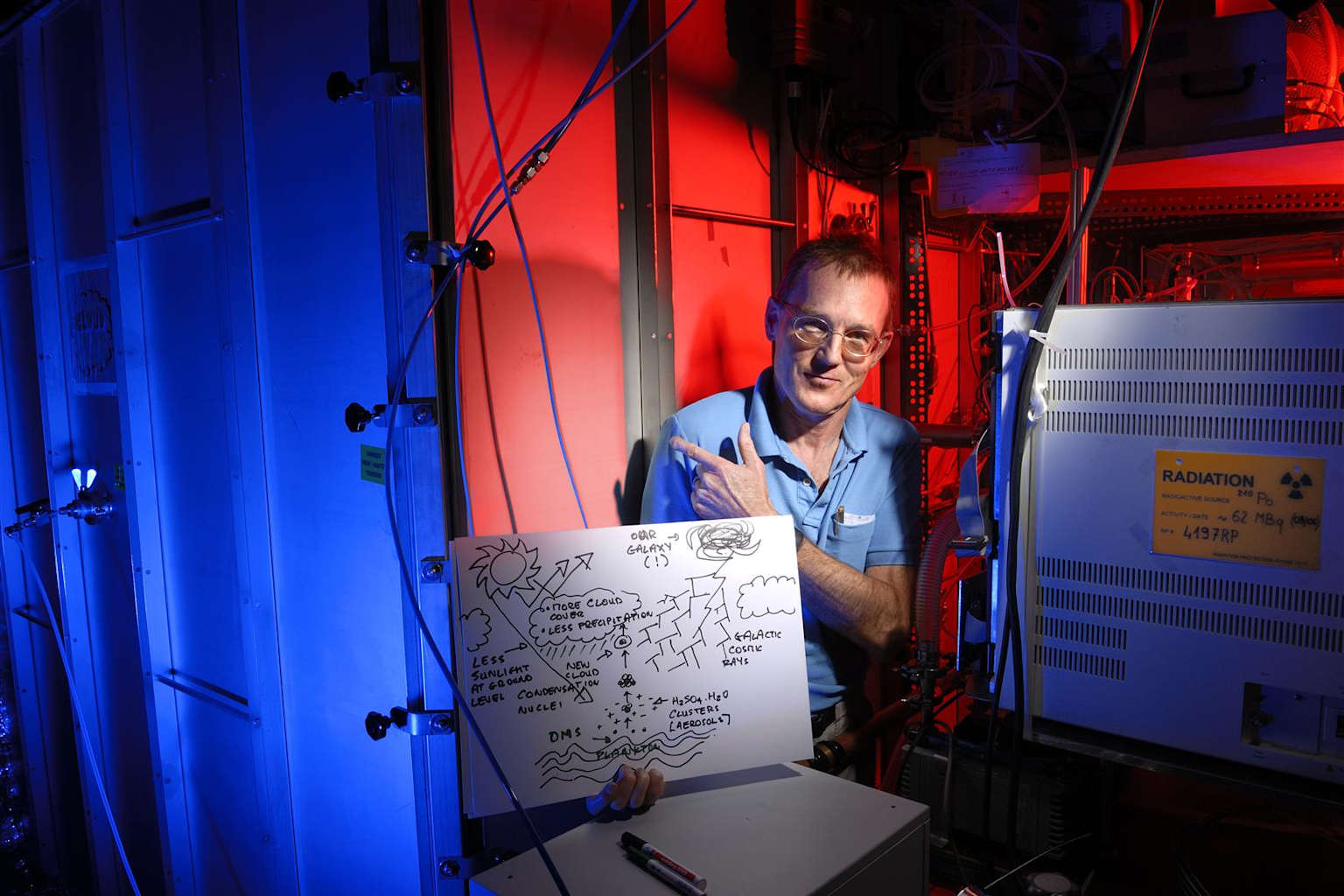
phys+1arxiv+1phys+1Physicists working with CERN's Large Hadron Collider have produced the first laboratory measurements of cosmic ray collisions with atmospheric gases, offering a new window into the particle showers that constantly bombard Earth. The results, published in Physical Review Letters, are an order of magnitude more precise than existing computer models and could reshape how scientists study the highest-energy events in the universe.journals.aps+1
On July 1, 2025, scientists at CERN introduced oxygen beams into the Large Hadron Collider for the first time and collided them with protons at a center-of-mass energy of 9.62 TeV. The proton beam acted as a stand-in for cosmic rays — fast-moving nuclei, mostly hydrogen, that stream through the universe from exploding stars and supermassive black holes — while the oxygen beam represented Earth's atmosphere. The collisions recreated the first moments of what researchers call "cosmic rainstorms," the cascades of particles triggered when cosmic rays strike atmospheric atoms.phys+1
The ATLAS experiment, a detector the size of a football field staffed by thousands of scientists, captured millions of close-up images of the resulting particle sprays using a 100-million-pixel camera capable of recording up to 40 million collisions per second. Researchers analyzed 246 million selected events to measure the number, energies, and angles of particles produced, achieving precision more than ten times greater than differences between competing hadronic-interaction models.arxiv+1
The study was led by physicist Jesse Liu, now at New York University, who spent years collaborating with physicist Lydia Beresford to make the case for reconfiguring existing CERN instruments to study cosmic rays. According to an NYU news release, the results "help decipher the origins of interstellar particles from the cosmos" and represent the first measurements of cosmic rainstorms recreated in controlled laboratory conditions.phys+1
The measurements include a fiducial proton-oxygen cross section and an extrapolated inelastic proton-air cross section, data that will help scientists determine the composition of high-energy cosmic rays — specifically, how many are hydrogen nuclei versus heavier atoms. Understanding that composition could provide clues about where cosmic rays originate and how they reach extreme energies, questions that have persisted since Victor Hess first discovered cosmic rays from a hot-air balloon more than a century ago.arxiv+1
The study renews links between particle physics and high-energy astrophysics, two fields with shared history but limited collaboration. As ATLAS noted in an official briefing, the results "establish a novel way to use the LHC as a cosmic-ray laboratory, opening the path for detailed experimental studies of proton-oxygen interactions". Those improved models will be valuable for large-scale cosmic ray observatories like the Telescope Array project in Utah, which currently rely on simulations that disagree with one another to interpret data from the highest-energy particles arriving from the cosmos.atlas-public.cern+1


