


Newsletter Subscribe
Enter your email address below and subscribe to our newsletter
[forminator_form id="25163"]

All voices matter
cnbcreutersunited24media+2Governments and defense contractors are racing to deploy autonomous underwater vehicles across the world's ocean floors, as a series of Russian provocations and cable sabotage incidents has turned seabed surveillance into one of the fastest-growing segments in defense technology.
CNBC reported on September 19 that the contest to protect critical undersea infrastructure is accelerating, with more than 1.5 million kilometers of submarine communications cables now in service globally. NATO Secretary General Mark Rutte has said that over 95 percent of international internet traffic travels through undersea cables, carrying an estimated $10 trillion in financial transactions daily. That infrastructure, along with oil and gas pipelines, subsea power links, and offshore wind connections, has become a prime target for hybrid warfare.startupfortune+1
The urgency sharpened this spring when Britain, Norway, and the United States disrupted a covert Russian operation near the Svalbard archipelago. Reuters reported on September 10 that vessels linked to Moscow's GUGI deep-sea directorate were rehearsing the use of technology designed to disable cables without leaving an obvious trace. Allied forces tracked and confronted the Russian vessels, which were prevented from completing the exercise and eventually withdrew. No cables were damaged.reuters+1
German defense-tech firm Euroatlas has emerged as an early mover, securing contracts worth more than $116 million from two unnamed European governments for its Greyshark autonomous underwater vehicle, which is designed for cable monitoring, mine detection, and reconnaissance. The Greyshark carries 17 integrated sensors and can operate without continuous human control, while a larger variant called Foxtrot uses hydrogen fuel cells for underwater endurance of up to 16 weeks.cnbc+3
France's Thales is approaching the market from a different angle, leveraging existing businesses in sonar, anti-submarine warfare, and autonomous underwater systems to offer navies a fuller technology stack. Italy's Fincantieri is developing its DEEP system, which can deploy swarms of autonomous drones once a threat is detected.euronews+1
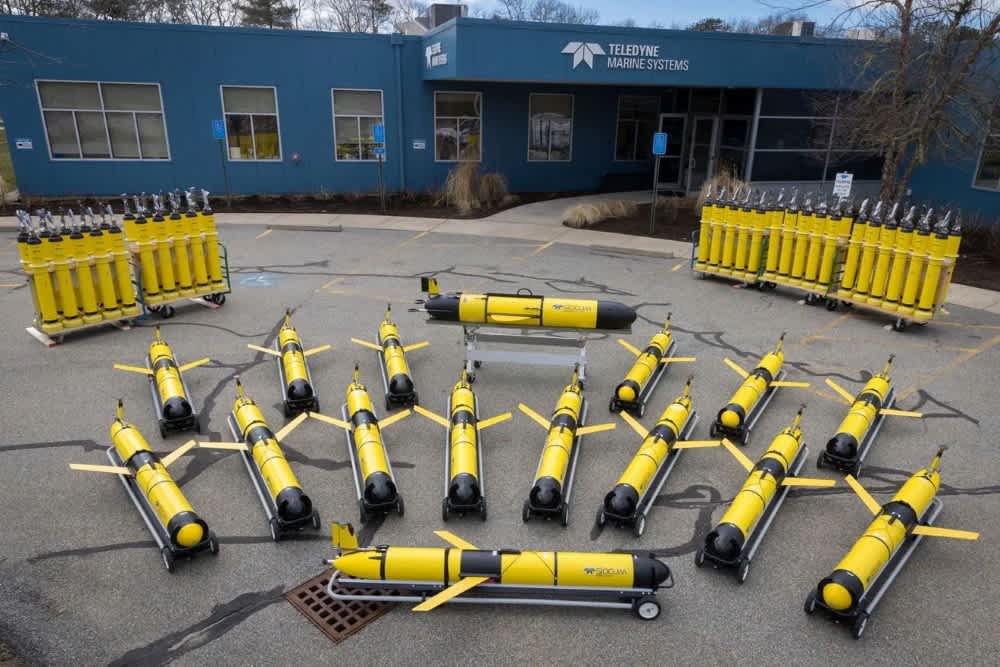
NATO launched Baltic Sentry in January 2025 after suspected sabotage incidents in the Baltic Sea, and followed with Arctic Sentry in February 2026 to bolster security in the Arctic and High North. Under the AUKUS alliance, the United States, United Kingdom, and Australia announced in May 2026 that they would jointly develop underwater drone technology to protect undersea cables. The Royal Navy completed a record 64-day ocean glider deployment in September 2026, its longest autonomous underwater operation to date, using five Slocum G3 gliders to collect oceanographic data around the British Isles.bbc+4
Katja Bego, a senior research fellow at Chatham House, told CNBC that no one listening to NATO officials would argue the alliance can protect a network stretching over a million kilometers. The drones cannot guard every meter of cable — but they can, as the industry sees it, make the seabed a less comfortable place for adversaries to operate undetected.startupfortune


