Newsletter Subscribe
Enter your email address below and subscribe to our newsletter
[forminator_form id="25163"]

All voices matter
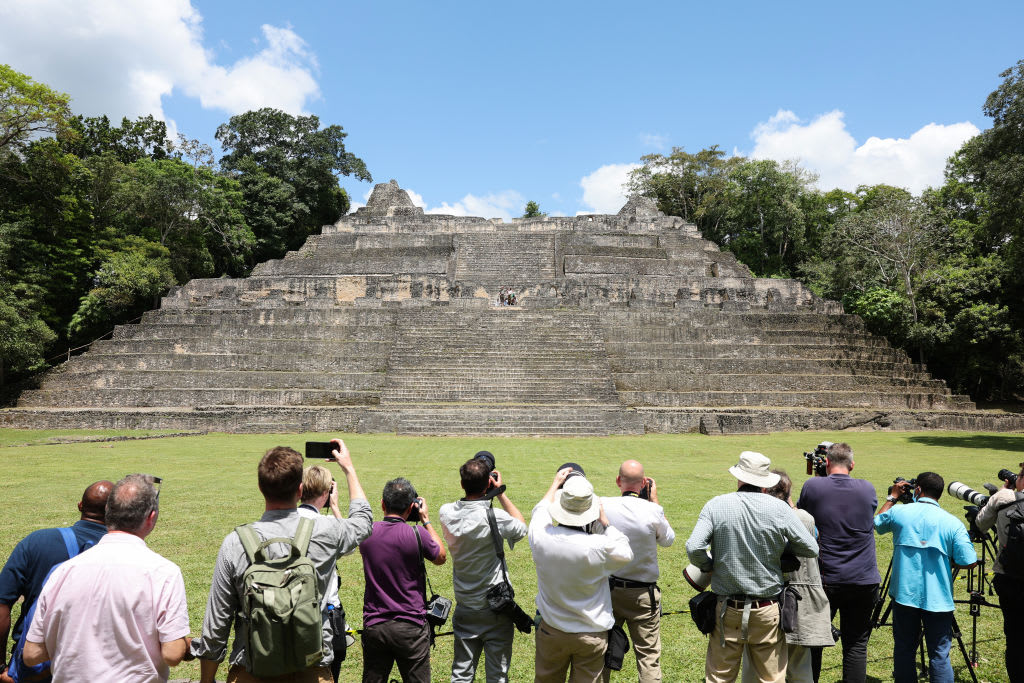
iflscience+2.iflscience+2.iflscience+2.iflscience+1.arkeonews+1.Archaeologists from the University of Houston have made a groundbreaking discovery in Belize, unearthing the 1,600-year-old tomb of Te K'ab Chaak, the first ruler of the ancient Maya city of Caracol and founder of its royal dynasty, complete with elaborate artifacts including jade jewelry, pottery vessels, carved bones, and a mosaic death mask.
Te K'ab Chaak, whose name translates to "Tree Branch Rain God" (though some scholars suggest "Tree-Armed Chaak" might be more accurate), established a powerful royal lineage that would endure for over 460 years after his ascension to the throne in 331 CE. His significance to Caracol's history is underscored by the fact that he continued to be referenced in Late Classic texts hundreds of years after his reign, strongly suggesting his status as the dynasty's founder. The royal succession he initiated included at least fourteen identifiable rulers spanning from the early fourth to early ninth centuries CE, with the last known ruler (designated as "Ruler XIII") presumed to have reigned around 859 CE.wikipedia+2
During its peak around 650 CE, nearly three centuries after Te K'ab Chaak's rule, Caracol had grown into a dominant Maya polity housing approximately 100,000 people. The city's influence reached its zenith when Caracol forces defeated the powerful city of Tikal in Guatemala in 562 CE, cementing its regional supremacy. This remarkable legacy of political and military power all traces back to the dynasty's founder, whose tomb discovery provides crucial insights into the origins of one of the Maya civilization's most significant royal lineages.livescience+1
The jade mosaic death mask discovered in Te K'ab Chaak's tomb represents a masterpiece of Maya funerary art, following a tradition reserved for royalty. Composed of dozens of carefully fitted jade pieces, the mask was found fragmented but is being painstakingly reconstructed by archaeologists. For the Maya, jade held profound significance as a symbol of birth, vitality, fertility, and eternal life, making it the perfect material to transform a deceased ruler into a divine being in the afterlife.wikipedia+2
Maya jade death masks, like the famous example of K'inich Janaab' Pakal of Palenque, were crafted with remarkable skill. Pakal's mask, made from over 346 green jade fragments with shell and obsidian eyes, demonstrates the artistic heights of this tradition. These intricate mosaics not only preserved the ruler's likeness but served a spiritual purpose—conferring "a sort of eternal life that his human body did not possess" and facilitating the deceased's transformation into a deity. The discovery of Te K'ab Chaak's mask adds another significant example to this royal Maya tradition that connected the physical world to the cosmos.artsq+1
The Northeast Acropolis at Caracol has been a focal point of archaeological investigation since the 1990s, with excavations revealing crucial information about the site's earliest periods. In 1996, archaeologists discovered a Preclassic shrine dating to approximately 100 BC in front of Structure B34, demonstrating the area's ancient origins. Recent excavations have proven particularly significant, as Te K'ab Chaak's tomb was found beneath a royal shrine in this complex, establishing it as a location of profound ceremonial importance from Caracol's founding period.caracol+3
The tomb's discovery is part of a broader pattern of important finds in the Northeast Acropolis. Archaeological investigations show that Te K'ab Chaak's burial was the first of three major royal interments in this location, suggesting the area maintained its sacred status throughout generations. Between 2009 and 2017, the Caracol Archaeological Project conducted deep excavations here, uncovering a series of early caches that further illuminate the site's developmental history. This sustained research has transformed our understanding of Caracol's origins, with the Northeast Acropolis emerging as a crucial nexus of royal power and ritual activity spanning over a millennium of Maya civilization.livescience+1