Newsletter Subscribe
Enter your email address below and subscribe to our newsletter
[forminator_form id="25163"]

All voices matter
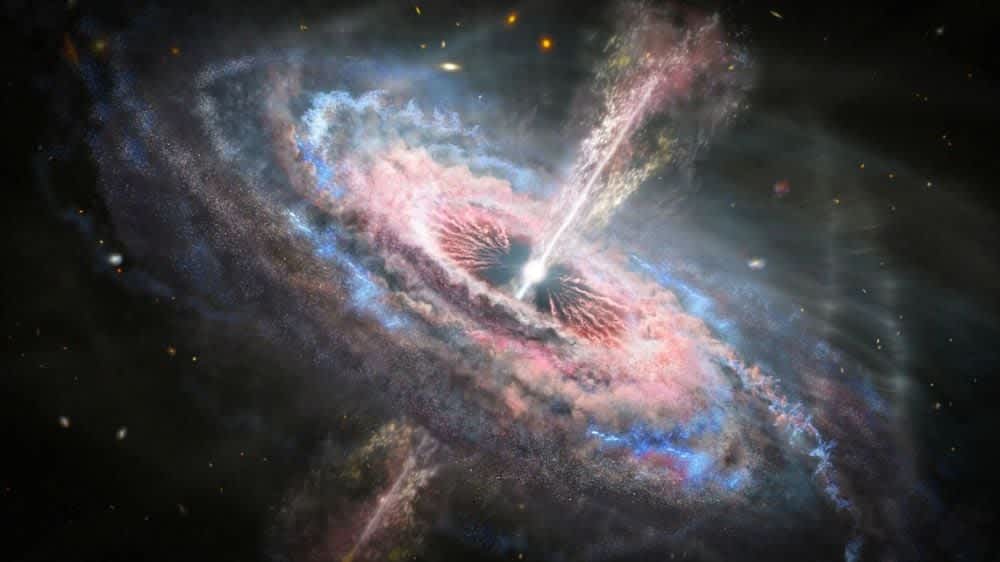
phys+1cfa.harvard+1starlustA study published September 15 in The Astrophysical Journal has found that actively feeding supermassive black holes may contribute to star formation in their host galaxies rather than suppress it, challenging a widely held view of how galaxies evolve.
Researchers led by Peixin Zhu, a graduate student at the Center for Astrophysics | Harvard & Smithsonian, surveyed nine nearby galaxies using the Multi Unit Spectroscopic Explorer (MUSE) instrument on the European Southern Observatory's Very Large Telescope. Across all nine galaxies, the team identified star-forming rings at distances of roughly 0.8 to 6 kiloparsecs from the galactic center, along with cone-shaped regions of ionized gas and fast shock waves produced when energy outflows from the black hole collide with surrounding gasphys+1.
The study used a new three-dimensional diagnostic technique to separate three distinct phenomena: star formation, radiation from the active black hole, and excitation by shocks. One consistent finding stood out across the entire sample.
"The most interesting phenomenon about shocks is that they always go perpendicular to where the black hole's injected outflows go," Zhu said. "It is very common, and we see it consistently appearing across all nine galaxies."phys
The team's interpretation was independently supported by observations from NASA's Chandra X-ray Telescope.starlust+1
"We're seeing that black holes are not just consuming material at the centers of galaxies, but they're actively reshaping their surroundings," said Lisa Kewley, an astrophysicist and director of the Center for Astrophysics who advised Zhu on the research. "This work helps us understand a complex feedback cycle that plays an important role in galaxy evolution."cfa.harvard
The prevailing theory of AGN feedback holds that energy released by accreting supermassive black holes heats or expels gas from the surrounding galaxy, shutting down star formation. A separate study published in March found that quasars can suppress star formation in neighboring galaxies millions of light-years away. But the new findings suggest the relationship is more nuanced, with the black hole's activity simultaneously driving outflows and fostering conditions for new stars to form.sciencedaily
"Once we resolved them, we could see that they not only accrete things, but they also eject things," Zhu said. "The injection and accretion are linked with each other."phys
The results, built on theoretical models developed by Zhu with Kewley and Ralph Sutherland of the Australian National University, demonstrate that actively growing black holes engage in a complex cycle of accretion, outflow, and interaction with their host galaxies — one that standard methods alone may not fully capture.arxiv+1