Newsletter Subscribe
Enter your email address below and subscribe to our newsletter
[forminator_form id="25163"]

All voices matter
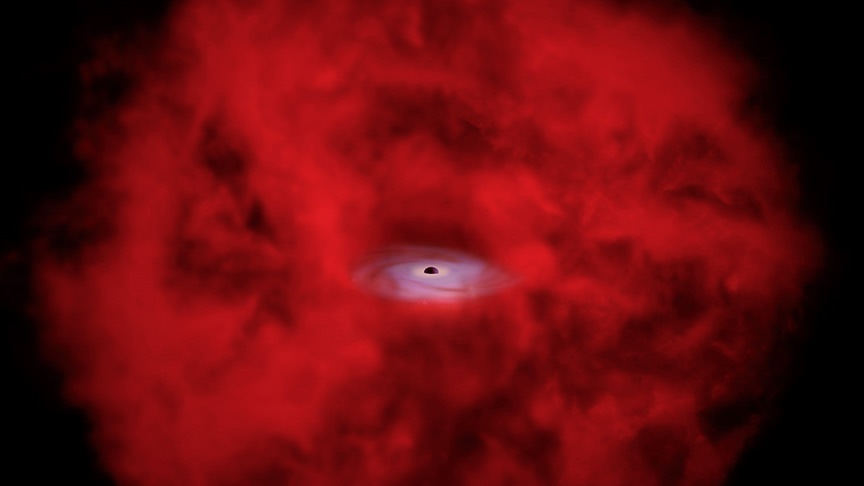
nytimesnature+1skyatnightmagazineA wave of new research is converging on an answer to one of the James Webb Space Telescope's most tantalizing puzzles: the nature of mysterious "little red dots" scattered across the early universe. Multiple studies published this year now point to these compact, red-hued objects as young supermassive black holes wrapped in dense cocoons of gas, offering a window into how the universe's most massive objects first took shape.
Little red dots — so named because they often appear as single red pixels in JWST images — were first identified in early telescope campaigns beginning in 2023. Hundreds have since been cataloged, all dating to the universe's first one to two billion years after the Big Bang. Their spectral signatures show broad emission lines characteristic of active galactic nuclei, regions where gas spirals around supermassive black holes.skyatnightmagazine+2
A landmark study published in Nature in January 2026 by researchers at the University of Copenhagen's Cosmic Dawn Centre argued that the dots are young black holes "a hundred times less massive than previously believed, enshrouded in a cocoon of gas, which they are consuming in order to grow larger". The team found that electron scattering within dense ionized gas — rather than the high-speed orbital motion of matter — was responsible for broadening the spectral lines, meaning earlier estimates of black hole mass had been inflated.nature+2
Since then, the evidence has only mounted. In August, a team led by Xuheng Ding and Yiyang Zhang combined JWST NIRCam images of 217 little red dots and detected faint extended emission around the central objects, revealing compact star-forming galaxies with average masses of about one billion times that of the Sun. That same month, MIT-led researchers reported the discovery of a "black hole star" — a dense gas cloud powered by a central black hole — that matched the profile of a little red dot.techno-science+2
A Nature study published on Wednesday by Sunmyon Chon of the Max Planck Institute for Astrophysics presents simulations showing that massive black holes can naturally emerge from turbulent material flows in the early universe, and that their light emissions closely resemble the observed little red dots.nytimes
Pierluigi Rinaldi of the Space Telescope Science Institute, who discovered an early-universe object called the Virgil Galaxy, noted that some little red dots contain black holes visible only in mid-infrared wavelengths — hidden engines that may regulate how their host galaxies evolve. Whether these objects grew through exotic pathways such as "quasi-stars" or through more conventional accretion remains an open question.scienmag+1
"After four years, JWST has delivered great results, but there's a hidden part of the Universe we can only access with mid-infrared observations," Rinaldi said.skyatnightmagazine