Newsletter Subscribe
Enter your email address below and subscribe to our newsletter
[forminator_form id="25163"]

All voices matter
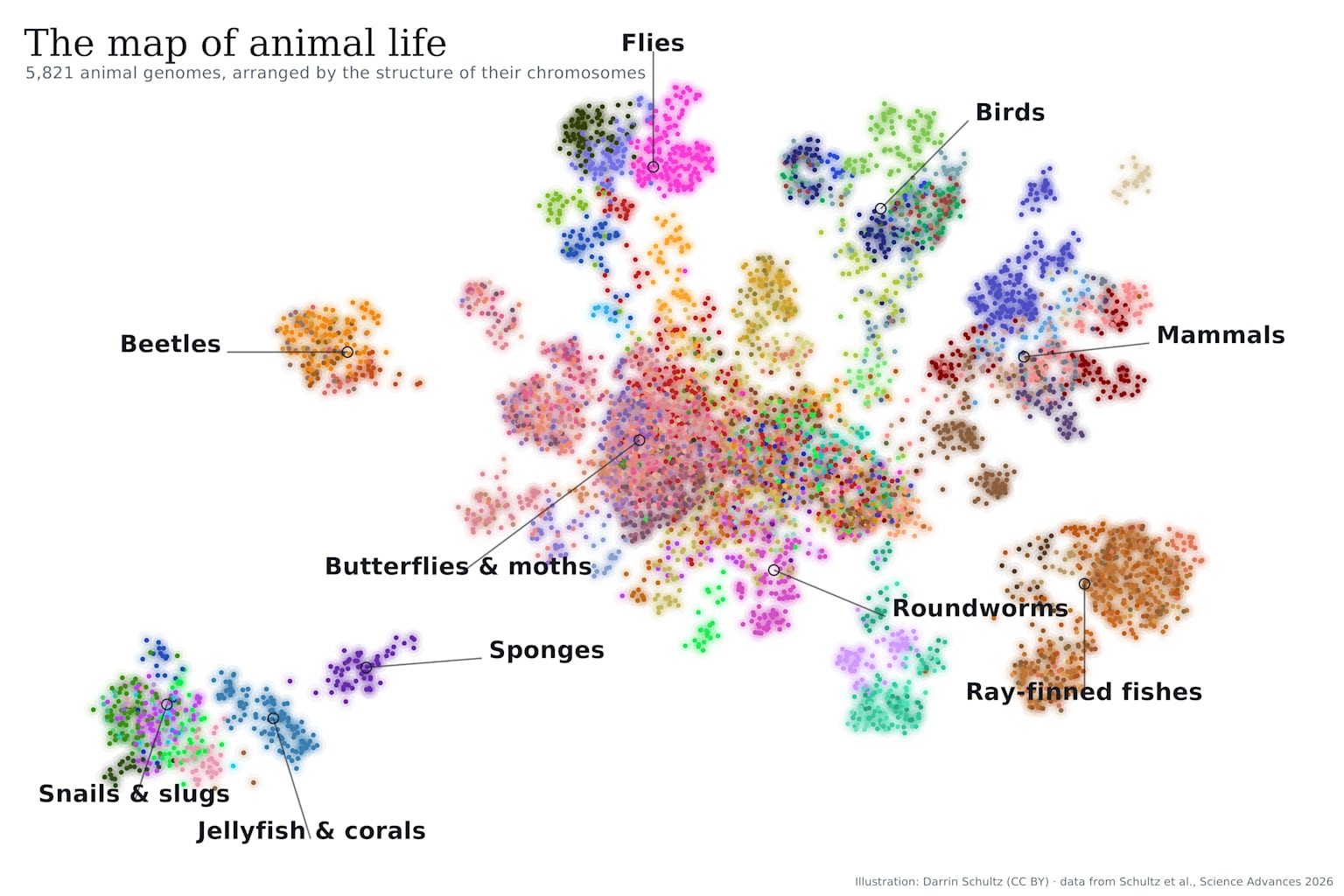
univie+1sflorgunivieResearchers at the University of Vienna have produced the largest-ever comparison of chromosome-scale animal genomes, revealing that the evolution of animal DNA architecture follows a limited set of one-way "evolutionary highways" rather than changing at random. The study, published on August 19 in Science Advances, introduces a framework called evolutionary genome topology that projects the structural diversity of 5,821 genomes from 4,454 species across 19 animal phyla onto a single map.univie+1
All living animals descend from a common ancestor that existed more than 600 million years ago. Since then, chromosomes have fused, split, and rearranged — but until now, making sense of those changes across the full breadth of animal life was not feasible. The new study, led by Darrin Schultz and Oleg Simakov, overcame that barrier by working exclusively with chromosome-scale assemblies, which place every gene in order along complete chromosomes rather than offering the fragmented "draft" view typical of most sequenced genomes.sflorg+1
"For the first time, we can see thousands of genomes on a single map and trace the unique paths along which animals' DNA evolved," said Schultz, who conducted the work as a postdoctoral researcher in Vienna and is now an assistant professor at Lehigh University.univie+1
At the core of the findings is a process the team calls "fusion-with-mixing." When two ancestral chromosomes merge, their genes permanently intermingle in a way that cannot be undone. Because the process is irreversible, it acts as a reliable marker of shared ancestry and pushes major animal groups into distinct, non-overlapping regions of what the researchers term "genome-architecture space".sflorg+1
"Understanding these rules of evolution doesn't just tell us about the past," said Simakov. "It also lets us ask where genome evolution might go next and enables us to identify key measures for the conservation of animal biodiversity".univie
The framework flags lineages occupying unique, isolated positions on the map — groups such as glass sponges, mosquitoes, and earthworms whose genome architecture has no close parallel. Such evolutionarily distinctive organisms could be prioritized for deeper study or conservation efforts. The team also demonstrated that the topology can simulate possible future directions of genome evolution, offering a tool to explore how biodiversity may continue to shift.lifescience+1