Newsletter Subscribe
Enter your email address below and subscribe to our newsletter
[forminator_form id="25163"]

All voices matter
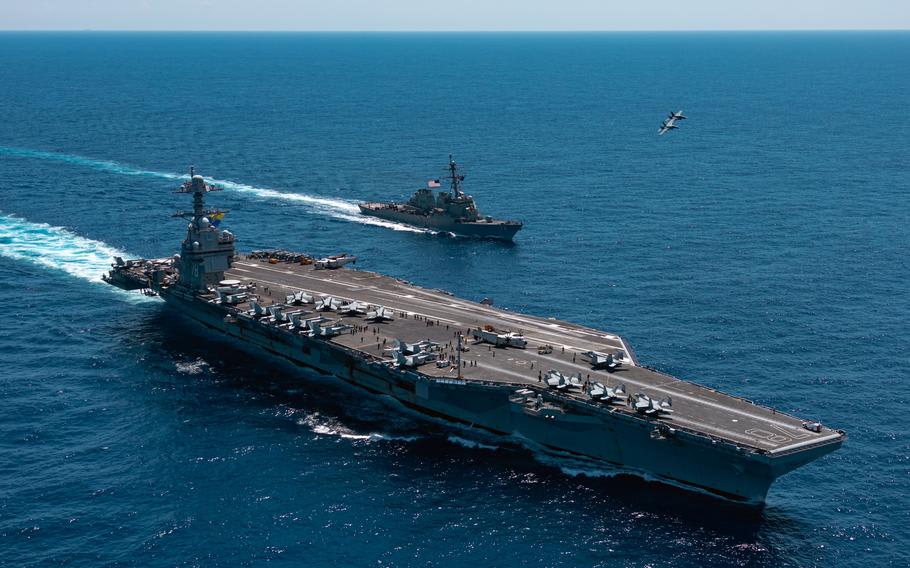
wsj.mediaite.wsj+1.The Pentagon is sending a third aircraft carrier strike group and more Marine Corps ships to the Middle East. The move will add 9,000 to 10,000 troops to the region as President Trump considers renewing strikes on Iran after the midterm elections, The Wall Street Journal News Corp reported Thursday, citing U.S. officials.wsj
The officials said the ships, fighter jets, Marines and sailors are expected to reach the region by the end of November. According to the Journal, Trump recently told aides he expects to resume bombing Iran that same month.politicalwire+1
The USS Theodore Roosevelt left its home port of San Diego on Sunday, Sept. 27, on a scheduled deployment. The USS Makin Island Amphibious Ready Group followed on Monday, Sept. 28. It is made up of three amphibious ships carrying Marines from the 13th Marine Expeditionary Unit.mediaite
Two carriers, the USS George H.W. Bush and the USS George Washington, are already in the Middle East. If the Washington stays once the Roosevelt arrives, the region will have three carrier strike groups for the first time since April. The Journal also reported that the Washington could instead go back to its home port in Japan, which would bring the force back down to two carriers. The Washington replaced the USS Abraham Lincoln in August after the Lincoln's long deployment.nypost+1
The New York Post reported that the Pentagon stocked the Roosevelt for a long stay. It loaded extra food, hygiene products and other supplies after reports that sailors had suffered shortages when Iranian attacks disrupted supply routes, including a key port in Bahrain. The White House and Pentagon did not respond to the Journal's requests for comment.mediaite+1
The buildup comes as diplomacy has stalled. Axios reported Tuesday, Sept. 29, that Secretary of State Marco Rubio had asked Iran's delegation to leave the United States before its scheduled departure date, after talks on the sidelines of the United Nations General Assembly made no progress. Axios reporter Barak Ravid wrote that Rubio's move "was a highly unusual diplomatic rebuke and laid bare the deep distrust between the two countries amid fruitless efforts to broker an end to the war".mediaite
In his U.N. speech, Trump said he faced a "big decision" about whether to "annihilate" Iran.mediaite
Fighting between the United States and Iran began on Feb. 28. A fragile ceasefire agreed in the spring temporarily stopped it, but that truce later collapsed, and the two sides have fought on and off since.mediaite