Newsletter Subscribe
Enter your email address below and subscribe to our newsletter
[forminator_form id="25163"]

All voices matter
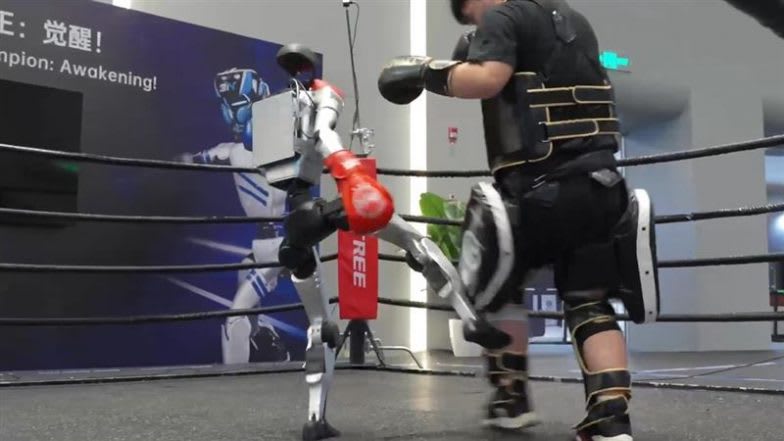
cryptobriefing+1cryptobriefing+1english.elpaisChinese robotics company Unitree Robotics on Monday demonstrated what it called the world's first fully autonomous humanoid robot powered by a real-time world model, releasing video of two robots sparring without any human control. The system, dubbed UnifoLM-X2-1.0, marks an attempt to move beyond the teleoperation and pre-scripted routines that still define most humanoid robots on the market.
In a post on X, Unitree said the UnifoLM-X2-1.0 "breaks through world-action foundation models' bottlenecks in instant planning, decision-making, and dynamic interactive execution." Rather than following scripted commands or relying on a remote operator, the robot uses a world model to predict how physical interactions will unfold — anticipating object movement, force dynamics, and the consequences of its own actions — then plans and executes movements in real time.cryptobriefing+1
The accompanying video showed two humanoid robots punching, kicking, and sparring autonomously, a demonstration Unitree framed as "combat-level autonomy." The company said the breakthrough "validates the fundamental feasibility of large-scale deployment of world model-driven humanoid robots."roboticgizmos+2
The announcement builds on Unitree's open-source UnifoLM-WMA-0 framework, released in September 2025, which laid the groundwork for improved robotic decision-making. The X2-1.0 model represents the production-grade evolution of that earlier research.cryptobriefing
Unitree, founded in 2016 by Wang Xingxing in Hangzhou, has moved rapidly from quadruped robots to humanoids. The company went public on the Shanghai STAR Market on August 19, 2026, in a debut that saw shares surge more than 600 percent on the first day of trading, according to France 24. The IPO raised roughly $905 million and was oversubscribed by a factor of 8,000 among retail investors.english.elpais+2
As of mid-2026, Unitree had shipped more than 18,000 humanoid units, with its G1 models priced between $16,000 and $18,000 — far below competitors like Boston Dynamics Hyundai Motor Company or Figure AI. Still, nearly three-quarters of sales go to universities and research institutions, with only about 9 percent reaching industrial settings, according to El País.cryptobriefing+1
Wang has pointed to education, entertainment, and industrial automation as primary targets for the technology. But he has also tempered expectations, telling Time that the "ChatGPT moment" for humanoid robots — the kind of breakthrough that could transform the industry — remains at least two to three years away in the best case and perhaps a decade off in the worst.pandaily.com+2
"It won't happen overnight," Wang said.english.elpais