Newsletter Subscribe
Enter your email address below and subscribe to our newsletter
[forminator_form id="25163"]

All voices matter
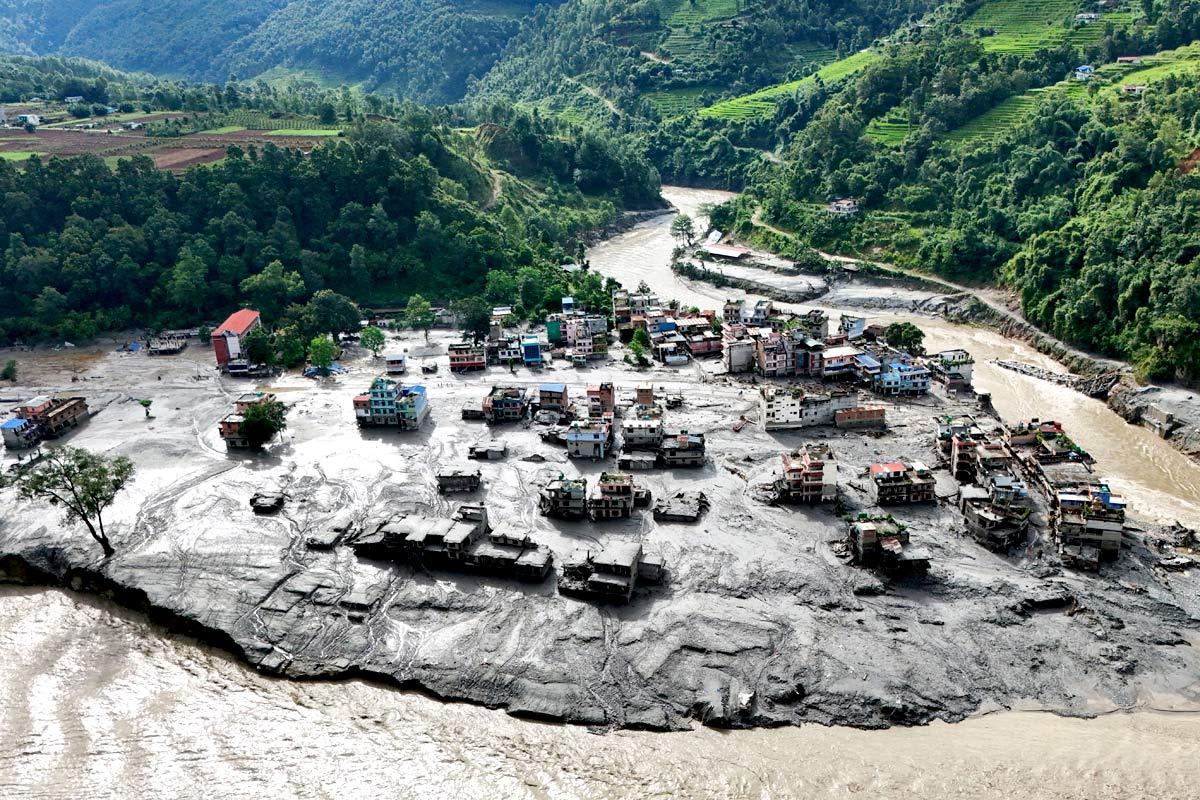
reuters+1independent+1reuters+1Nepal and China issued urgent flood warnings on Thursday as two newly formed barrier lakes on either side of their Himalayan border threatened to burst, raising the prospect of a second catastrophe in a region still reeling from flash flooding that killed more than 350 people a day earlier.
Nepal's National Disaster Risk Reduction and Management Authority warned that a lake formed by debris blocking the Bhote Koshi River at the flood site was rising and at risk of bursting, urging "residents of the lower banks… passengers, rescuers engaged in rescue operations, and all concerned to exercise special caution and stay in safe places away from the river banks and risky areas."reuters
On the Chinese side, authorities warned that 3 million cubic meters of water — equivalent to about 1,200 Olympic swimming pools — were expected to flow into an already dammed lake over the next three days, creating a high risk of a breach with peak flow expected around September 1.reuters
"The volume of water is continuing to increase, and so is the risk," Zhu Jinfeng, a researcher at the Chinese water resources ministry's hydrology department, told state broadcaster CCTV.reuters
The fresh warnings have complicated rescue efforts, with heeding the threat, some teams in Nepal began moving toward higher ground on Thursday. Pawan Koirala, leading a 13-person rescue team, told Reuters: "We are here for rescue and don't want to be near the danger zone."reuters
More than 910 people remain unaccounted for, including over 500 foreign nationals. India had the highest number of missing foreigners at 178, while 33 British tourists and 54 Americans were among those still missing or confirmed dead.nypost+1
Wednesday's flash flood, which both countries have attributed to a glacier collapse that pushed rock, ice, mud and debris into river systems, devastated the Rasuwa, Nuwakot and Dhading districts. Entire villages were swept away, more than three dozen bridges destroyed, and a dozen hydropower dams wrecked.dw
Nepal's Minister for Information and Communication Bikram Timilsina told DW: "I don't think our state mechanism had ever imagined a flood and disaster of such magnitude."dw
Climate scientist Sudip Thakuri of Tribhuvan University said preliminary assessments indicated the flood was likely triggered by a massive avalanche that blocked a river, and when the resulting dam burst, it may have also swept away a subglacial lake downstream, triggering the catastrophic flooding.dw
Scientists warned that climate change is making such events more likely. Benjamin Horton, dean of the School of Energy and Environment at the City University of Hong Kong, said the disaster could be a "compound event" where an earthquake interacts with climate-driven changes such as glacier loss and thawing permafrost to "create a more complex and damaging disaster than would occur from any one factor alone."independent
Rainfall forecast over the coming week is expected to exacerbate the threat from both barrier lakes, with Chinese meteorologists warning of possible floods, landslides and other secondary disasters in the days ahead.dw+1