Newsletter Subscribe
Enter your email address below and subscribe to our newsletter

All voices matter
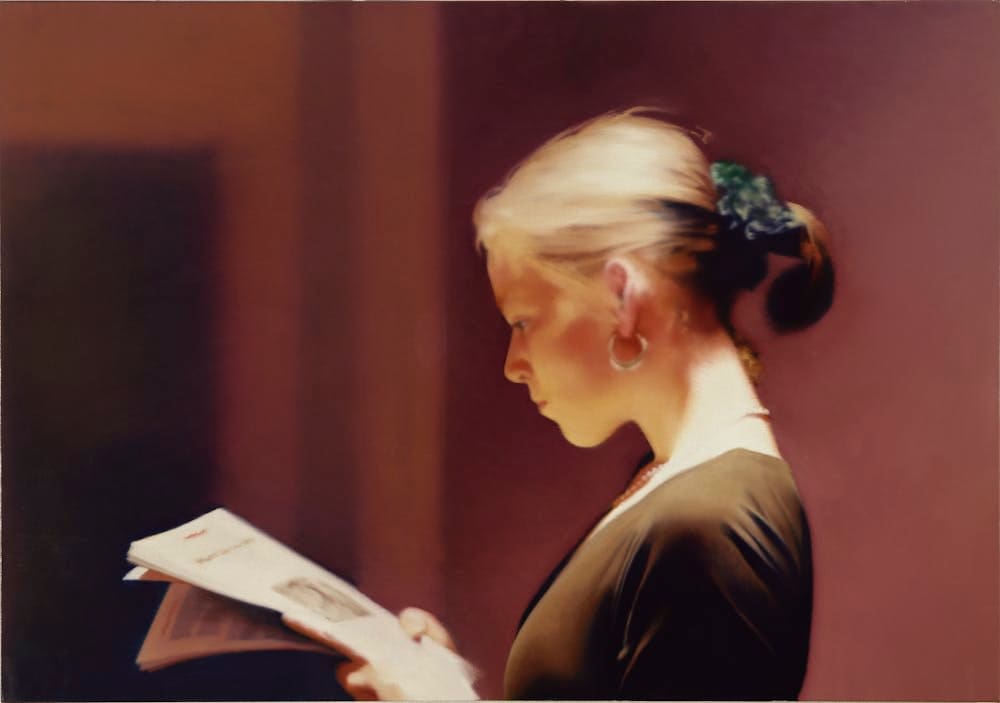
theartnewspaper+1.theartnewspaper.theartnewspaper.theartnewspaper.theartnewspaper.According to The Art Newspaper, a major retrospective of influential German artist Gerhard Richter will be presented at the Fondation Louis Vuitton in Paris from October 17, 2025 to March 2, 2026, featuring an exceptional collection of 270 works spanning his entire career from 1962 to 2024.
Richter's iconic blur technique begins with meticulously painting photorealistic images before transforming them with his distinctive softening effect. He first projects photographs onto canvas, traces them in pencil, and fills them with paint to create a "sharp" image. While the paint remains wet, Richter drags a dry brush or squeegee horizontally across the surface with varying pressure, creating his hallmark blur that mimics out-of-focus photography. This technique isn't merely aesthetic—it serves a philosophical purpose, as Richter himself explained: "I blur to make everything equal, everything equally important and equally unimportant."grin+4
The blur effect functions on multiple levels, simultaneously emphasizing the painting's identity as a constructed image while creating distance between viewer and subject. By introducing another layer of depiction—essentially creating "the depiction of a depiction"—Richter places the subject further from both artist and audience. This deliberate distancing reflects his skepticism toward definitive interpretations and highlights the limitations of representation itself. The technique transforms familiar subjects into something simultaneously intimate yet unreachable, compelling viewers to question the relationship between photography, painting, and our perception of reality.am556855948.wordpress+2
Richter's fifteen-part painting cycle "October 18, 1977," created in 1988, stands as one of his most significant and politically charged works. The series depicts members of the Red Army Faction (RAF), also known as the Baader-Meinhof Group, who were found dead in their cells at Stuttgart-Stammheim prison on the date that gives the work its title. Working from press photographs, Richter transformed these images into somber, blurred grey paintings that capture the deaths of Andreas Baader, Gudrun Ensslin, and Jan-Carl Raspe—events that profoundly shook West Germany during what was called the "German Autumn."smb+2
The series deliberately employs ambiguity through its grey monochrome palette and characteristic blur technique, creating what scholar Frances Guerin calls a "grey space between" that invites viewers into an active relationship with difficult historical material. Rather than providing clear answers about these controversial deaths, the paintings function as a form of witnessing that revives repressed collective trauma. Richter's titles for individual works—such as "Arrest," "Confrontation," and "Hanged"—introduce further uncertainty, compelling viewers to question official narratives about these events and consider Germany's broader post-war history. Created just before German reunification, the series serves as a powerful reminder of unresolved historical wounds at a time when such reflections were largely absent from public discourse.blogs.ncl+1
Richter's "4900 Colours" represents a fascinating exploration of chance and mathematical precision in art. Created in 2007 alongside his commission for Cologne Cathedral's south transept window, the work consists of 196 square panels, each containing 25 colored squares arranged in grid formations. The installation's brilliance lies in its versatility—it can be configured in 11 different variations, ranging from a single expansive piece to multiple smaller paintings. For the Serpentine Gallery exhibition in 2008, Richter developed "Version II," comprising 49 paintings measuring 97×97 centimeters each.serpentinegalleries+3
What makes "4900 Colours" particularly remarkable is its method of composition. Richter employed a specially developed computer program to generate seemingly random color arrangements, removing subjective artistic preferences from the process—a technique that connects to his earlier color chart paintings from 1966. This calculated coincidence approach has drawn comparisons to John Cage's composition methods and Donald Judd's Minimalism. The work's enamel-on-aluminum panels feature bright monochrome squares that create stunning kaleidoscopic effects, continuing Richter's career-long quest to "desubjectivize" painting by eliminating hierarchy between colors and challenging traditional notions of artistic expression.artmagazine+5