Newsletter Subscribe
Enter your email address below and subscribe to our newsletter
[forminator_form id="25163"]

All voices matter
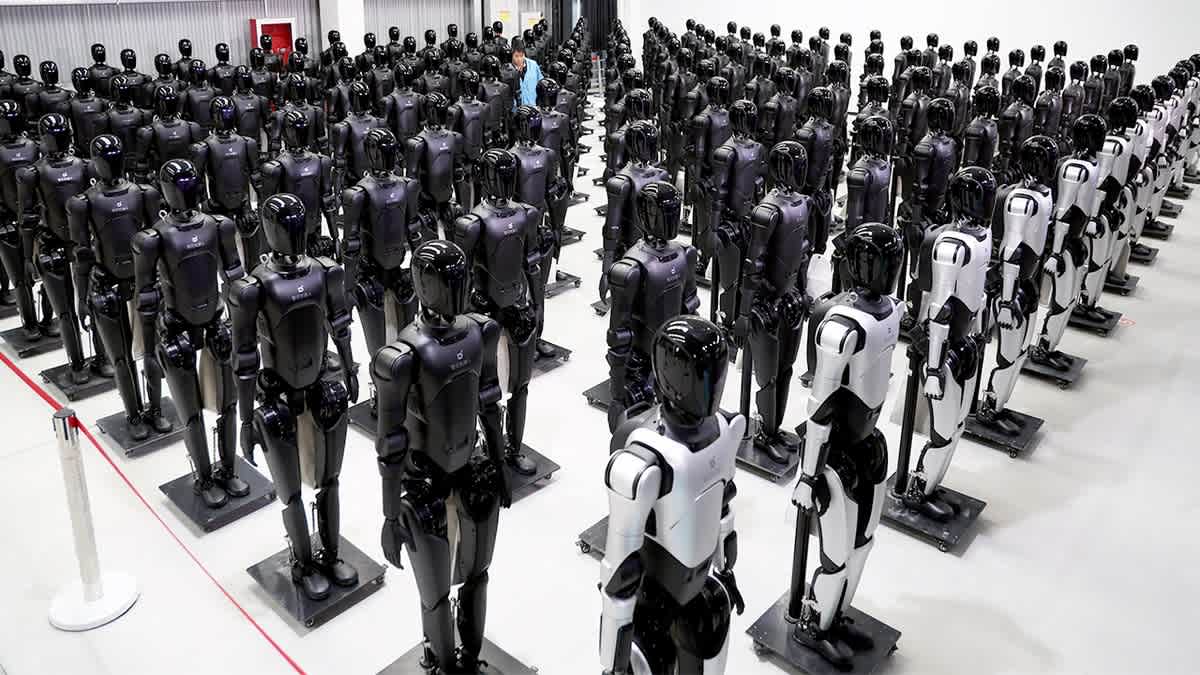
reutersreutersautonews.gasgoo+1More than 100 humanoid robots stand in neat rows inside a training center in Liuzhou, southern China, guided through simple tasks by human trainers wearing headsets. The machines are slow and awkward — a novice trainer might coax one usable movement from 300 attempts. The scene, described in a Reuters special report published Wednesday, captures the central tension in China's humanoid robot push: world-class hardware hobbled by insufficient artificial intelligence.reuters
China now dominates global humanoid production, accounting for 95% of the roughly 20,000 units shipped worldwide last year, according to BofA Global Research Bank of America Corporation . The country's Ministry of Industry and Information Technology expects output to exceed 100,000 units this year. Yet industry executives and researchers say the robots remain too unintelligent for general-purpose work, struggling with any situation requiring intuition or deviation from programmed routines.english.news+1
"The robots' IQ is too low," Tang Wenbin, co-founder and CEO of AI robotics venture Yuanli Lingji, said at a March industry panel. "A lot of what we see is dancing disguised as working."reuters
Data from Counterpoint Research shows that entertainment and performance account for 33.6% of humanoid shipments in the first half of 2026, with data production and research making up 27%. Smart manufacturing represents just 12.8%, and warehousing and logistics a mere 4.9%. At the Liuzhou training center, Reuters observed robots completing tasks at just 20% of human speed.autonews.gasgoo+1
Unitree founder Wang Xingxing offered a sober assessment at the 2026 World Robot Conference in Beijing: the "ChatGPT moment" for embodied intelligence remains two to three years away at minimum and could take a decade. The company listed on the STAR Market on August 19 at 150.80 yuan per share, with its stock surging 629% on debut — a sign that capital markets are pricing the technology aggressively against its current capabilities.autonews.gasgoo
China's approach follows the industrial-policy blueprint it deployed for electric vehicles and solar panels: subsidize early, build capacity, and drive down costs through competition. But unlike those mature industries, humanoids remain early-stage technology with unresolved problems in dexterity, reliability, and intelligence. Government entities spent at least $230 million buying humanoids and related items in the first half of 2026, up from $62 million a year earlier, according to procurement data reviewed by Reuters.reuters
In July, the Trump administration banned imports of new Chinese humanoids, citing threats to the U.S. AI industry. Kevin Xu of Interconnected Capital said some founders have characterized China's humanoid sector as a "bubble," adding: "There will 100% be a consolidation sooner or later. It's just a matter of who and how ugly."reuters
The core weakness is generalization — the ability to handle unfamiliar environments without retraining. UBTech won an $18 million government tender to supply the Liuzhou facility, which aims to sell robot-training data to factories. But three staffers acknowledged the subsidy-dependent project has no clear path to profitability.reuters
A staffer at the center said the robots might catch up to human performance in two to three years. For now, China's humanoid ambitions remain a gamble on a future that hasn't arrived.reuters