Newsletter Subscribe
Enter your email address below and subscribe to our newsletter
[forminator_form id="25163"]

All voices matter
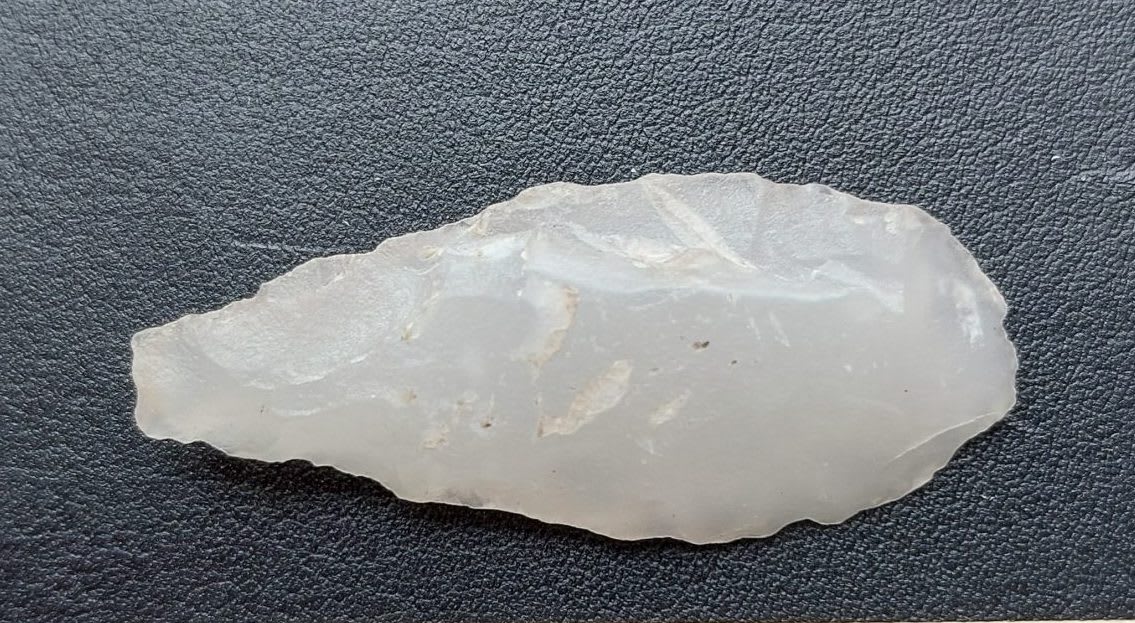
heritagedaily.heritagedaily.heritagedaily.heritagedaily.heritagedaily.Archaeologists from Arkeologerna have unearthed a remarkable crystal bifacial arrowhead crafted from pure white quartzite during excavations at the Hedkammen ridge near Skellefteå in northern Sweden, part of a larger discovery revealing over 300 archaeological features dating from 500 BC to the late Middle Ages.
Quartzite presents unique challenges and advantages for bifacial arrowhead production. Unlike more commonly used materials like flint, quartzite requires exceptional skill to work due to its crystalline structure, making the white quartzite arrowhead from Hedkammen even more remarkable. Bifacial technology involves shaping both sides of the tool through careful flaking, creating symmetrical pieces with sharp edges. The manufacturing process typically progresses through distinct phases: initial shaping with hard hammer percussion, advanced shaping with soft hammer techniques, and finishing—which for high-quality pieces like the Hedkammen artifact often involved pressure flaking to achieve the precise, parallel removal scars visible on finished points.youtube+1
The technical properties of quartzite bifacial points made them particularly effective hunting tools. These arrowheads typically feature a planoconvex or biconvex cross-section, with carefully crafted penetrating angles around 45-46° at the tip. The symmetrical, fusiform lanceolate shape of many quartzite points suggests they were designed for axial hafting onto wooden shafts. While quartzite is more difficult to work than other materials, its durability and availability in regions lacking flint made it a valuable resource for prehistoric toolmakers, who demonstrated remarkable adaptability by mastering the techniques required to transform this challenging material into lethal hunting implements.elfshotgallery.blogspot+2
The Hedkammen ridge, located south of Bureå near Skellefteå in northern Sweden, represents a significant archaeological landscape formed by melting ice sheet waters that deposited sand and gravel materials. This natural formation provided prehistoric communities with resources for constructing ancient burial mounds and served as a strategic settlement location. The ongoing excavation has uncovered approximately 300 archaeological features across 16,000 square meters, including hearths, cooking pits, stone clusters, and potential boat landing structures. Many of these features are positioned near what would have been natural harbors around 2,500 years ago, suggesting the site functioned as a coastal activity center.heritagedaily+1
The archaeological significance of Hedkammen has attracted public interest, with Skellefteå Museum organizing guided tours every Wednesday in July 2025, allowing visitors to witness the excavation process firsthand. The site is being thoroughly documented before construction of the Norrbotniabanan railway begins, making this a crucial rescue archaeology project. Among the approximately 150 artifacts recovered are worked stone materials, ceramic shards, charred bone, and imported materials like flint possibly originating from Denmark, indicating extensive trade networks during the Late Bronze or Early Iron Age.arkeonews+2
The white quartzite arrowhead discovered at Hedkammen offers insights into Bronze Age hunting practices in Scandinavia. During this period (c. 2000-500 BC), hunting remained an important subsistence activity even as bronze technology spread through the region. While bronze tools were primarily reserved for elites due to the need to import the material, stone implements like the quartzite arrowhead continued to form a crucial part of the everyday hunting toolkit. The exceptional craftsmanship of this particular arrowhead suggests it may have held special significance, possibly connected to the period's religious practices where sacrificial artifacts were often associated with water bodies and paired objects.lufolk+1
Bronze Age hunting techniques in northern Sweden included a diverse arsenal of methods. Individual hunting with bow and arrow was practiced but had limitations since elk could easily detect hunters' movements beyond arrow range. More effective were communal drives directing animals toward water or precipices, often depicted in rock art near suitable locations. Pitfall hunting also emerged during this period, with archaeological evidence showing increased intensity of pitfall use beginning around 1800 BC in the Bronze Age, though with regional variations across Sweden. These sophisticated hunting strategies reflect communities that maintained strong connections to their hunting traditions even as metallurgical innovations transformed other aspects of society.wikipedia+2