Newsletter Subscribe
Enter your email address below and subscribe to our newsletter
[forminator_form id="25163"]

All voices matter
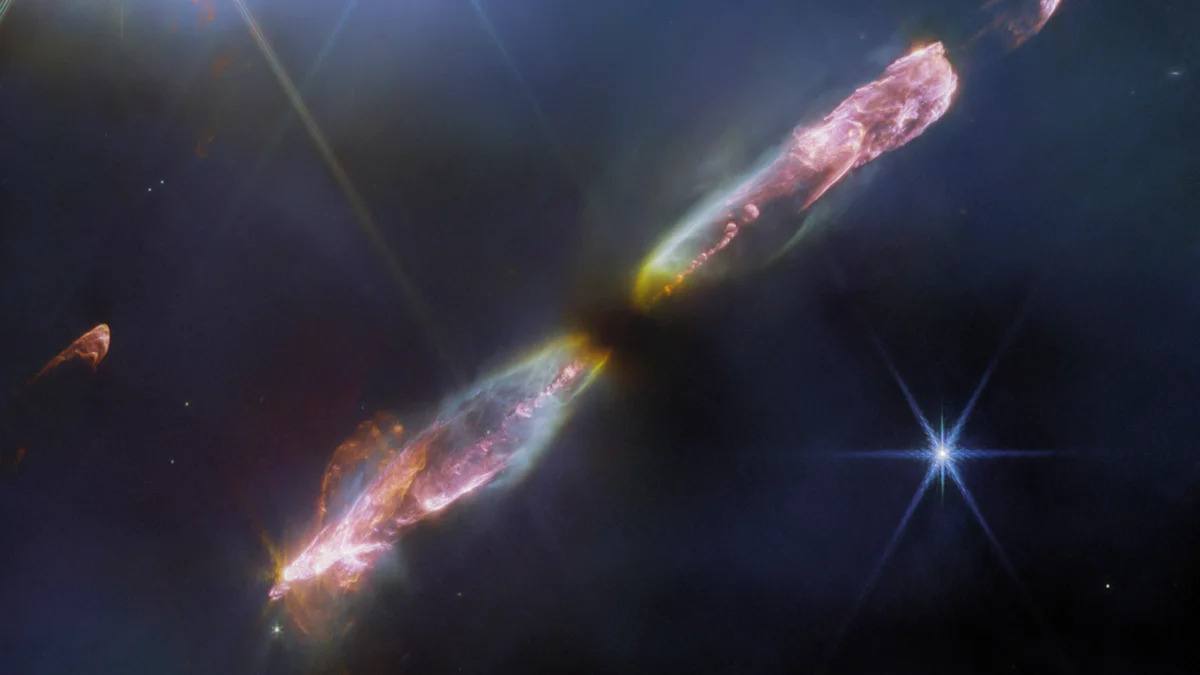
arxiv.org+1.tech.yahoo.com.arxiv.org.Astronomers using the James Webb Space Telescope have recorded the pure rotational spectrum of the trihydrogen cation, H3+, for the first time. The faint "forbidden" light had been predicted for four decades but had never been seen in a laboratory or in space, according to the team's paper. The signal came from HH 168, a Herbig-Haro object in the star-forming region Cepheus A West, about 700 parsecs away. The study has been accepted for publication in The Astrophysical Journal Letters.arxiv.org+1
H3+ is often called "the molecule that made the Universe" because it underpins nearly all gas-phase interstellar chemistry, including reactions that lead to complex organic molecules, ScienceAlert reported. Seeing its rotational lines gives astronomers a new way to measure ionization in shocked molecular gas, the authors wrote.tech.yahoo.com+1
The molecule's three hydrogen nuclei form an equilateral triangle. That shape leaves it with no permanent dipole moment, so it would not normally emit light as it rotates. In 1986, Fu-Shih Pan and Takeshi Oka of the University of Chicago calculated that centrifugal distortion would produce a tiny dipole and allow extremely weak "forbidden" transitions, ScienceAlert noted.tech.yahoo.com
The team was led by David Neufeld of Johns Hopkins University, with Joel Green and Paule Sonnentrucker of the Space Telescope Science Institute and Dan Watson of the University of Rochester. They used Webb's MIRI spectrometer to observe two fields in HH 168 on August 1, 2026, under program 7084, the paper states. They found 26 lines above 5 sigma, and the strongest, at 16.325 micrometers, reached 72 sigma, according to ScienceAlert and SSBCrack News.news.ssbcrack.com+2
The H3+ emission matched the velocity and spatial distribution of the hot shocked molecular hydrogen, not the ionized gas. Its level populations point to gas at roughly 2,000 kelvin or hotter, the researchers reported. The models only partly explain the signal. A nondissociative C-type shock model fit the hydrogen lines well but underpredicted H3+ by a factor of 5 to 6. A dissociative J-type model came within a factor of about 1.5, but it ran outside the shock code's validated range, according to the paper.arxiv.org
When the team checked archival Webb data, the same spectrum turned up in the bow shocks of HH 211, an outflow driven by a low-mass protostar. There, the 16.325-micrometer line was detected at 12 sigma at two locations, even though each band had only 200 seconds of exposure, the study says. The authors expect the lines to be detectable in other outflows with strong warm hydrogen emission and weak infrared irradiation. They added that better collision-rate data for H3+ will be needed before the lines can be used quantitatively.arxiv.org
"Pan and Oka have been right all this time – the thing lacking was the tool sensitive enough to confirm it," ScienceAlert's Michelle Starr wrote.tech.yahoo.com