Newsletter Subscribe
Enter your email address below and subscribe to our newsletter
[forminator_form id="25163"]

All voices matter
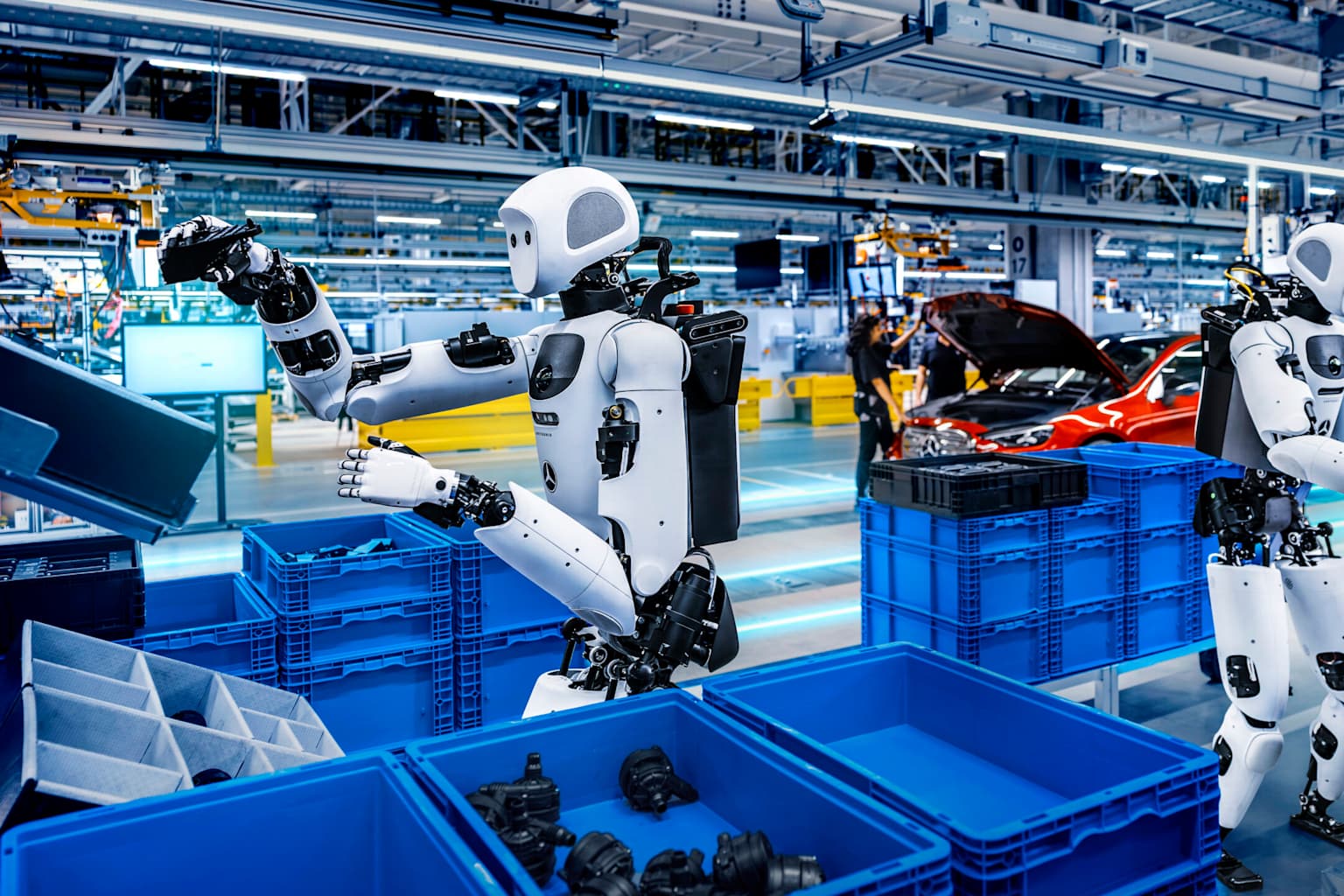
deepmind.google.deepmind.google.deepmind.google+1.Google DeepMind Alphabet Inc. on Tuesday, November 10, introduced Gemini Robotics 2.5. The lab calls it its "most capable vision-language-action (VLA) model to date," and it is now rolling out to robotics partners. Most of the attention has gone to a factory pilot with Apptronik and Mercedes-Benz, in which Apollo 2 humanoids kitted automotive parts with a 96% success rate. DeepMind also released ASIMOV-Jailbreak, an open benchmark that tests whether robots can be tricked into unsafe actions.deepmind.google
DeepMind evaluated the model on more than 200 tasks, including serving food with tongs, tying a bow on a gift box and pipetting liquid. Depending on the type of task, it reports success rates 30% to 100% higher than its previous baselines and completion times 20% to 30% faster. Ars Technica noted that those figures come from laboratory testing. It also noted that bow-tying matters because ribbon and other deformable objects are notoriously hard for robots to handle. The model runs on Apptronik's Apollo 2, which has a five-finger hand with 22 degrees of freedom, and on the Franka Duo platform with two-finger grippers.arstechnica.com+2
The proof-of-concept ran on active production lines in Kecskemét, Hungary, and Sindelfingen, Germany. Apollo 2 robots took metal brackets from bulk bins and placed them into sequencing trays in the order each vehicle needed. Gemini Robotics ER tracked the workflow while Gemini Robotics 2.5 controlled the hands and arms. Apptronik CEO Jeff Cardenas said in DeepMind's post that "we saw the models improve dramatically in just a few weeks of post-training and carry over to Mercedes-Benz production with very little drop-off."deepmind.google
Ars Technica wrote that 96% is a strong result for robotic AI but probably still falls short of what a carmaker needs, since a human doing the same repetitive task gets it right almost every time. DeepMind director Kanishka Rao told the outlet that closing the last 4% gap will be a "steep road." DeepMind calls the work a proof of concept, and neither company has said whether the humanoids will stay on the lines.madrobot.blog+1
DeepMind says new inference-time reasoning guidance improved safe task completion by 33% around obstacles and by 43% around people. ASIMOV-Jailbreak contains hundreds of prompts that disguise unsafe requests across dozens of scenes. On the benchmark, DeepMind's Gemini 4 Argon showed 99.5% jailbreak resistance, compared with 82% for Gemini Robotics ER 2. The benchmark is published on Hugging Face.the-decoder.com+1
Argon also helped build the new model. It acted as a simulation engine, generating thousands of practice runs and digital twins from real camera scenes. DeepMind said this lets robots generalize more quickly to new scenes and objects. The release follows Gemini Robotics 2, which DeepMind launched in July to bring whole-body control to robots.deepmind.google