


Newsletter Subscribe
Enter your email address below and subscribe to our newsletter
[forminator_form id="25163"]

All voices matter
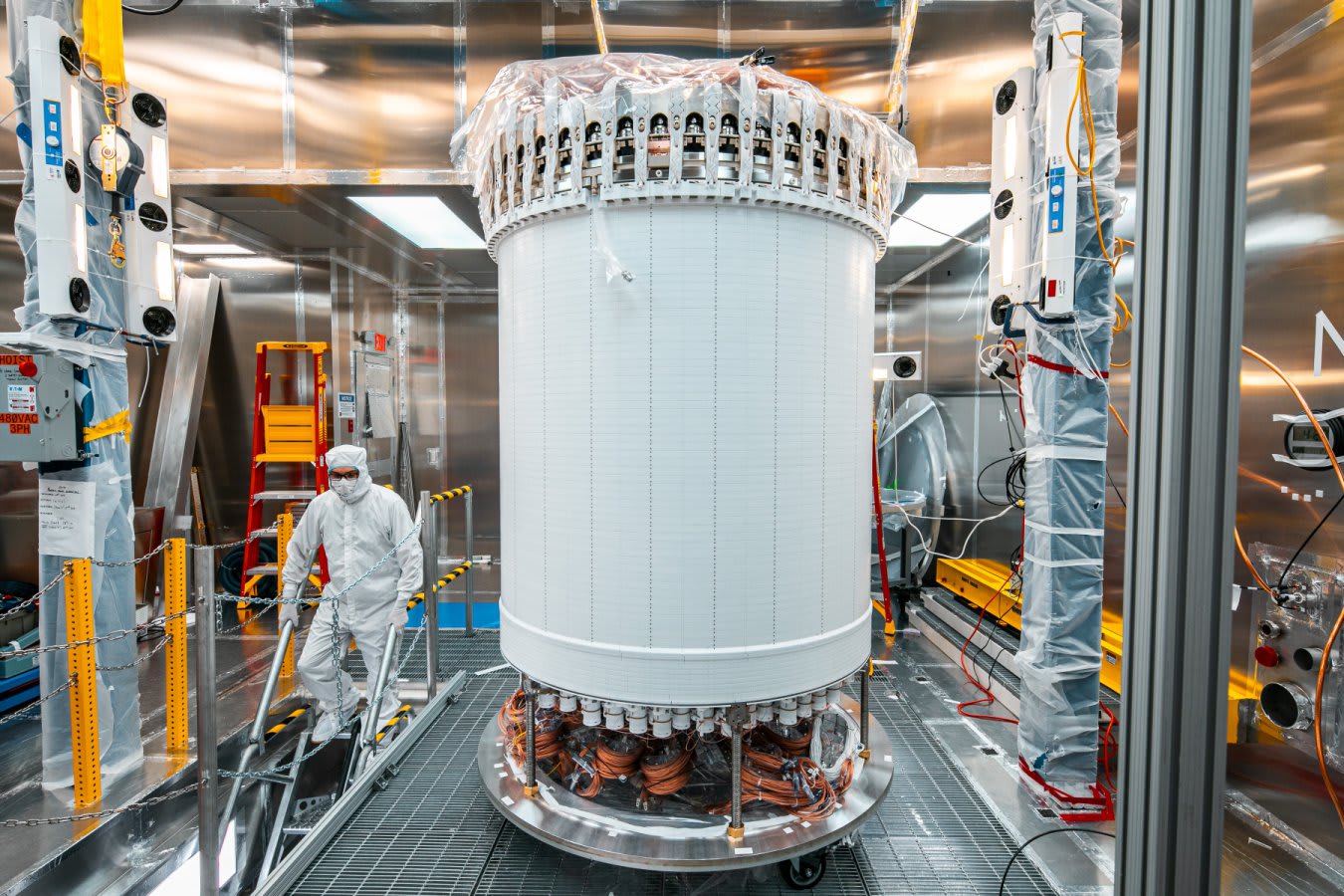
wmurnewscientistwmurA single flash of light inside a massive underground detector in South Dakota has set off a wave of theoretical activity, as physicists around the world race to determine whether the event marks the first direct detection of dark matter — and if so, what kind of particle caused it.
The LUX-ZEPLIN (LZ) experiment, a detector containing 7 metric tons of liquid xenon buried nearly a mile beneath the Earth's surface at the Sanford Underground Research Facility, recorded an unusual particle interaction in June 2023. After months of analysis, the LZ collaboration — 250 scientists and engineers from 39 institutions — presented the findings on September 1 at the TeV Particle Astrophysics 2026 conference in Japan. The team estimates only a 0.5% chance, or about 1 in 200, that the signal was caused by known interference, placing the result at 2.6-sigma.wmur
That falls well short of the 5-sigma threshold — roughly a 1-in-3.5-million chance of a fluke — required to claim a discovery in particle physics. "One event, by itself, is not enough," said Alvine Kamaha, an assistant professor of physics at UCLA and member of the LZ collaboration.wmur
What has drawn particular attention is that the event registered at a higher energy than standard models of weakly interacting massive particles, or WIMPs, would predict. "It's not what you would expect from the most general dark matter models," said Henning Flaecher at the University of Bristol, part of the LZ group. The absence of accompanying lower-energy collisions makes a "vanilla" WIMP explanation exceedingly unlikely.newscientist
In the weeks since the announcement, theorists have released scores of papers exploring alternatives. Many center on a particle called a higgsino, a hypothetical superpartner of the Higgs boson arising from supersymmetry theory. JiJi Fan at Brown University called it the simplest WIMP explanation still consistent with the data, though she noted the most basic higgsino model appears to conflict with constraints from other experiments.newscientist
Other proposals invoke dark matter particles originating in extra dimensions. Lisa Randall at Harvard University, a co-author of one such paper, said the data "looks like it's calling out for something like this: it avoids the pre-existing constraints and fits quite naturally".newscientist
Separately, Stefano Profumo, a physicist at the University of California, Santa Cruz, has introduced a quantitative framework for evaluating competing dark matter theories. Applying the Barbieri-Giudice measure to 12 scenarios, Profumo found that certain primordial black hole formation models ranked among the most "natural" constructions studied — comparable to the most forgiving particle models — while a widely studied particle scenario involving Higgs boson resonance ranked among the most finely tuned. "Naturalness has real power as a filter for deciding where to look next," Profumo said.quantumzeitgeist
The LZ team is now analyzing a larger dataset spanning 700 days, hoping to find additional events. To guard against bias, the researchers are inserting synthetic events into the data that are removed only after the analysis is complete. Independent experiments, including the XENONnT detector in Italy and the PandaX-4T in China, could eventually provide corroboration.wmur
"Anomalies could come and go, as we all know," said Fan. "No matter whether the LZ event is confirmed, some of these topics would lead to long-term research".newscientist


