Newsletter Subscribe
Enter your email address below and subscribe to our newsletter
[forminator_form id="25163"]

All voices matter
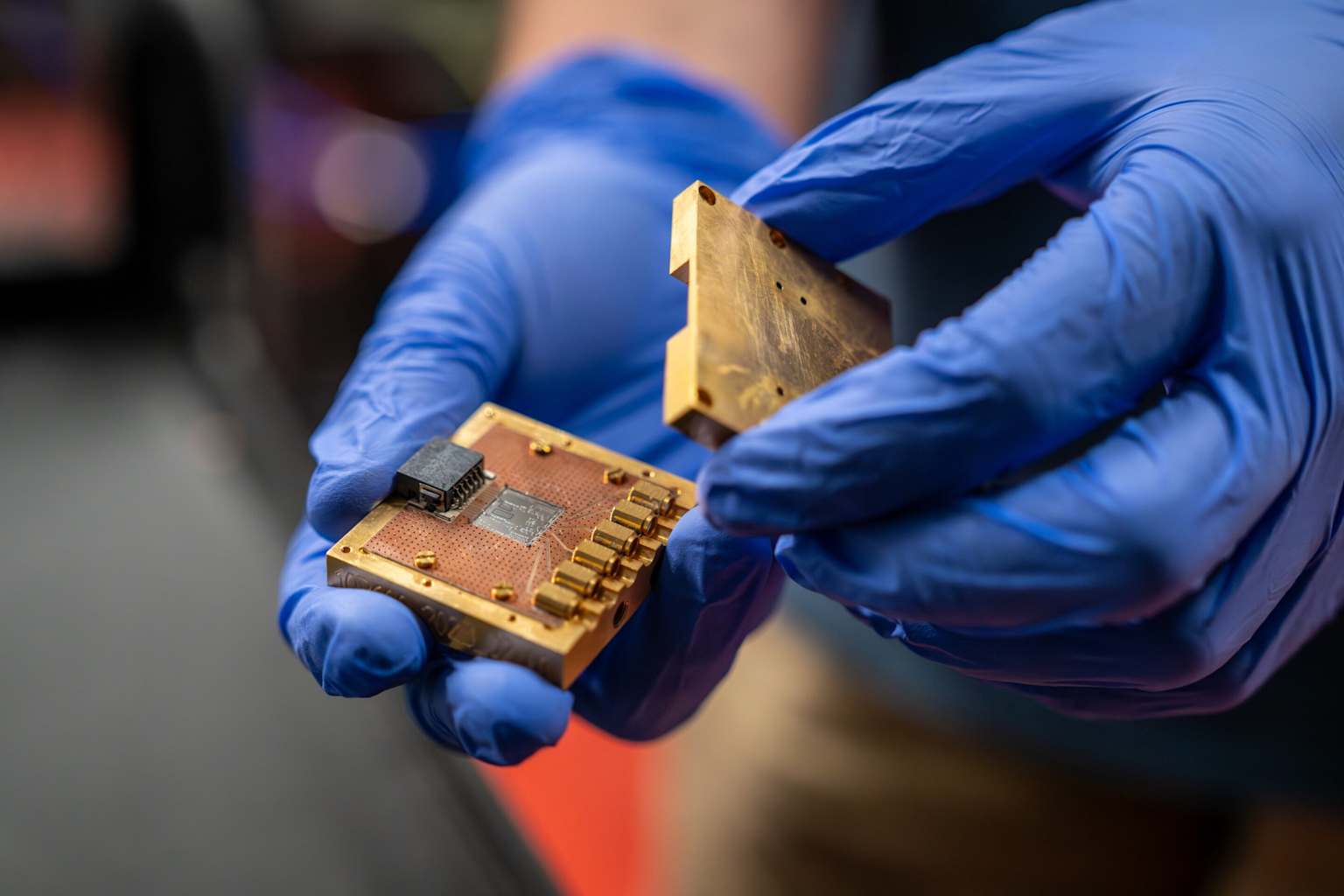
quantumzeitgeist+1istaquantumzeitgeist+1Two research groups working on opposite sides of the Atlantic have independently demonstrated a way to keep physically separated qubits continuously entangled without the precisely timed control pulses that typically make remote entanglement an engineering bottleneck. The parallel results, published in Physical Review X in July 2026, point toward multiple viable paths for building modular quantum computers connected by always-on quantum links.quantumzeitgeist+2
Teams at the University of Illinois Urbana-Champaign, led by Wolfgang Pfaff, and at the Institute of Science and Technology Austria, led by Johannes Fink, both used superconducting qubits and a technique called driven dissipation to lock their systems into stable "dark states" — entangled configurations protected from photon loss by destructive quantum interference.pfaff.physics.illinois+1
The UIUC group coupled two qubits to a waveguide made unidirectional with a microwave circulator, then tuned driving signals so that overlapping emission pathways cancelled out, suppressing photon emission and trapping the qubits in an entangled state regardless of the physical distance between them. The ISTA group took a different route: a parametric amplifier generated pairs of entangled microwave photons — a "squeezed" quantum bath — that were sent to each qubit through separate waveguides, producing the same kind of interference-protected dark state.quantumzeitgeist+1
"In our method, the quantum bath — meaning the qubits' environment — is the source of entanglement," Fink said. "The entangled qubit state is stabilized, even beyond the qubits' own 'lifetime,' and remains always available as a resource for further quantum processing."ista
The ISTA experiment carries additional theoretical weight. PhD student Alejandro Andrés-Juanes and collaborators showed for the first time that a shared source of correlated photons can autonomously entangle distant qubits, confirming a prediction made more than 20 years ago under idealized conditions. The team reported transferring about 10 percent of the bath's available entanglement to the qubits and verified the result with quantum tomography measurements as short as 20 to 80 nanoseconds.ista
Both demonstrations achieved what the researchers describe as modest state fidelity, and whether the steady-state entanglement can remain active during computation is still under investigation. Still, the results suggest that future quantum processors could be linked without the overhead of repeated measurements or post-selection — a step toward fault-tolerant, distributed quantum computing. "We present a relatively simple method that could be scaled up to synchronize multiple distant qubits," Andrés-Juanes said.quantumzeitgeist+1