Newsletter Subscribe
Enter your email address below and subscribe to our newsletter
[forminator_form id="25163"]

All voices matter
science+1nature+1scitechdaily+1In a pair of advances reported this month, physicists have tested Einstein's equivalence principle in ways never before attempted — one team by measuring the quantum phase of a freely falling atom, the other by building an exotic particle beam that could extend the test to an entirely new class of matter.
An international team led by Ben-Gurion University of the Negev, the University of Ulm, and the University of Oxford has for the first time directly measured the quantum phase acquired by an object in free fall — and found it matches the prediction derived from Einstein's equivalence principle. The study, published September 2 in Science Advances, included Nobel laureate Sir Roger Penrose among its coauthors.science+2
Using an apparatus called the Quantum Galileo Interferometer, the researchers split clouds of rubidium atoms cooled near absolute zero into quantum superpositions, sending one part of each atom's wave into free fall while holding the other stationary with a magnetic field. When the two halves reunited, the interference pattern revealed a phase difference consistent with Einstein's prediction that gravity's effects vanish for a freely falling observer.scitechdaily+2
"This experiment pushes quantum mechanics into one of its most intriguing frontiers, gravity, and shows that, once again, its predictions hold," said study coauthor Vlatko Vedral of the University of Oxford. Lead author Ron Folman of Ben-Gurion University called the work "a unique paper, in the sense that it combines a hard experiment with a far-reaching theoretical interpretation" about unifying gravity and quantum theory.ox+1
The experiment does not test whether gravity itself is quantum. It also does not reach the mass or timescales needed to probe Penrose's proposal that quantum mechanics may break down for sufficiently massive objects, though the group is already working toward that goal using heavier particles such as nanodiamonds.scitechdaily
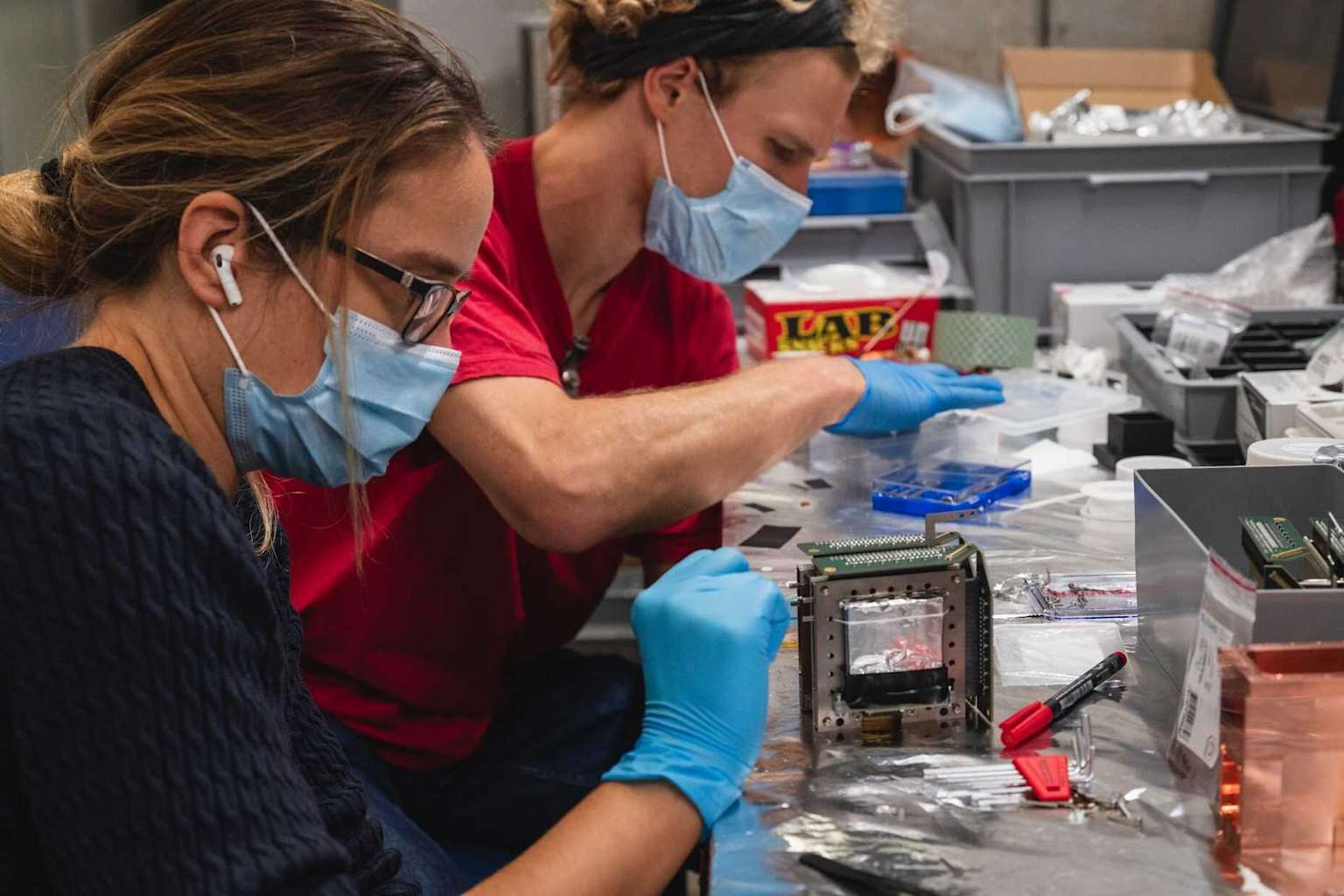
Separately, researchers at ETH Zurich and the Paul Scherrer Institute reported in Nature Physics on September 14 that they have created a tightly controlled beam of muonium — an exotic atom whose mass comes almost entirely from a muon, a heavier cousin of the electron. No one has ever directly tested whether gravity acts the same way on such second-generation particles.nature+1
The team fired antimuons into a two-millimeter layer of superfluid helium chilled to about 0.2 kelvin. The liquid expelled the resulting muonium atoms upward into vacuum at a narrow range of speeds near 2.1 kilometers per second, functioning as what the researchers described as an "atomic cannon". The beam is far more orderly than anything previously achieved for muonium, whose 2.2-microsecond lifetime had long made such experiments impractical.thebrighterside+1
"We have taken an important step toward carrying out an exciting experiment," said ETH Zurich professor Anna Soter, who led the work. "We want to measure the gravitational interaction of the muon". The team projects it could reach roughly one percent precision on muonium's gravitational acceleration after about 100 days of data collection, though the interferometry and systematic controls required for an actual gravity measurement have yet to be demonstrated.ethz+1
Neither experiment resolves the longstanding incompatibility between quantum mechanics and general relativity. But together, they mark a broadening front in the effort to test Einstein's gravity at the quantum scale — from ordinary rubidium atoms that confirmed a century-old prediction, to exotic short-lived particles that have never been weighed by gravity at all.