Newsletter Subscribe
Enter your email address below and subscribe to our newsletter
[forminator_form id="25163"]

All voices matter
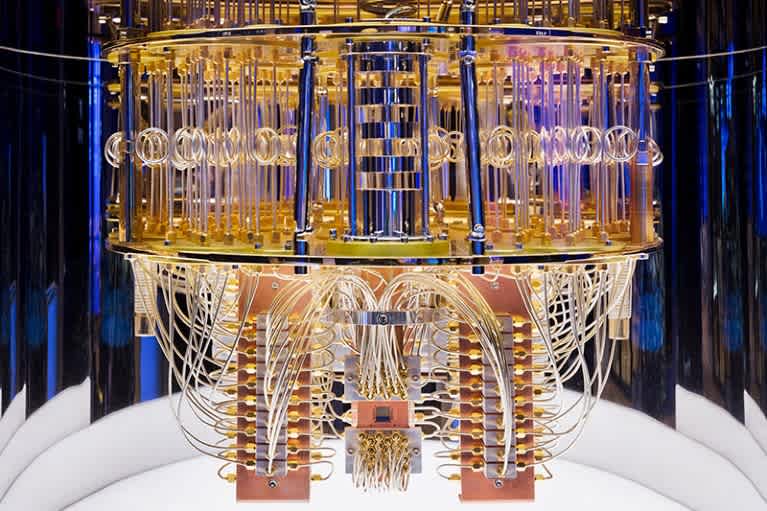
nature+1bioengineer+1bioengineerA team of physicists has used a digital quantum processor to simulate the conversion of kinetic energy into new particles during a collision — one of the most fundamental processes in nature — marking a milestone in the convergence of quantum computing and high-energy physics.
The research, published in Nature Physics on September 11, was carried out by Roland C. Farrell and John Preskill of the California Institute of Technology alongside Nikita A. Zemlevskiy and Marc Illa of the University of Washington. Running on 104 qubits of IBM's International Business Machines Corporation ibm_marrakesh processor with up to 5,589 two-qubit gates, the experiment represents one of the deepest quantum simulations of scattering dynamics reported to date.bioengineer+2
The team simulated collisions within the one-dimensional Ising field theory, a simplified but physically rich model of interacting particles. Two quantum wavepackets, each encoding the lightest particle in the theory, were sent hurtling toward each other on the lattice. After the collision, the researchers measured the skewness of the resulting energy density — a quantity that distinguishes elastic scattering, where particles simply bounce off one another, from inelastic events where new matter is created.scienmag+1
Their measurements revealed a final state containing one light and one heavy particle, a configuration possible only if the collision's kinetic energy had been converted into additional particle mass. At low collision energies, the dynamics remained elastic; at higher energies, the inelastic channel opened and the telltale skewness signal emerged clearly.bioengineer+2
Central to the advance is a new algorithm for preparing realistic scattering states on quantum hardware. Previous methods required circuit depths that grew with wavepacket size, quickly becoming impractical on noisy devices. The new approach uses W states — multipartite entangled states — combined with mid-circuit measurements and feed-forward operations. This makes the preparation circuit's depth independent of the wavepacket's spatial volume, a property the authors describe as a "superexponential improvement" over earlier techniques.bioengineer+1
The researchers demonstrated the versatility of their method by constructing circuits for several other theories, including the Schwinger model of quantum electrodynamics and two-dimensional Ising field theory. The ultimate target for this line of research is quantum chromodynamics, the theory governing quarks and gluons, where inelastic processes like hadron production are central to collider physics.bioengineer
The simulated theory remains one-dimensional, and the experiment relied on error mitigation rather than full quantum error correction. Extending the approach to higher-dimensional theories and achieving precision comparable to experimental collider data are challenges that lie ahead. Still, the demonstration that a noisy quantum processor can witness energy turning into matter in a quantum field theory suggests that future, more powerful machines may tackle real-time scattering problems that remain intractable for classical computers.nature+2