Newsletter Subscribe
Enter your email address below and subscribe to our newsletter
[forminator_form id="25163"]

All voices matter
economictimes+1.economictimes+1.economictimes.unsw+1.economictimes+1.More than one-third of Tuvalu's population has applied for Australia's groundbreaking climate visa program, as the low-lying Pacific island nation faces an existential threat from rising sea levels that scientists predict could leave large parts of the country underwater by mid-century.
The Australia-Tuvalu Falepili Union Treaty, which entered into force on August 28, 2024, represents a groundbreaking bilateral agreement addressing climate migration. At its core, the treaty establishes a "special human mobility pathway" enabling Tuvaluan citizens to "live, study and work in Australia" with access to education, health, and income support. Under Article 3, Australia commits to providing 280 permanent resident visas annually to Tuvaluan citizens, while recognizing that "the statehood and sovereignty of Tuvalu will continue, and the rights and duties inherent thereto will be maintained, notwithstanding the impact of climate change-related sea-level rise".dfat+3
The agreement extends beyond climate mobility to include security provisions, with Tuvalu agreeing to consult Australia on any security and defense partnerships with other states. This aspect has strategic implications for Australia's position in the Pacific, particularly regarding China's growing regional influence. The treaty also establishes a Joint Committee meeting at least annually to oversee implementation and resolve disputes, embodying the Tuvaluan concept of "Falepili" which connotes "traditional values of good neighbourliness, duty of care and mutual respect".dfat+2
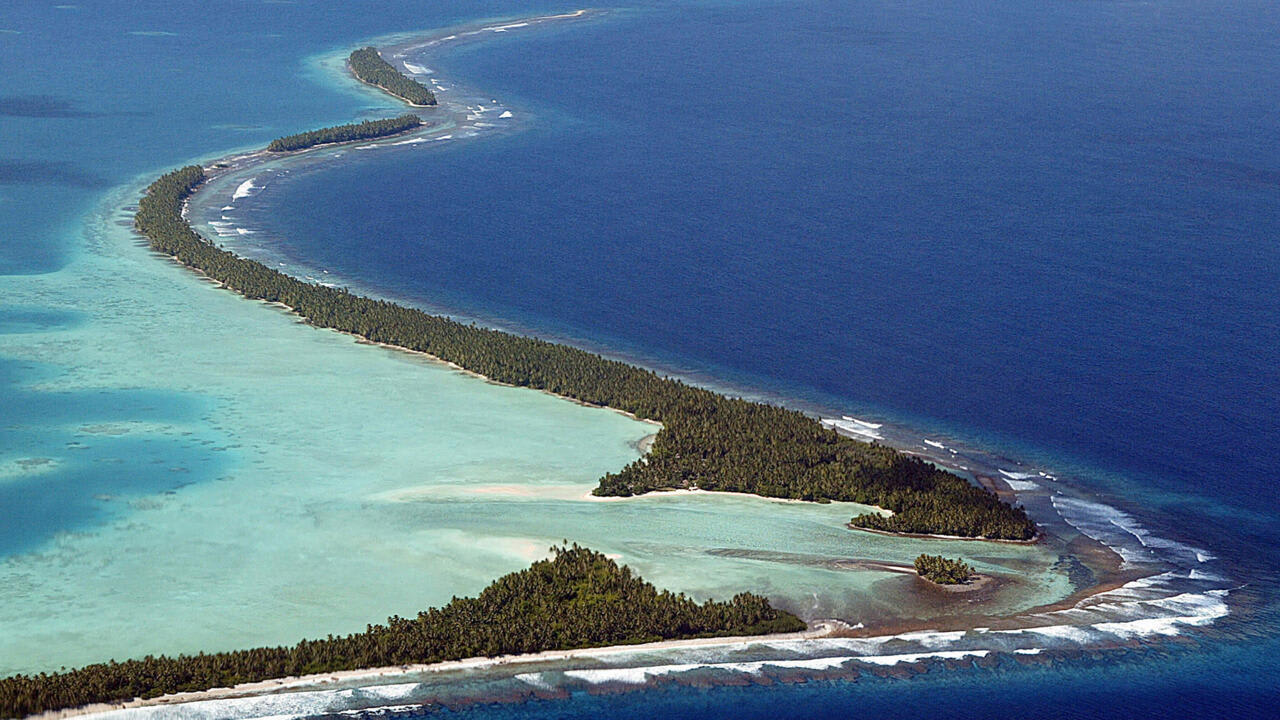
Tuvalu faces an existential crisis due to accelerating sea level rise, with NASA reporting levels nearly 6 inches higher than 30 years ago, rising at about 0.2 inches annually—1.5 times faster than the global average. This rate is expected to more than double by 2100, with projections indicating that 50% of Funafuti, the capital, could be regularly flooded by mid-century and 95% by 2100. The consequences are already visible: saltwater intrusion is contaminating groundwater and farmland, destroying deep-rooted food crops like coconut and taro, while stronger tides are gradually eroding the islands' limited land mass.wikipedia+2
The nation's vulnerability stems from its geography—nine low-lying coral atolls with an average elevation below 2 meters above sea level. With limited options for retreat to higher ground, Tuvalu's government has implemented innovative adaptation strategies, including the creation of 7.3 hectares of new raised land designed to remain above projected 2100 sea levels. Despite these efforts, the threat remains so severe that Australia and Tuvalu established the Falepili Union Treaty, which includes provisions for climate migration while maintaining Tuvalu's sovereignty "notwithstanding the impact of climate change-related sea-level rise."sealevel.nasa+3
Australia's decision to limit the climate visa program to 280 Tuvaluans annually reflects a careful balancing act between humanitarian response and practical implementation. This cap, while seemingly modest compared to the overwhelming demand—over 3,125 applications were submitted within just four days of the program's launch—allows Australia to provide comprehensive support including permanent residency, Medicare, education, and employment rights to recipients. The controlled pace enables proper integration while maintaining what Australian Foreign Minister Penny Wong described as "mobility with dignity."economictimes+1
The visa allocation process operates through a random ballot system rather than skills-based criteria, with applications costing just $25. This approach ensures fairness while acknowledging the gravity of Tuvalu's situation, where two coral atolls have already nearly disappeared beneath rising seas. While the cap means many applicants will face disappointment, the program represents a pioneering model for climate migration that preserves Tuvalu's sovereignty even as its physical territory diminishes—a critical diplomatic consideration that treats the migration as a voluntary pathway rather than a mass evacuation.sofx+3