


Newsletter Subscribe
Enter your email address below and subscribe to our newsletter
[forminator_form id="25163"]

All voices matter
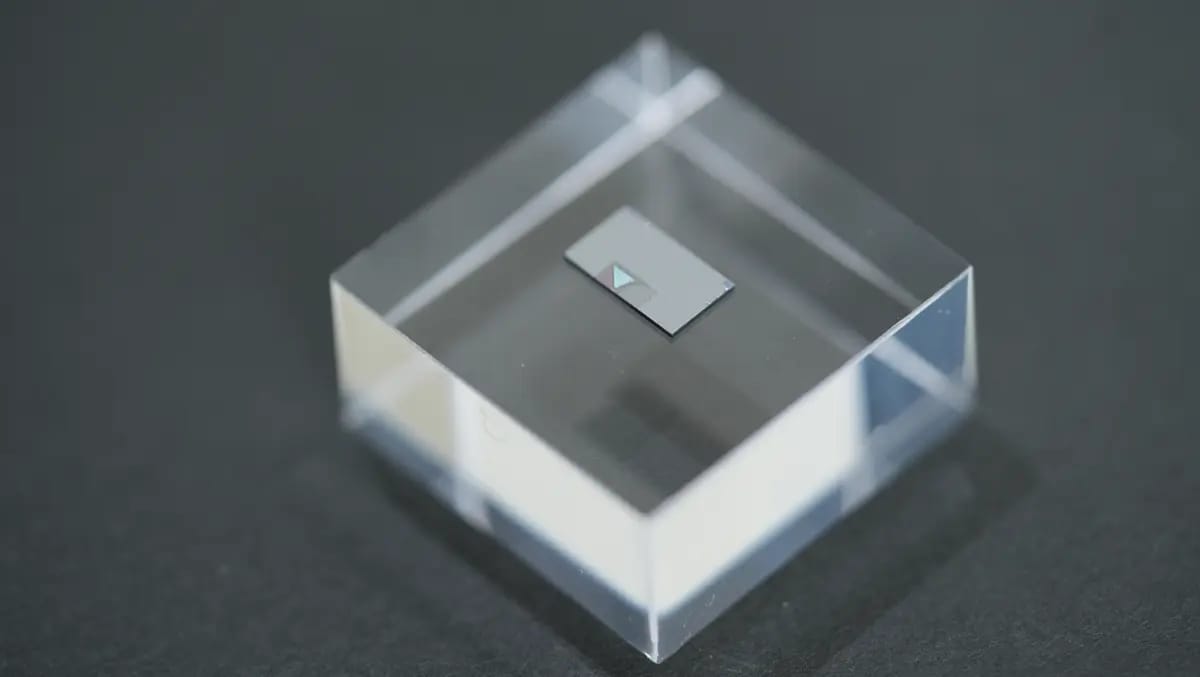
thequantuminsider+1thequantuminsiderthequantuminsider+1Fujitsu on Tuesday announced it has built what it describes as the world's first working prototype of a diamond-spin quantum computer, a hardware approach that diverges from the superconducting qubit systems pursued by IBM International Business Machines Corporation and Google Alphabet Inc. .thequantuminsider+1
The prototype incorporates tin-vacancy centers — lattice defects in diamond crystals where a tin atom sits between two adjacent vacancies — into photonic integrated circuits. These so-called color centers serve as qubits, exploiting the inherent stability of quantum states in diamond to achieve high fidelity with potentially fewer physical qubits per logical qubit than competing approaches.global+1
The system operates at minus 271.6 degrees Celsius, warmer than the roughly minus 273.13 degrees required by superconducting quantum computers. Fujitsu said it demonstrated in a test environment that the prototype can be accessed through its Hybrid Quantum Computing Platform without specialist knowledge.global
Three core technologies underpin the prototype: a quantum circuit conversion mechanism that translates standard quantum gate instructions into the light, microwave, and radio frequency signals needed to control diamond-spin qubits; a heterogeneous material bonding process that attaches high-quality diamond substrates to alumina/silicon dioxide substrates and thins the diamond from hundreds of micrometers to hundreds of nanometers; and a photonics-integrated circuit fabrication method that pairs nanometer-sized diamond crystals with alumina optical waveguides.thequantuminsider
The work builds on a collaboration launched in 2020 between Fujitsu, Delft University of Technology, and QuTech, the Dutch quantum research institute. In March 2025, the partnership demonstrated a complete universal quantum gate set for diamond spin qubits with error probability below 0.1 percent, among the highest fidelities reported across all quantum hardware platforms. Earlier this year, the team also demonstrated entanglement and quantum gate operations between remote nitrogen-vacancy centers housed in separate cryostats.fujitsu+1
Fujitsu said it plans to develop a multi-module diamond-spin prototype by 2027 and will begin exploring integration of the diamond-spin approach with its superconducting quantum hardware. The company's broader roadmap targets a 250-logical-qubit system by fiscal 2030 and a 1,000-logical-qubit system by fiscal 2035.thequantuminsider+1
The announcement comes days after NEC disclosed that it has halted quantum computer hardware development, concluding the path to commercialization was too long to justify the investment. Fujitsu, by contrast, is doubling down — it announced in August 2025 that it had begun official development of a 10,000-plus qubit superconducting quantum computer targeting completion in 2030.thequantuminsider+1


