Newsletter Subscribe
Enter your email address below and subscribe to our newsletter
[forminator_form id="25163"]

All voices matter
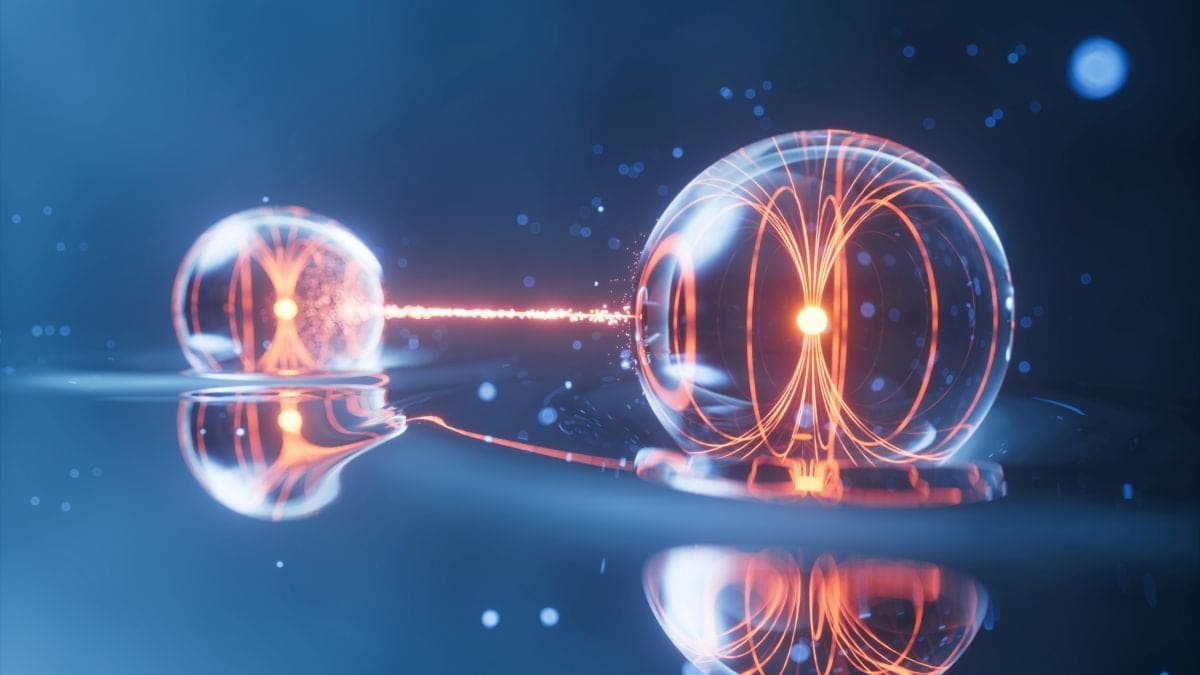
sciencealert+1arxivsciencealertA team of physicists at the University of Science and Technology of China has entangled two quantum memories across 420 kilometers of optical fiber, setting a new record for fiber-based matter-to-matter entanglement — more than four times farther than any previous demonstration.yahoo+1
The experiment, led by Xi-Yu Luo, Chao-Yang Wang, and Ming-Yang Zheng, used laser-cooled clouds of rubidium atoms as quantum memories. Two memory units, nicknamed Alice and Bob, were placed at opposite ends of the fiber link, while a central node called Charlie detected photons emitted by each memory. When Charlie observed the correct interference pattern, it confirmed that entanglement had been achieved between the two distant memories.arxiv+1
Three technical advances made the feat possible. First, the team converted photons from the memories into telecommunications-band wavelengths, reducing fiber transmission losses. Second, a stabilization system continuously corrected temperature fluctuations and vibrations that could scramble the quantum signals. Third, they employed a single-photon entanglement scheme requiring only one photon to survive the trip rather than two.sciencealert
Beyond the raw distance record, the experiment cleared a theoretical benchmark known as the PLOB bound — a 2017 result that defines the maximum rate at which quantum information can travel through a lossy channel without repeaters. At distances exceeding 320 kilometers, the team's system generated entanglement faster than direct optical transmission could achieve, demonstrating that memory-based quantum networks can outperform even the best possible direct fiber link.arxiv+1
A practical quantum internet remains years away, but long-distance entanglement between stationary quantum memories is widely considered one of its essential building blocks. Previous demonstrations had linked memories over roughly 50 kilometers in 2020 and across urban networks of about 20 kilometers in 2023. The leap to 420 kilometers moves the technology from metropolitan to intercity scale.sciencenews+1
"Our experiment provides a test bed of studying quantum network applications beyond metropolitan scale," the researchers write in their paper, published in Physical Review Letters. They note that the system also generates entanglement at high rates over shorter distances of around 100 kilometers, which could support the construction of quantum repeaters — devices that would eventually chain together many such links into continent-spanning networks.sciencealert+1