Newsletter Subscribe
Enter your email address below and subscribe to our newsletter
[forminator_form id="25163"]

All voices matter
sedaily+1sedaily+1sedailyTwo of Silicon Valley's legacy chipmakers are staking their futures on quantum computing, each unveiling advances aimed at solving the technology's most stubborn problems — error correction and extreme cooling — with the goal of reaching commercial viability before the decade's end.
IBM International Business Machines Corporation researchers published a paper on arXiv introducing a technique called spacetime probabilistic error cancellation, which layers probabilistic error cancellation on top of quantum error detection — two methods that had previously been developed on separate tracks. The hybrid approach, verified on IBM's Aachen superconducting quantum processor, reduces the sampling overhead of error mitigation by a factor of 63, according to the Quantum Computing Report. Seoul Economic Daily reported that the combined method can screen out up to 65 percent of errors in advance.sedaily+2
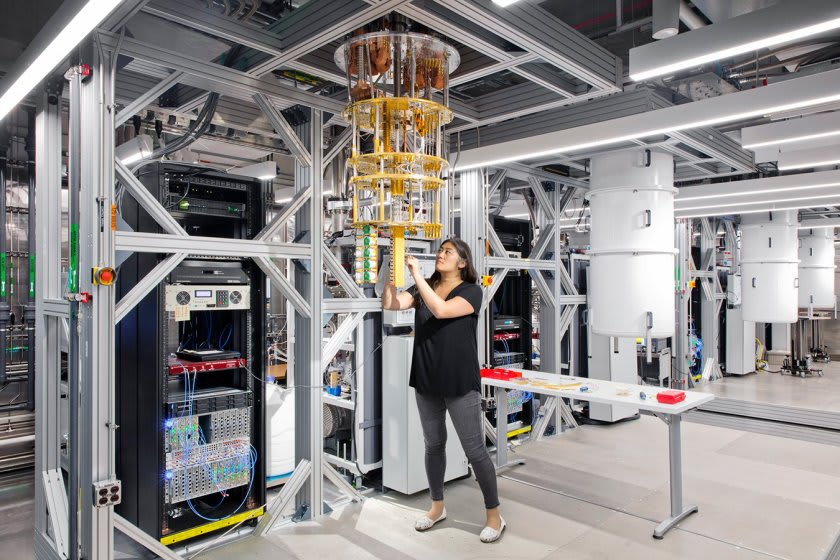
On the hardware side, IBM announced in August that it had joined and cooled two modular cryogenic cells into a single operating environment at its facility in Poughkeepsie, New York. The modular design houses a single quantum chip per cell and links adjacent cells, removing unnecessary wiring and reducing noise. IBM plans to install its Quantum Nighthawk processors in the modules later this year and to connect at least 1,000 programmable qubits by 2027, on its path toward IBM Quantum Starling, a fault-tolerant quantum computer slated for 2029.ibm+3
Intel CEO Lip-Bu Tan, speaking at a conference in mid-September, framed quantum processors as an eventual peer to GPUs and CPUs rather than a replacement. "GPUs, CPUs and quantum are all forms of computing, so they will run together in some application areas and make quantum computing more efficient to use," Tan said. He added that his immediate focus remains on error correction and finding customers willing to pay for early quantum services.sedaily+1
Intel Labs continues work on Tunnel Falls, a silicon spin qubit device that operates at higher temperatures than most competing architectures, and previously developed Horse Ridge II, a cryogenic control chip.sedaily
Microsoft unveiled its Majorana 2 quantum chip in June and has targeted 2029 for a commercial quantum computer. Amazon Amazon.com, Inc. AI chief Peter DeSantis told CNBC he expects the first commercially valuable small quantum machines within five to seven years. The convergence of timelines from multiple major players suggests the industry sees the late 2020s as the window in which quantum computing moves from laboratory curiosity to practical tool — though Tan's candid emphasis on "who is going to pay for it" serves as a reminder that technical breakthroughs and commercial demand do not always arrive on the same schedule.sedaily