Newsletter Subscribe
Enter your email address below and subscribe to our newsletter
[forminator_form id="25163"]

All voices matter
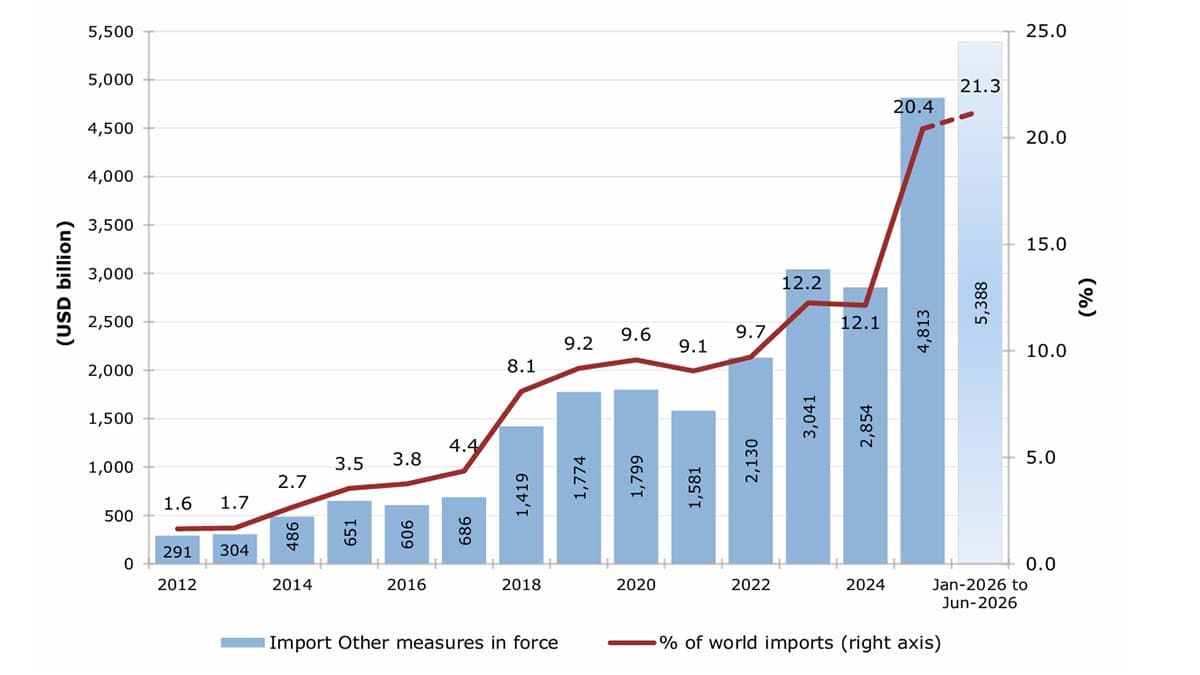
wto.org.wto.org.wto.org.The stock of trade restrictions still in force worldwide has hit its highest level since the World Trade Organization began monitoring in 2009, according to the WTO Director-General's annual overview of the trading environment, released on November 17, 2026. The report also found that governments were easing trade at a faster pace at the same time. Members brought in 466 trade-facilitating measures in the first half of 2026, more than the 391 recorded in all of 2025.wto.org
The report covers measures up to June 30, 2026. It shows that new tariffs and other "non-facilitating" measures came in more quickly. Members introduced 333 of them in the first six months of the year, compared with 300 in all of 2025. These new import-related measures covered $2.0 trillion, or 8% of world imports, while export-related ones covered $794 billion.wto.org
As of June 30, import restrictions adopted since 2009 and still in force covered $5.4 trillion of trade, or 21.3% of world imports. The export-side stockpile reached $1.5 trillion, or 6.3% of world exports. Both are records. Two years earlier, in mid-October 2024, the WTO put the import stockpile at $2.94 trillion, or 11.8% of world imports.wto.org+1
Policy activity overall also sped up. Members recorded 1,048 trade and trade-related measures in the first half of 2026, against 1,229 in all of 2025. The WTO said the increase was spread across its membership and not limited to the largest economies.wto.org
New export-facilitating measures covered a record $570 billion of world exports, more than five times the 2025 level. Much of that came from temporary steps taken after trade was disrupted around the Strait of Hormuz. Import-facilitating measures covered about $1.3 trillion.wto.org
Director-General Ngozi Okonjo-Iweala said new import-facilitating measures covered a larger share of imports than new restrictions in most sectors. The exceptions were electric vehicles and photovoltaic cells, "where major economies have been heavily competing for market share." She urged "restraint in the use of new trade restrictions". Trade itself held up better than expected. Demand for AI-related goods led the WTO to raise its 2026 forecast for merchandise trade volume growth to 3.9%.wto.org
An opinion piece by Nironjan Roy in Bangladesh's Daily Sun cited WTO estimates on what fragmentation could cost. If the world split into geopolitical blocs, global exports could fall by 19% and global output by 5.1% by 2050. If cooperation led to lower tariffs, trade could instead rise by 18%. The piece quoted WTO chief economist Robert Staiger as saying "the cost of inaction on reform would be up to 10% of global GDP." Staiger also warned that unresolved tensions "will continue to roil the world trading system". The WTO's World Trade Report 2026 describes the system as being at "a critical juncture".daily-sun.com+1