Newsletter Subscribe
Enter your email address below and subscribe to our newsletter
[forminator_form id="25163"]

All voices matter
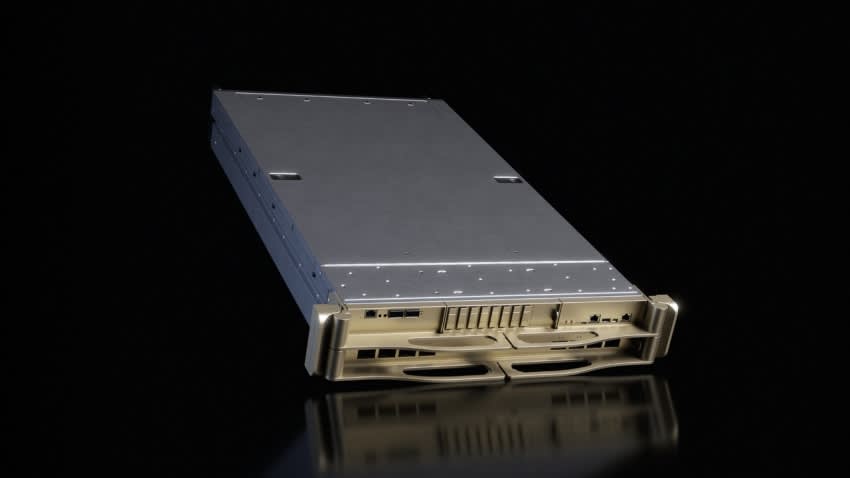
prnewswire.com+1.news.fnal.gov.nvidianews.nvidia.com.NVIDIA , IBM International Business Machines Corporation and the U.S. Department of Energy's Fermi National Accelerator Laboratory announced plans on Monday, Nov. 16, for a modular quantum computing codesign platform. The platform will place NVIDIA DGX B200 systems alongside IBM quantum computers so researchers can work on error correction and on high-energy and nuclear physics problems. The IBM machines include systems running IBM Quantum Nighthawk, which IBM calls its most powerful processor so far. Nighthawk can run circuits of up to 7,500 two-qubit operations on 120 qubits.nvidianews.nvidia.com+1
The partners want to work out how to link several quantum processors so they can handle calculations too large for one device, a key step toward fault-tolerant machines.news.fnal.gov
Fermilab plans to make the platform a hub for high-energy and nuclear physics researchers. They will build algorithms and benchmarks for problems such as particle interactions, neutrino physics and nuclear simulations. Fermilab will also manage researcher access through its HEPCloud infrastructure. At first, researchers will simulate communication between linked processors to study how link errors and latency affect performance. Later, the lab's Superconducting Quantum Materials and Systems (SQMS) Center intends to add its own superconducting cavity hardware for use as quantum memories.news.fnal.gov
"Some of the most fundamental problems in science remain out of reach for classical computers alone," said Jerry Chow, IBM's chief technology officer of quantum-centric computing. Anna Grassellino, Fermilab's chief technology officer, called the effort "an important step toward the capabilities and community needed for a future DOE quantum computing user facility". The project would complement an existing codesign platform run by IBM, Oak Ridge National Laboratory and AMD Advanced Micro Devices, Inc. .prnewswire.com+1
NVIDIA separately released TCBP-JOBS, a new decoding algorithm in its CUDA-Q QEC 0.9.0 library. The company says it decodes up to 13,000 times faster than existing leading algorithms, cutting the computing time for researching new quantum designs from 12 weeks to 45 minutes. Decoders read measurement data from qubits to find likely errors so they can be fixed. Speeding them up lets scientists test candidate error-correction codes more quickly.nvidianews.nvidia.com
The companies also expanded Slurm, the open-source scheduler used on many large supercomputers, so it can manage quantum processors. The integration uses IBM's open-source, vendor-agnostic Quantum Resource Management Interface, built with NVIDIA and Pasqal. Supercomputing centers can then schedule quantum processors alongside CPUs and GPUs as ordinary jobs.prnewswire.com
IBM also reported a related result with RIKEN and NVIDIA. Their hybrid simulation of an iron-sulfur cluster combined quantum hardware with GPUs and was 79 times more accurate than earlier runs of the same experiment. "Realizing quantum computing's potential requires quantum processors and accelerated computing to evolve together," said Krysta Svore, NVIDIA's vice president of applied research for quantum computing.prnewswire.com