Newsletter Subscribe
Enter your email address below and subscribe to our newsletter
[forminator_form id="25163"]

All voices matter
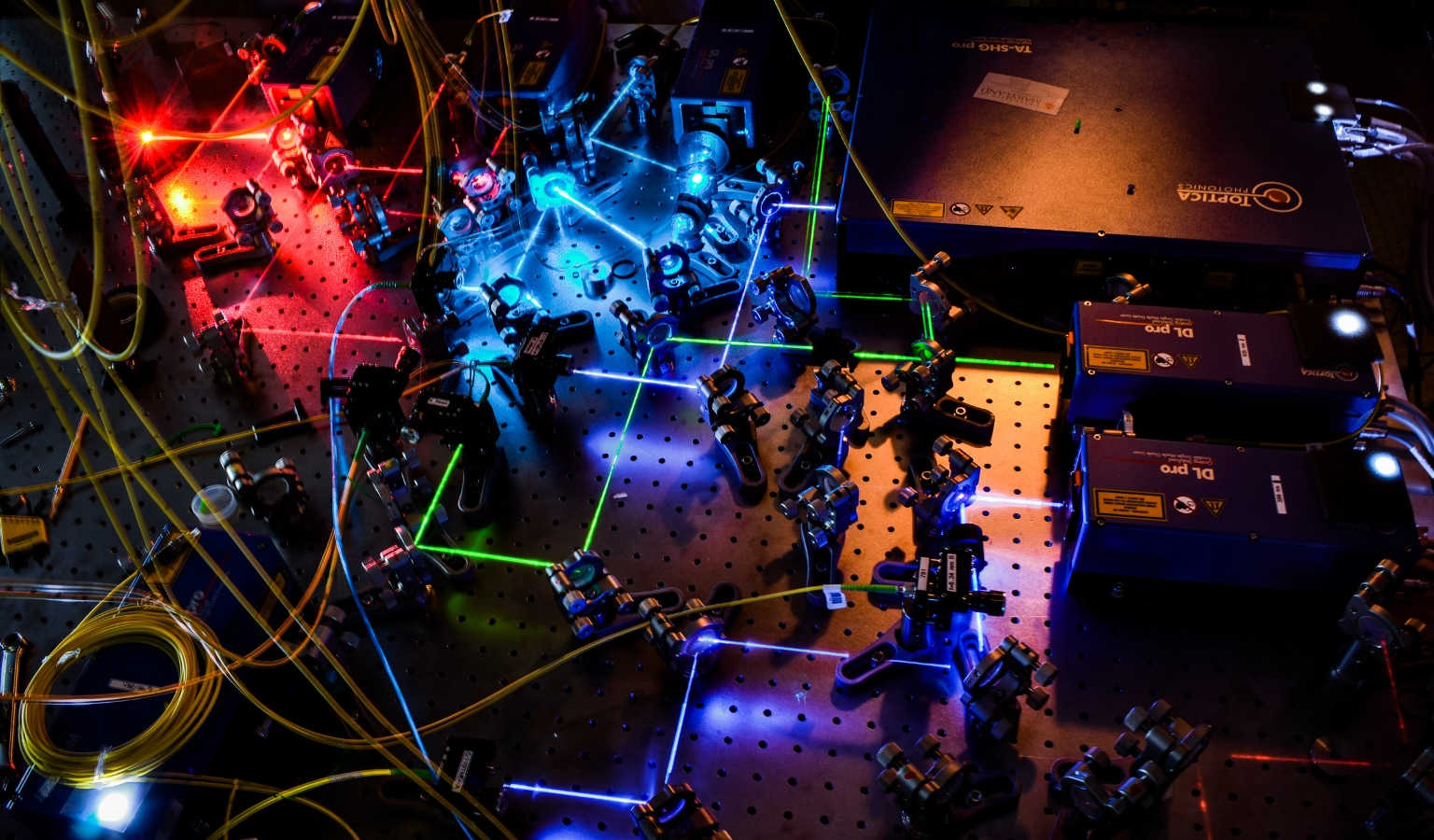
eurekalert+1eurekalert+1pratt.duke+1Researchers at the Duke Quantum Center have used a trapped-ion quantum simulator to observe string-breaking dynamics — a process tied to the creation of matter in the earliest moments after the Big Bang — in a study published Wednesday in Nature Physics.eurekalert+1
The experiment emulates a phenomenon from quantum field theory in which two confined fundamental particles, connected like a taut string, are stretched apart until the stored energy is enough to spontaneously produce new particle-antiparticle pairs. In nature, this process requires extreme conditions found only at facilities like the Large Hadron Collider or in the immediate aftermath of the Big Bang.eurekalert
To recreate the effect, the team encoded a string-breaking model into a chain of 13 trapped ions and used precisely controlled laser beams to tune the interactions among them, mimicking the stretching and snapping of the connection between confined charges. By preparing the system in an out-of-equilibrium state and tracking its evolution, researchers observed the emergence of effective charges and reconstructed the resulting dynamics.phys+1
"Quantum computer simulations provide the best platform to investigate complex questions like matter formation, short of having witnessed the Big Bang itself," said Christopher Monroe, the Gilhuly Family Presidential Distinguished Professor of Electrical and Computer Engineering and Physics at Duke , who led the research.eurekalert
The Duke results join similar findings from teams led by Google Alphabet Inc. and QuEra Computing, which simulated string-breaking on superconducting-circuit and neutral-atom platforms, respectively. QuEra's team, working with the University of Innsbruck and Harvard, reported the first observation of string breaking in a two-dimensional quantum simulator in a separate Nature paper last year. A further experiment by a University of Science and Technology of China group demonstrated the underlying mechanism using an optical lattice.pratt.duke+3
"These are the three platforms leading the charge in quantum computing, so it's a nice benchmark and comparison for the quantum community," Monroe said.eurekalert
The classical computer simulations the team ran alongside the quantum experiment confirmed its accuracy, but as problem sizes grow, only quantum computers will be able to handle the calculations. "As a physicist, it is incredibly exciting to investigate the conditions of the early universe in an atomic-level computing machine," said Zohreh Davoudi, associate professor of physics at the University of Maryland and a member of the research team. "Even the slightest insights from an out-of-equilibrium physics model will guide us in the future".phys+1